

International troops stepped up patrols in East Timor's capital yesterday as East Timorese President Jose Ramos-Horta recuperated in Australia after an assassination bid doctors said he was lucky to survive.
Residents packed markets as usual, seemingly oblivious to a state of emergency declared following audacious attacks by renegade soldiers on both the president and Prime Minister Xanana Gusmao, who escaped unscathed.
The assaults heralded a renewed crisis for violence-weary East Timor, where Australian-led peacekeepers and UN police were deployed in 2006 to quell unrest between military and police factions that left at least 37 dead.
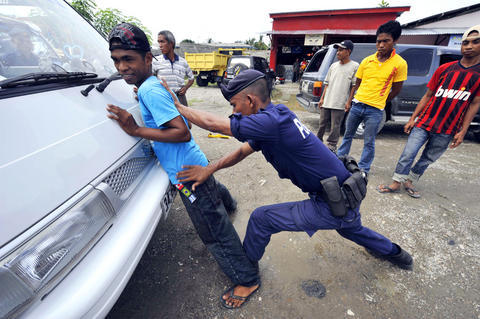
PHOTO: AFP
Some 340 Australian soldiers and police were poised to leave for East Timor yesterday as reinforcements at Gusmao's request, defense officials in Canberra said.
The prime minister told a meeting of communities from Portuguese-speaking countries at a downtown hotel that the current situation in the fledgling nation is "normal, and all is stable."
"We all hope that Dr Jose Ramos-Horta will soon recover from this difficult phase and resume leading the country," Gusmao said.
Interim president Vicente Guterres issued a decree at the prime minister's request saying a state of emergency had come into force from 10pm on Monday evening and would last for an initial 48 hours.
Under the emergency, a curfew will be in place from 8pm to 6am, while all gatherings and rallies were banned, the decree said.
Ramos-Horta was in a serious but stable condition following overnight surgery for bullet wounds, doctors said in the Australian city of Darwin where he was airlifted on Monday.
"I believe he is extremely lucky to be alive," Royal Darwin Hospital General Manager Len Notaras said.
Ramos-Horta, 58, underwent two-and-a-half hours of surgery late Monday but was in intensive care recovering well from his second operation in 24 hours after being shot in the chest and back, the doctor said.
"The operation went well and President Ramos-Horta is quite stable," Notaras said, adding that doctors were treating three bullet wounds and that the head of state would need a further operation within 36 hours.
Ramos-Horta, who was reportedly out walking when gun-toting rebels arrived at his residence, was hit by two or possibly three bullets that formed three deep wounds in his lower chest and back, Notaras said.
He was sedated and on a ventilator, but the doctor said he was not on life support. The president would remain unconscious and in intensive care until at least tomorrow, he said.
"We are quietly confident that as long as there are no untoward complications, such as infections and so forth, we expect to have a reasonable path forward and to see a full recovery," he said.
The international community expressed outrage over the attack on the Nobel peace laureate, who became known on the diplomatic circuit as he campaigned for East Timor's independence from Indonesia from the 1970s.
Indonesia invaded East Timor in 1975 and ruled the former Portuguese colony brutally until 1999, when the UN took charge and the East Timorese voted overwhelmingly in favor of breaking away.
US President George W. Bush condemned the assassination attempt but said the failed attack would not threaten democratic rule in the young country, which became independent in 2002.
"Those who are responsible must know that they cannot derail democracy in Timor-Leste, and they will be held accountable for their actions," Bush said in a statement, referring to East Timor by its official name.
The UN Security Council condemned the attack "in the strongest possible terms" and urged Dili "to bring to justice those responsible for this heinous act and all Timorese parties to cooperate actively with the authorities."
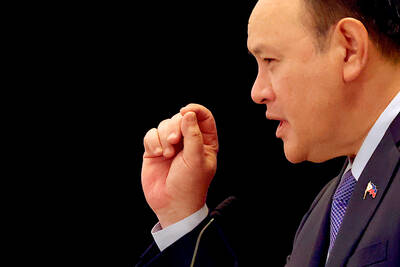
Philippine Secretary of National Defense Gilberto Teodoro Jr on Tuesday hit out at China at an international forum after a memo asserting Beijing’s position over their longstanding maritime dispute was delivered to him while he was speaking on stage. The unusual incident was captured on video at the Seoul Defense Dialogue as the secretary was responding to a question about “gray zone” coercion in the South China Sea. The video shows what appears to be a conference staffer placing it on the table next to him while speaking. “I have a note here, I think this is from China,” he said, describing
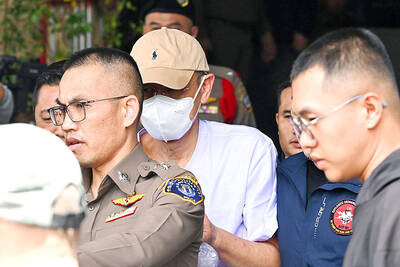
Thai police yesterday said that they arrested a senior Buddhist monk on suspicion of embezzling US$2.8 million intended for his monastery, alongside a suspected female accomplice he was having sex with. The case is the latest scandal to hit the clergy in Buddhist-majority Thailand after a sex and extortion case involving senior monks last year prompted public outrage and calls for greater scrutiny of temple finances. Phra Wachirayan Wi, the 66-year-old abbot of the 14th-century Wat Phutthaisawan in the ancient capital of Ayutthaya, was arrested on Thursday on charges including embezzlement and money laundering, lead police investigator Pattanasak Bupphasuwan said. A 47-year-old woman

SECRET FOOTAGE: A 17-year-old girl told British broadcaster Channel 4 that she had been approached by a man who covertly recorded her and their interaction Calls are growing louder in Europe for action against “pervert” smart glasses after secretly filmed footage of girls and women appeared online — with a petition in Britain demanding a ban on their sale. Anyone wearing smart glasses can take photos, film videos, listen to music, make phone calls, translate text or interact with an artificial intelligence (AI) assistant, with sales now hitting millions. The devices grabbed attention this summer after a marketing tie-up between Kylie Jenner, beauty mogul and member of the Kardashian dynasty, and tech giant Meta. Since smartphones are now embedded in daily life, “big tech” is
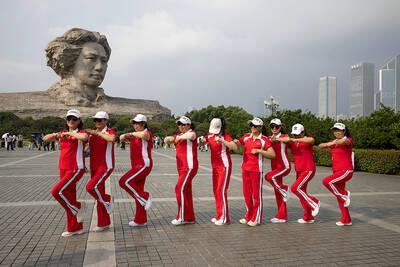
China yesterday marked half a century since the death of Mao Zedong (毛澤東), founder of the People’s Republic, who brought roughly one-quarter of the world’s population under communist rule and whose specter still haunts China’s future. Mao’s death on Sept. 9, 1976, at age 82, mourned by many and welcomed by some who suffered under his nearly three-decade rule, also hastened the end of the Cultural Revolution, a frenzied mass movement he launched in 1966. The party later condemned the Cultural Revolution as a grave error for which Mao bore primary responsibility, but still reveres him, saying his achievements outweigh his mistakes. Mao’s


 RSS
RSS