


In the depths of a strangely cold winter in the Middle East, Iraqis complain that the lights are not on, the kerosene heaters are without fuel and the water doesn't flow -- and they blame the government.
And with the war nearing its fifth anniversary, Iraqi Prime Minister Nouri al-Maliki is feeling the discontent as well from the most powerful political centers in the majority Shiite community.
It's a pincer movement of domestic anger that yet again could threaten al-Maliki's hold on his Green Zone office.
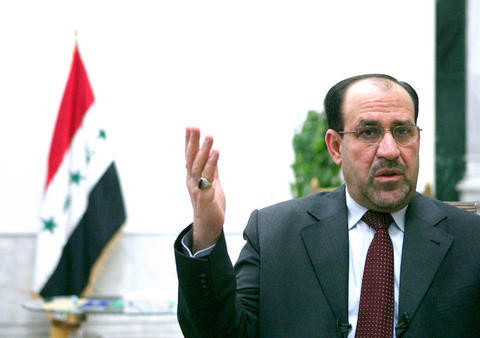
PHOTO: AP
"Where's the kerosene and the water?" asked 56-year-old Amjad Kazim, a Shiite who lives in eastern Baghdad.
"We hear a lot of promises but we see nothing," he said.
Little kerosene is available on the state-run market at the subsidized price of US$0.14 a liter. But the fuel can be found on the black market, where it goes for more than US$1 a liter.
An average household needs at least five liters a day to stay warm, which translates into a monthly expense of US$150, or half what an average Iraqi earns.
"I have had no electricity for a week, and I cannot afford to buy it from neighborhood generators," said 42-year-old Hamdiyah Subeih, a homemaker from Baghdad's Shiite Baladiyat district. "I would rather live in Saddam Hussein's hell than the paradise of these new leaders."
Even during the shortages of last summer's heat, most Iraqi's were counting on electricity for air conditioners, fans and refrigeration about half the day.
Now the power is off for days at a stretch in many areas and on only a few hours daily on average, residents say.
"My children are so happy when the power comes back on they dance," said 34-year-old Marwan Ouni, a college teacher from Tikrit, Saddam's hometown north of Baghdad. "For me, the nonstop power cuts have made my life tedious. It's depressing."
That's the view from below, despite a considerable reduction in violence across the country.
And now the view among those who hold power here is growing equally bilious.
Stinging criticism late last week from Abdul-Aziz al-Hakim, leader of parliament's largest Shiite bloc, was a stark break with the past. And a threat by Moqtada al-Sadr, the maverick Shiite cleric who once supported al-Maliki, not to renew an expiring six-month ceasefire he imposed on his feared militia could upend recent security progress.
In admonishing tones, al-Hakim called on the government and parliament not to be "entirely focused on political rivalries at the expense of the everyday problems faced by Iraqis."
Al-Hakim also demanded that lawmakers quickly adopt key legislation divvying up the country's oil wealth and setting the rules for provincial elections to be held later this year.
He spoke of administrative and financial corruption, saying Iraqis were now forced to pay bribes to get business done with ministries and government agencies.
"It makes one's heart bleed ... it's a violation of man's freedom and dignity," he told a crowd of tens of thousands of supporters in Baghdad on Friday.
Al-Hakim's harsh words carry considerable weight because his party, the Supreme Iraqi Islamic Council, is al-Maliki's most important backer after al-Sadr pulled all the ministers loyal to him from the Cabinet last year and removed his 30 lawmakers from the Shiite voting bloc.
Al-Hakim's focus on the daily hardships of most Iraqis finds a ready audience among those struggling to keep warm through one of the coldest winters in years -- it snowed for the first time in living memory on Jan. 11.
And al-Sadr's huge following among more radical Shiites could close the pincer on al-Maliki.
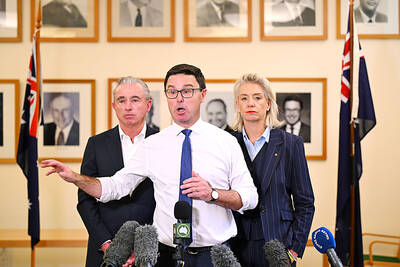
BACKLASH: The National Party quit its decades-long partnership with the Liberal Party after their election loss to center-left Labor, which won a historic third term Australia’s National Party has split from its conservative coalition partner of more than 60 years, the Liberal Party, citing policy differences over renewable energy and after a resounding loss at a national election this month. “Its time to have a break,” Nationals leader David Littleproud told reporters yesterday. The split shows the pressure on Australia’s conservative parties after Prime Minister Anthony Albanese’s center-left Labor party won a historic second term in the May 3 election, powered by a voter backlash against US President Donald Trump’s policies. Under the long-standing partnership in state and federal politics, the Liberal and National coalition had shared power

A Croatian town has come up with a novel solution to solve the issue of working parents when there are no public childcare spaces available: pay grandparents to do it. Samobor, near the capital, Zagreb, has become the first in the country to run a “Grandmother-Grandfather Service,” which pays 360 euros (US$400) a month per child. The scheme allows grandparents to top up their pension, but the authorities also hope it will boost family ties and tackle social isolation as the population ages. “The benefits are multiple,” Samobor Mayor Petra Skrobot told reporters. “Pensions are rather low and for parents it is sometimes

CONTROVERSY: During the performance of Israel’s entrant Yuval Raphael’s song ‘New Day Will Rise,’ loud whistles were heard and two people tried to get on stage Austria’s JJ yesterday won the Eurovision Song Contest, with his operatic song Wasted Love triumphing at the world’s biggest live music television event. After votes from national juries around Europe and viewers from across the continent and beyond, JJ gave Austria its first victory since bearded drag performer Conchita Wurst’s 2014 triumph. After the nail-biting drama as the votes were revealed running into yesterday morning, Austria finished with 436 points, ahead of Israel — whose participation drew protests — on 357 and Estonia on 356. “Thank you to you, Europe, for making my dreams come true,” 24-year-old countertenor JJ, whose
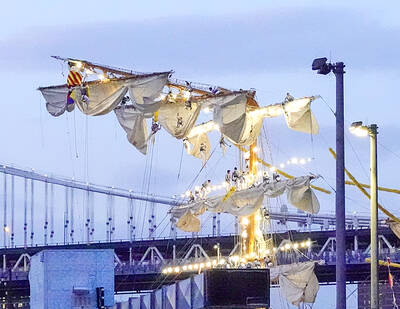
Two people died and 19 others were injured after a Mexican Navy training ship hit the Brooklyn Bridge, New York City Mayor Eric Adams said yesterday. The ship snapped all three of its masts as it collided with the New York City landmark late on Saturday, while onlookers enjoying the balmy spring evening watched in horror. “At this time, of the 277 on board, 19 sustained injuries, 2 of which remain in critical condition, and 2 more have sadly passed away from their injuries,” Adams posted on X. Footage shared online showed the Mexican Navy ship Cuauhtemoc, its sails furled


 RSS
RSS