


A suicide bomber attacked a checkpoint manned by a group fighting against al-Qaeda in Iraq, killing 12 people in one of a series of strikes against the largely Sunni movement singled out by Osama bin Laden as a "disgrace and shame."
Leaders of the rapidly expanding US-backed movement, credited with helping slash violence across the country by 60 percent since June, condemned bin Laden's latest message to his followers.
"We consider our fighting against al-Qaeda to be a popular revolution against the devil," said Sheik Mohammed Saleh al-Dohan, head of one of the groups in southern Ramadi, a city in Anbar province where the movement was born.
Al-Dohan blamed al-Qaeda, which espouses a radical version of Sunni Islam, for bringing destruction to Iraq: "They made enemies between Sunnis, Shiites and Christians who lived in peace for centuries."
Bin Laden and his fighters "are the traitors who betrayed the Muslim nation and brought shame to Islam in all the world," he said Monday.
In an audiotape that emerged on Saturday, bin Laden warned Iraq's Sunni Arabs against joining the groups, known as "awakening councils," or participating in any unity government. He said Sunni Arabs who join the groups "have betrayed the nation and brought disgrace and shame to their people. They will suffer in life and in the afterlife."
In the northern city of Tikrit, Saddam Hussein's hometown, the local Salahuddin Awakening Council said the movement was founded in response to "the crimes of followers of Osama bin Laden in Iraq."
The "Awakening Council's fighters are protecting people from criminals," the statement said, and demanded an apology "for those who have been harmed by the brutal acts of al-Qaeda members."
The groups took root in Anbar, once a hotbed of al-Qaeda in Iraq activity, but have become a mass movement that includes more than 70,000 fighters who are paid a monthly salary of US$300 by the US to protect their neighborhoods.
In the most serious attack against one of the groups on Monday, a suicide bomber drove a minibus rigged with explosives into a checkpoint in Tarmiyah, 48km north of Baghdad, police and a member of the local awakening council said.
The explosion killed 12 people, said Adil al-Mishhadani, a member of the council. The council commander, who gave his name only as Abu Arkan for security reasons, said later that the dead included three children on their way to school and nine council members.
Three people were missing, Abu Arkan said.
In a western neighborhood of Baghdad, a mortar round believed to have been targeting a council headquarters wounded three civilians when it landed on a nearby house, a Baghdad police officer said on condition of anonymity because he was not authorized to release information to the media.
To the south in Wasit province, gunmen shot and wounded an awakening council member in al-Hafriyah, a village 160km southeast of Baghdad, police said.
And in the town of Khalis, 80km north of Baghdad, gunmen traded fire with police and awakening council members, killing one member of the group and a policeman, a police officer said.
Earlier, a roadside bomb targeting a border patrol near the Iranian frontier killed two Iraqi guards, a police officer said on condition of anonymity as he was not authorized to release information to the media.
Mohammed Mulla Karim, mayor of a nearby town, said one border guard was killed in the explosion and four were wounded. The differing death tolls could not immediately be reconciled.
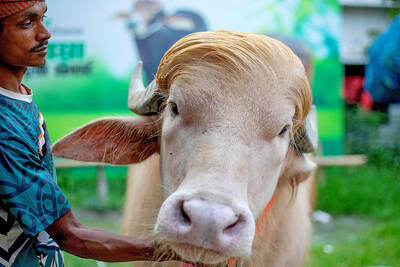
Crowds in Bangladesh are flocking to snap photographs with an unlikely social media star — an albino buffalo with flowing blond hair nicknamed “Donald Trump” that is due to be sacrificed within days. Owner Zia Uddin Mridha, 38, said his brother named the 700kg bull over its flowing helmet of hair resembling the signature look of the US president. “My younger brother picked this name because of the buffalo’s extraordinary hair,” he said at his farm in Narayanganj, just outside the capital, Dhaka. Mridha said that a constant stream of curious visitors — social media fans, onlookers and children — have come throughout
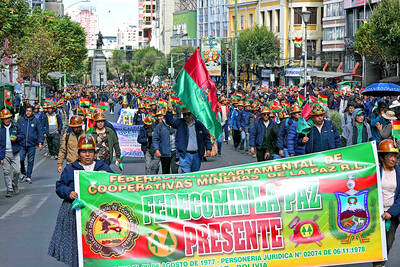
The Bolivian government on Friday struck a deal with protesting miners, but was still grappling with blockades and demonstrations by other workers across La Paz. Other groups are still blocking access roads into the city, which is also the seat of the government. Police on Thursday prevented the miners from entering the main square by using tear gas, while the demonstrators hurled stones and explosives with slingshots. Protests against the policies of Bolivian President Rodrigo Paz have convulsed the Andean nation since early this month, and roadblocks were choking routes into La Paz throughout Friday, the national road authority said. Miners demanded that Paz
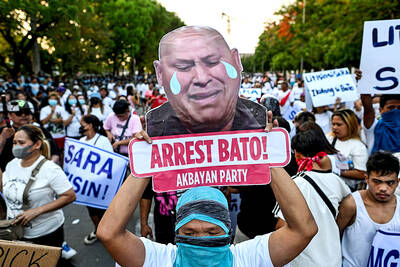
The Philippines said it has asked the country’s Supreme Court to allow it to arrest former Philippine president Rodrigo Duterte’s chief drug war enforcer to stand trial in an international tribunal. The International Criminal Court (ICC) last week unsealed an arrest warrant against Philippine Senator Ronald dela Rosa, accusing him along with Duterte and other “coperpetrators” of the “crime against humanity of murder.” Dela Rosa briefly sought refuge in the Philippine Senate last week while asking the Philippine Supreme Court to stop an ongoing attempt by government agents to arrest him. “By his own conduct, he has placed himself outside the protection of
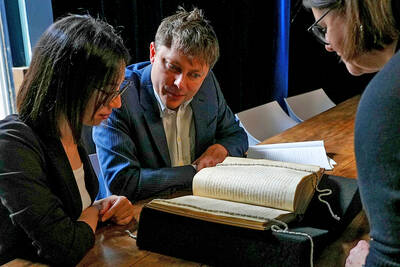
The researchers in Ireland looked at their computer screen, marveling at a medieval book tracked down in a Roman library. They flipped through its digitized pages and found their sought-after treasure: the oldest surviving English poem. “We were extremely surprised. We were speechless. We couldn’t believe our eyes when we first saw that,” said Elisabetta Magnanti, a visiting research fellow at Trinity College Dublin’s school of English. The poem was also within the main body of Latin text, she said, calling it “extraordinary.” Composed in Old English by a Northumbrian agricultural worker in the 7th century, Caedmon’s Hymn appears within some copies of


 RSS
RSS