


Every new police officer in New York City will be sent onto the streets of some of the city's toughest neighborhoods as part of a broad anti-crime operation that the authorities say has helped produce historic drops in crime, the city announced on Wednesday.
Police officials and Mayor Michael Bloomberg said that each of the 914 police recruits being sworn in yesterday would join the program, Operation Impact. They also announced that crime in almost every major category declined again this year, with violence down in the schools and on the subways and with homicides on track to fall below 500 for the first time since reliable statistics became available 44 years ago.
Because some areas, mostly in northern Brooklyn, show stubbornly higher crime rates, they will get a bigger influx of Operation Impact officers, Police Commissioner Raymond Kelly said. They include parts of Brownsville, Bedford-Stuyvesant, East New York and Crown Heights.
Operation Impact, begun in 2003, matches new recruits with seasoned officers and supervisors to tackle crime spikes in narrowly drawn geographic areas. Coming at a time when the department is facing recruitment challenges, the new influx will double -- to more than 1,800 -- the number of officers assigned to those duties in a force that currently has 35,400 members.
"If you look at a map showing where crime is, it is clearly concentrated in a couple of areas and the people that live in those areas have a right to live in a safe neighborhood just like those who are lucky enough to do so today," Bloomberg said as he stood with Kelly and a phalanx of police commanders inside the 28th Precinct station house in Harlem.
As of 7:30am on Wednesday, 484 homicides had been recorded in New York City this year, Kelly said, 97 fewer than at the same time last year. Officials said the city was headed toward having fewer than 500 homicides this year, by far the lowest number in a 12-month period since reliable Police Department statistics became available in 1963, when there were 548 killings.
Dennis Smith, a professor at the Wagner Graduate School of Public Service at New York University and an author of an analysis of Operation Impact, hailed the new emphasis on the program as a "targeted use of scarce resources."
He said he had feared that city officials might curb the program.
"This is further validation of research that has been done around the country -- on smaller, more temporary versions of this approach -- that hot-spot policing really works," Smith said.
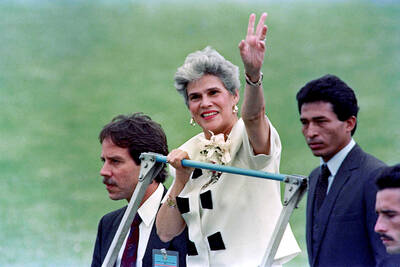
Former Nicaraguan president Violeta Chamorro, who brought peace to Nicaragua after years of war and was the first woman elected president in the Americas, died on Saturday at the age of 95, her family said. Chamorro, who ruled the poor Central American country from 1990 to 1997, “died in peace, surrounded by the affection and love of her children,” said a statement issued by her four children. As president, Chamorro ended a civil war that had raged for much of the 1980s as US-backed rebels known as the “Contras” fought the leftist Sandinista government. That conflict made Nicaragua one of

BOMBARDMENT: Moscow sent more than 440 drones and 32 missiles, Volodymyr Zelenskiy said, in ‘one of the most terrifying strikes’ on the capital in recent months A nighttime Russian missile and drone bombardment of Ukraine killed at least 15 people and injured 116 while they slept in their homes, local officials said yesterday, with the main barrage centering on the capital, Kyiv. Kyiv City Military Administration head Tymur Tkachenko said 14 people were killed and 99 were injured as explosions echoed across the city for hours during the night. The bombardment demolished a nine-story residential building, destroying dozens of apartments. Emergency workers were at the scene to rescue people from under the rubble. Russia flung more than 440 drones and 32 missiles at Ukraine, Ukrainian President Volodymyr Zelenskiy
COMPETITION: The US and Russia make up about 90 percent of the world stockpile and are adding new versions, while China’s nuclear force is steadily rising, SIPRI said Most of the world’s nuclear-armed states continued to modernize their arsenals last year, setting the stage for a new nuclear arms race, the Stockholm International Peace Research Institute (SIPRI) said yesterday. Nuclear powers including the US and Russia — which account for about 90 percent of the world’s stockpile — had spent time last year “upgrading existing weapons and adding newer versions,” researchers said. Since the end of the Cold War, old warheads have generally been dismantled quicker than new ones have been deployed, resulting in a decrease in the overall number of warheads. However, SIPRI said that the trend was likely

‘SHORTSIGHTED’: Using aid as leverage is punitive, would not be regarded well among Pacific Island nations and would further open the door for China, an academic said New Zealand has suspended millions of dollars in budget funding to the Cook Islands, it said yesterday, as the relationship between the two constitutionally linked countries continues to deteriorate amid the island group’s deepening ties with China. A spokesperson for New Zealand Minister of Foreign Affairs Winston Peters said in a statement that New Zealand early this month decided to suspend payment of NZ$18.2 million (US$11 million) in core sector support funding for this year and next year as it “relies on a high trust bilateral relationship.” New Zealand and Australia have become increasingly cautious about China’s growing presence in the Pacific


 RSS
RSS