


A judge released 14 suspected Islamic extremists for lack of evidence of their involvement in a plot to break free an al-Qaeda prisoner convicted of planning an attack on US air base personnel.
Prosecutors said on Saturday that the investigation would continue and that heightened security measures imposed across the country after Friday's arrests would remain in place through the New Year.
"We think there is still a threat," said Lieve Pellens, spokeswoman for the Federal Prosecutor's office.
She said intelligence that an attack could be imminent meant the security forces had to act without waiting to gather the evidence.
"We could not treat this as we would a normal criminal case," Pellens said on Saturday. "According to our investigation there were sufficient indications pointing to a terrorist threat. That is why we did not wait to detain the suspects."
The government had said it had information the suspects were plotting to use explosives and other weapons to free Nizar Trabelsi, a 37-year-old Tunisian serving 10 years for planning to a drive a car bomb into the cafeteria of a Belgian air base where about 100 US military personnel were stationed.
Prime Minister Guy Verhof-stadt warned on Friday that the suspects could have other targets and stepped up police patrols in public places, including the Brussels airport, subway stations and the capital's popular downtown Christmas market.
The 14 suspects were arrested on Friday in overnight raids. Reports indicated explosives had also been seized, but Pellens said on Saturday that searches of the suspects' homes uncovered no explosives, weapons or other evidence to persuade a magistrate to either charge them with any offense or keep them in jail.
The release renewed criticism of Belgian laws giving authorities only 24 hours to present enough evidence to charge suspects or free them.
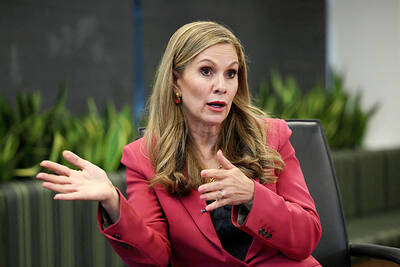
Australians were downloading virtual private networks (VPNs) in droves, while one of the world’s largest porn distributors said it was blocking users from its platforms as the country yesterday rolled out sweeping online age restriction. Australia in December became the first country to impose a nationwide ban on teenagers using social media. A separate law now requires artificial intelligence (AI)-powered chatbot services to keep certain content — including pornography, extreme violence and self-harm and eating disorder material — from minors or face fines of up to A$49.5 million (US$34.6 million). The country also joined Britain, France and dozens of US states requiring
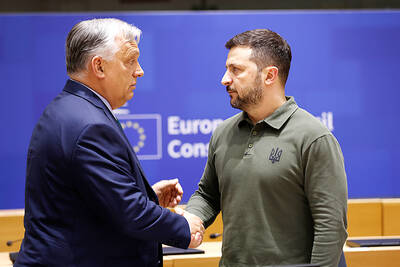
Hungarian authorities temporarily detained seven Ukrainian citizens and seized two armored cars carrying tens of millions of euros in cash across Hungary on suspicion of money laundering, officials said on Friday. The Ukrainians were released on Friday, following their detention on Thursday, but Hungarian officials held onto the cash, prompting Ukraine to accuse Hungary’s Russia-friendly government of illegally seizing the money. “We will not tolerate this state banditism,” Ukrainian Minister of Foreign Affairs Andrii Sybiha said. The seven detained Ukrainians were employees of the Ukrainian state-owned Oschadbank, who were traveling in the two armored cars that were carrying the money between Austria and
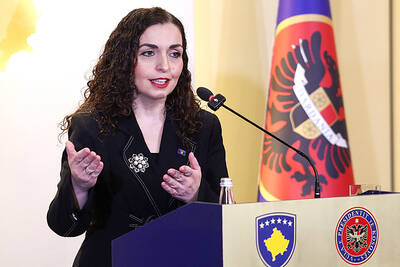
Kosovar President Vjosa Osmani on Friday after dissolving the Kosovar parliament said a snap election should be held as soon as possible to avoid another prolonged political crisis in the Balkan country at a time of global turmoil. Osmani said it is important for Kosovo to wrap up the upcoming election process and form functional institutions for political stability as the war rages in the Middle East. “Precisely because the geopolitical situation is that complex, it is important to finish this electoral process which is coming up,” she said. “It is very hard now to imagine what will happen next.” Kosovo, which declared

MORE BANS: Australia last year required sites to remove accounts held by under-16s, with a few countries pushing for similar action at an EU level and India considering its own ban Indonesia on Friday said it would ban social media access for children under 16, citing threats from online pornography, cyberbullying, online fraud and Internet addiction. “Accounts belonging to children under 16 on high-risk platforms will start to be deactivated, beginning with YouTube, TikTok, Facebook, Instagram, Threads, X, Bigo Live and Roblox,” Indonesian Minister of Communications and Digital Meutya Hafid said. “The government is stepping in so that parents no longer have to fight alone against the giants of the algorithm. Implementation will begin on March 28, 2026,” she said. The social media ban would be introduced in stages “until all platforms fulfill their


 RSS
RSS