


Nestor Kirchner, Argentina's most popular president in decades, draped the light-blue-and-white sash over the shoulder of his wife, Cristina Fernandez de Kirchner, on Monday, officially passing power to the first woman to be elected Argentina's leader in its 191-year history.
The handover was sealed with an emphatic, crowd-pleasing hug that seemed to make Cristina Kirchner blush. She repeatedly stroked her husband's back during the embrace. No modern-day couple in a democracy has carried out a comparable transfer of power, and certainly not in Latin America.
In their four and a half years in the presidential palace, the couple, affectionately known as "the penguins" -- a reference to Nestor Kirchner's Patagonian home state of Santa Cruz -- have evolved into Latin America's dynamic duo, power brokers who hold sway over their country of 40 million people.
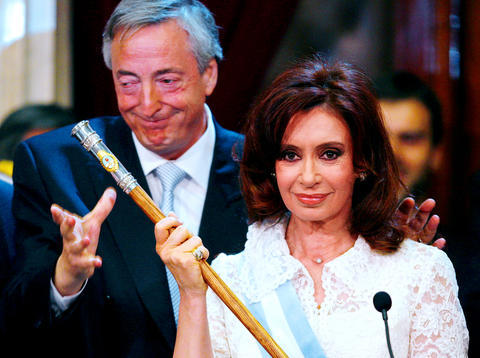
PHOTO: AFP
One major reason is Nestor Kirchner's stewardship following the country's worst financial crisis. The improvements in the country were, Cristina Kirchner said, "a result of his convictions," which she added, "are also mine."
Since shortly after Nestor Kirchner announced in July that he would not run for re-election and would back his wife's candidacy instead, the couple have made little secret of their plans to lead together. Cristina Kirchner conducted a carefully orchestrated campaign heavy on international diplomacy but light on opportunities for rigorous press questioning or debates with her rivals. In the end, facing a fractured opposition, she won emphatically, doubling the vote percentage that her husband was able to muster in 2003, when he got 22 percent before a rival dropped out.
"This says a lot about the weakness of Argentina's political party institutions," said Joan Caivano, director of special projects at the Inter-American Dialogue in Washington, who has studied the role of woman in Latin American politics.
"She was anointed by a very popular president, and that doesn't feel like a good thing for a democracy," she said.
But few doubt that the 54-year-old Cristina Kirchner, who served in Congress for a decade, has the political skills to lead. In her typically emphatic inauguration speech on Monday, she set out an agenda that emphasized greater South American integration and a desire to return Argentina to the world stage after four years in which her husband focused on improving the economy after the crisis in 2001.

North Korean leader Kim Jong-un sent Chinese President Xi Jinping (習近平) greetings with what appeared to be restrained rhetoric that comes as Pyongyang moves closer to Russia and depends less on its long-time Asian ally. Kim wished “the Chinese people greater success in building a modern socialist country,” in a reply message to Xi for his congratulations on North Korea’s birthday, the state-run Korean Central News Agency reported yesterday. The 190-word dispatch had little of the florid language that had been a staple of their correspondence, which has declined significantly this year, an analysis by Seoul-based specialist service NK Pro showed. It said

On an island of windswept tundra in the Bering Sea, hundreds of miles from mainland Alaska, a resident sitting outside their home saw — well, did they see it? They were pretty sure they saw it — a rat. The purported sighting would not have gotten attention in many places around the world, but it caused a stir on Saint Paul Island, which is part of the Pribilof Islands, a birding haven sometimes called the “Galapagos of the north” for its diversity of life. That is because rats that stow away on vessels can quickly populate and overrun remote islands, devastating bird

‘CLOSER TO THE END’: The Ukrainian leader said in an interview that only from a ‘strong position’ can Ukraine push Russian President Vladimir Putin ‘to stop the war’ Decisive actions by the US now could hasten the end of the Russian war against Ukraine next year, Ukrainian President Volodymyr Zelenskiy said on Monday after telling ABC News that his nation was “closer to the end of the war.” “Now, at the end of the year, we have a real opportunity to strengthen cooperation between Ukraine and the United States,” Zelenskiy said in a post on Telegram after meeting with a bipartisan delegation from the US Congress. “Decisive action now could hasten the just end of Russian aggression against Ukraine next year,” he wrote. Zelenskiy is in the US for the UN

CARTEL ARRESTS: The president said that a US government operation to arrest two cartel members made it jointly responsible for the unrest in the state’s capital Mexican President Andres Manuel Lopez Obrador on Thursday blamed the US in part for a surge in cartel violence in the northern state of Sinaloa that has left at least 30 people dead in the past week. Two warring factions of the Sinaloa cartel have clashed in the state capital of Culiacan in what appears to be a fight for power after two of its leaders were arrested in the US in late July. Teams of gunmen have shot at each other and the security forces. Meanwhile, dead bodies continued to be found across the city. On one busy street corner, cars drove


 RSS
RSS