


South Korea's largest oil spill reached part of the country's scenic and environmentally sensitive western shore yesterday as the Coast Guard struggled in high waves and strong winds to keep more oil from washing up on beaches.
Hundreds of troops, police and residents used buckets to remove dense crude oil from Mallipo -- one of South Korea's best-known beaches -- as tides of dark sea water crashed ashore. The odor could be smelled 1km away.
The region is popular for its scenic beaches and is also the site of fish farms, a national maritime park and is an important rest stop for migrating birds.
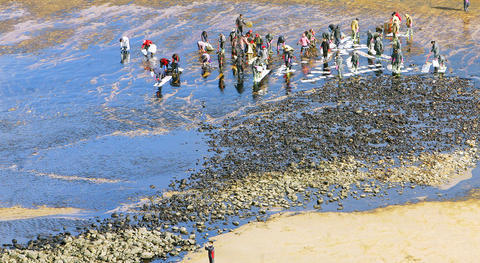
PHOTO: AP
Mallipo, about 150km southwest of Seoul, is one of the hardest-hit areas from the oil spill, which occurred on Friday when a crane-carrying barge slammed into a supertanker, punching holes and causing it to release 66,000 barrels (10.5 million liters) of oil into the ocean.
The spill was the country's largest, involving twice as much oil as the worst previous spill in 1995.
The accident occurred about 11km off Mallipo.
The oil reached shore yesterday morning, contaminating about 7km of coastline near Mallipo, said Jung Se-hi, a spokesman at the Coast Guard headquarters in Incheon. Strong winds and prevailing currents spread the oil slick overnight to an area about 2km wide and 20km in length, he said.
Environmental activists expressed anguish over the situation.
"It's helpless," said Lee Pyong-gook, an activist with the Korean Federation for Environmental Movement. "It's a sea of oil."
Lee said the region is a major stopover for migratory snipe.
"It was fortunate that those birds have yet to arrive," he said, adding however, that some seagulls had been tarred by oil.
The Coast Guard were mobilizing 103 vessels and six helicopters yesterday in an effort to clean up the spill, the Coast Guard's Jung said, adding that the operation was expected to take at least three days.
"We're doing our best to remove the contamination as quickly as possible, but it will take some time to clean up the shore because it needs to be done by hand," said Kim Woon-tae, a Coast Guard official stationed in the region.
Kim said oil was still trickling out of the punctured tanker, but the holes would soon be sealed completely. The Coast Guard headquarters had said on Friday that all three holes in the tanker were plugged.
"It's a difficult operation because weather is not good," Kim said. "We're focusing our efforts on preventing more oil from reaching the coast."
The size of the leak reported by the authorities would be about one-fourth that of the 260,000 barrels, or 41.6 million liters, of oil spilled into Alaska's Prince William Sound by the Exxon Valdez in 1989.
The tanker, the Hebei Spirit, and the other vessel, owned by South Korea's Samsung Corp, were in no danger of sinking, the Coast Guard said. There were no casualties in the accident.
The tanker was at anchor and carrying about 260,000 tonnes of crude oil -- about 1.8 million barrels -- to be loaded into boats from a nearby port when it was hit by the South Korean barge which was being towed by a small tug boat, said Kim Tae-ho, another Coast Guard official.
The barge, which was moving from a construction site, lost control after a wire linking it to the tug boat was cut as a result of high winds, waves and currents, he said.
Kim said the Coast Guard planned to question the barge's captain to find why he was sailing through the area despite the stormy weather.
The July 1995 leak caused damage estimated at 73.5 billion won, at today's exchange rates equal to US$80 million.

FRAUD ALLEGED: The leader of an opposition alliance made allegations of electoral irregularities and called for a protest in Tirana as European leaders are to meet Albanian Prime Minister Edi Rama’s Socialist Party scored a large victory in parliamentary elections, securing him his fourth term, official results showed late on Tuesday. The Socialist Party won 52.1 percent of the vote on Sunday compared with 34.2 percent for an alliance of opposition parties led by his main rival Sali Berisha, according to results released by the Albanian Central Election Commission. Diaspora votes have yet to be counted, but according to initial results, Rama was also leading there. According to projections, the Socialist Party could have more lawmakers than in 2021 elections. At the time, it won 74 seats in the

EUROPEAN FUTURE? Albanian Prime Minister Edi Rama says only he could secure EU membership, but challenges remain in dealing with corruption and a brain drain Albanian Prime Minister Edi Rama seeks to win an unprecedented fourth term, pledging to finally take the country into the EU and turn it into a hot tourist destination with some help from the Trump family. The artist-turned-politician has been pitching Albania as a trendy coastal destination, which has helped to drive up tourism arrivals to a record 11 million last year. US President Donald Trump’s son-in-law, Jared Kushner, also joined in the rush, pledging to invest US$1.4 billion to turn a largely deserted island into a luxurious getaway. Rama is expected to win another term after yesterday’s vote. The vote would

CANCER: Jose Mujica earned the moniker ‘world’s poorest president’ for giving away much of his salary and living a simple life on his farm, with his wife and dog Tributes poured in on Tuesday from across Latin America following the death of former Uruguayan president Jose “Pepe” Mujica, an ex-guerrilla fighter revered by the left for his humility and progressive politics. He was 89. Mujica, who spent a dozen years behind bars for revolutionary activity, lost his battle against cancer after announcing in January that the disease had spread and he would stop treatment. “With deep sorrow, we announce the passing of our comrade Pepe Mujica. President, activist, guide and leader. We will miss you greatly, old friend,” Uruguayan President Yamandu Orsi wrote on X. “Pepe, eternal,” a cyclist shouted out minutes later,
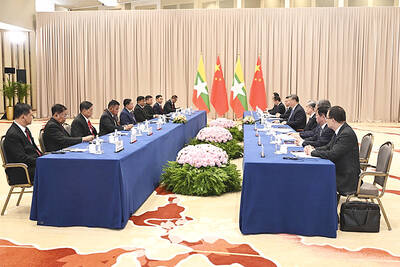
Myanmar’s junta chief met Chinese President Xi Jinping (習近平) for the first time since seizing power, state media reported yesterday, the highest-level meeting with a key ally for the internationally sanctioned military leader. Senior General Min Aung Hlaing led a military coup in 2021, overthrowing Myanmar’s brief experiment with democracy and plunging the nation into civil war. In the four years since, his armed forces have battled dozens of ethnic armed groups and rebel militias — some with close links to China — opposed to its rule. The conflict has seen Min Aung Hlaing draw condemnation from rights groups and pursued by the


 RSS
RSS