


US President George W. Bush and congressional Democrats were at a stalemate on Monday over federal spending, taxes, domestic surveillance and the war in Iraq -- and neither side made a move to negotiate, even though lawmakers have just a few weeks left to wrap up work for the year.
With Congress back at work after a two-week recess, Bush and the Democrats spent the day lobbing verbal grenades at one another. Bush appeared in the Rose Garden to chide lawmakers for failing to finish their work, and his aides said he would do so again at a news conference yesterday -- a rare departure for a White House that typically keeps its news conferences a secret until an hour before they occur.
"They have just two weeks to go before they leave town again," Bush said. "That's not really a lot of time to squeeze in nearly a year's worth of unfinished business."
At the Capitol, Senator Harry Reid of Nevada, the Democratic leader, responded by calling Bush's arguments "pretty weak" and accusing the president of being intransigent.
"If not for the stubborn refusal of the president and his Republican enablers to work with us," Reid said, "we would accomplish a lot more."
There was little evidence that either side was trying to ease the war of words.
The White House said there were no immediate plans to invite congressional leaders in to talk to the president, and Reid said he had not spoken to Bush's chief of staff, Joshua Bolten, since before Thanksgiving. Bolten, a former budget director who has respect on Capitol Hill, has helped resolve previous White House budget battles with Congress.
Tony Fratto, Bush's deputy press secretary, said Jim Nussle, the budget director, was taking the lead in negotiations over spending.
But Nussle has not met with Representative David Obey of Wisconsin, a Democrat who is chairman of the House Appropriations Committee, since Sept. 19, Obey's aides said, when the pair had drinks on the terrace of Obey's office overlooking the Washington Monument. The meeting was fruitless.
The deadlock recalls one of an earlier era -- between former president Bill Clinton and congressional Republicans at the end of 1995. That dispute ended with a government shutdown -- an outcome Bush and congressional Democrats say they intend to avoid. But with both sides digging in their heels, strategists said on Monday they did not know how the disagreements would be resolved.
"It's a huge game of chicken and I'm certain the president is not planning to back down," said Charlie Black, a Republican strategist close to the White House.
Bush, Black said, has "the zest for this combat."
But Democrats have a zest for combat as well and are calculating that the public will be paying more attention to issues like the mortgage crisis than to Bush's attacks on them.
"This country has bigger problems than the president's manufactured confrontation with the Congress," said Representative Rahm Emanuel of Illinois, chairman of the House Democratic caucus.
Emanuel warned of a "Bush recession" on the horizon, a signal that the Democrats plan to make the economy a major election issue.
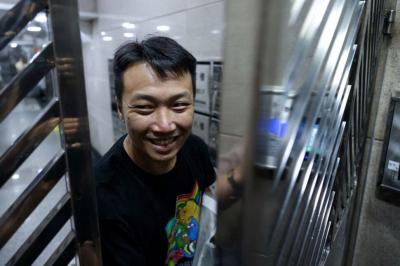
Four people jailed in the landmark Hong Kong national security trial of "47 democrats" accused of conspiracy to commit subversion were freed today after more than four years behind bars, the second group to be released in a month. Among those freed was long-time political and LGBTQ activist Jimmy Sham (岑子杰), who also led one of Hong Kong’s largest pro-democracy groups, the Civil Human Rights Front, which disbanded in 2021. "Let me spend some time with my family," Sham said after arriving at his home in the Kowloon district of Jordan. "I don’t know how to plan ahead because, to me, it feels

Poland is set to hold a presidential runoff election today between two candidates offering starkly different visions for the country’s future. The winner would succeed Polish President Andrzej Duda, a conservative who is finishing his second and final term. The outcome would determine whether Poland embraces a nationalist populist trajectory or pivots more fully toward liberal, pro-European policies. An exit poll by Ipsos would be released when polls close today at 9pm local time, with a margin of error of plus or minus 2 percentage points. Final results are expected tomorrow. Whoever wins can be expected to either help or hinder the

‘A THREAT’: Guyanese President Irfan Ali called on Venezuela to follow international court rulings over the region, whose border Guyana says was ratified back in 1899 Misael Zapara said he would vote in Venezuela’s first elections yesterday for the territory of Essequibo, despite living more than 100km away from the oil-rich Guyana-administered region. Both countries lay claim to Essequibo, which makes up two-thirds of Guyana’s territory and is home to 125,000 of its 800,000 citizens. Guyana has administered the region for decades. The centuries-old dispute has intensified since ExxonMobil discovered massive offshore oil deposits a decade ago, giving Guyana the largest crude oil reserves per capita in the world. Venezuela would elect a governor, eight National Assembly deputies and regional councilors in a newly created constituency for the 160,000
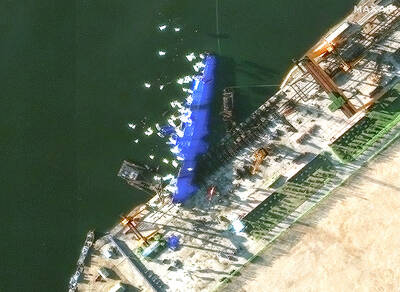
North Korea has detained another official over last week’s failed launch of a warship, which damaged the naval destroyer, state media reported yesterday. Pyongyang announced “a serious accident” at Wednesday last week’s launch ceremony, which crushed sections of the bottom of the new destroyer. North Korean leader Kim Jong-un called the mishap a “criminal act caused by absolute carelessness.” Ri Hyong-son, vice department director of the Munitions Industry Department of the Party Central Committee, was summoned and detained on Sunday, the Korean Central News Agency (KCNA) reported. He was “greatly responsible for the occurrence of the serious accident,” it said. Ri is the fourth person


 RSS
RSS