

Cuba announced on Tuesday it has set Jan. 20 for national elections that are part of the process of determining whether ailing President Fidel Castro will stay on as president.
The ruling, signed by interim leader Raul Castro, read on state TV, set the date for elections to provincial and national assemblies, voting that is held every five years.
There was no explicit mention of Fidel Castro, but the 81-year-old Cuban leader would have to be re-elected to the national parliament before he could repeat as president of the Council of State. Citizens do not directly elect Cuba's president.
Raul, 76, is the council's first vice president.
"This is an election with real suspense," said Phil Peters, a Cuba analyst at the Lexington Institute think tank outside Washington. "If he [Fidel Castro] doesn't put his name on the ballot, he is effectively resigning."
Peters said even if that happens, Castro could still play a key role as Communist Party general secretary -- arguably a more powerful job -- or in a new emeritus position.
The January elections will come almost 18 months after the elder Castro stepped aside on July 31 last year because of emergency intestinal surgery, provisionally ceding his functions to Raul and a team of other top leaders.
He has not been seen in public since, appearing only in official photographs and videos and regularly writing essays with mostly international themes.
The parliament, known in Cuba as the National Assembly, elects a new council every five years, several weeks after deputies are elected.
It was not announced when the new National Assembly would meet for the first time to renew the top council members.
Cuba's constitution calls for the council's first vice president, currently Raul, to fill the presidential slot when vacated.
Fidel, Cuba's unchallenged leader since 1959, held the council presidency since its 1976 creation.
Culture Minister Abel Prieto said in September that Fidel would disappoint many Cubans if he did not run, saying he was "convinced that the immense majority of our people, the overwhelming majority, want Fidel to continue as Council of State."
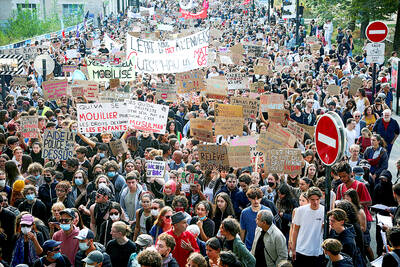
VIOLENT STANDOFFS: The government said 215 students have been injured since the start of the movement last month, including a teenager who lost a hand on Monday Thousands of demonstrators yesterday massed under heavy police surveillance in Paris and cities across France, as unions and teachers joined high-school students who for days have been demanding better conditions in protests punctuated by violent clashes. Students have blocked the entrances to hundreds of high schools for 15-to-17-year-olds since late last month, complaining of missing teachers, overloaded schedules, dilapidated classrooms and buildings that cannot cope with rising temperatures. In the Paris suburb of Creteil, where the protests started last month, students piled barriers outside the Saint-Exupery high school. “We are here to make our voice heard, all too often forgotten,” student Abderrahmane Abdelkader

As shark attack survivor Mel Ismail fought the predator that severed his leg, he noticed something odd. “I saw its eye ... a big black eye,” Ismail said. “But it was winking back at me — I was trying to get my fingers in its eye and just pushing its eye as I was being dragged.” When the shark swam off, he managed to struggle back to shore, the surfer and professional firefighter said in an Australian Broadcasting Corp interview broadcast on Thursday. He was surfing at Glenfield Beach near Geraldton on Australia’s west coast when he was attacked on Sept. 14. He
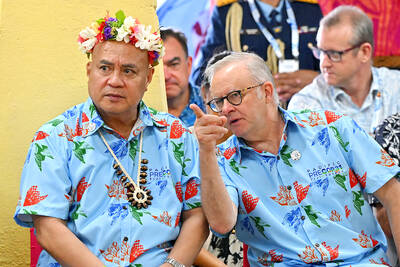
A Tuvalu government adviser yesterday said it felt like Australia had “taken over” the tiny country’s sovereignty during a visit by leaders to the Pacific island. The official — a senior government adviser who asked to remain anonymous because they were not authorized to speak to the media — said they were disappointed in Australia’s handling of the visit. The comments came during a visit by Australian Prime Minister Anthony Albanese and other leaders to Tuvalu, which has become a symbol of the existential threat posed by rising seas and is a key partner in Canberra’s Pacific strategy. “Just because we signed the
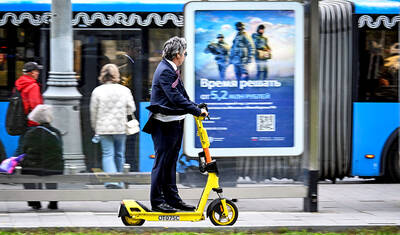
Halfway around the world from Russia, in a Caribbean tourism hot spot, men young and old are being lured by Moscow with tantalizing job offers, only to find themselves en route to the front lines in Ukraine. Moscow and Kyiv have recruited thousands of foreign nationals into their armies since Russia launched its invasion of Ukraine in 2022. Moscow is accused, in some cases, of using fake job ads to hoodwink men from deprived backgrounds in Africa, Asia and Latin America into traveling to Russia and then forcing them to fight on arrival. From countries such as India, Kenya, Equatorial Guinea, Colombia and


 RSS
RSS