


The Orbis Flying Eye Hospital, which was launched in 1982 and has traveled to 76 countries, landed in Taiwan yesterday on a mission to promote vocational safety for eyes.
The flying hospital, a refurbished DC-10 jet aircraft kitted out with medical equipment, brings the gift of sight to underdeveloped countries where 90 percent of preventable blindness occurs, Luis Echauri, a staff ophthalmologist from the hospital told a press conference held in the airplane.
"In 2006 the Bureau of Labor Insurance commissioned Orbis Taiwan to conduct a nationwide survey, and we found vocational eye trauma to be the third most common cause of blindness in the country," said Chan Chang-chuan (
Most vocational eye injuries affect young adult male workers with low socioeconomic status and education levels. They usually work in heavy industries, construction and farming, Chan said.
"Seasoned workers are at a higher risk," he said, "and most cases occur when the workers are under time pressure, distracted or fatigued."
Citing the survey results, Chan said that in Taiwan 6,600 cases of eye injury occur annually in the work place and cost NT$450,000 on average to treat.
"Not only are the injuries emotionally and economically devastating to the [injured] workers' families, the loss of able workers is also costly to society," Chan said.
"Orbis' mission is to travel to underdeveloped countries to train local ophthalmologists and nurses and treat under-served patients," Echauri said. "Of the 37 million people who are blind worldwide, 75 percent of them could have had their blindness prevented or restored if they had access to proper medical care."
In Taiwan, where the national health insurance offers Taiwanese excellent medical care, prevention is key, Orbis Taiwan public relations manager Wendy Liang (梁惠雯) said.
"An ounce of prevention is worth a pound of cure," Chan said. "We urge employers in high-risk industries to contact us for free workshops on how their employees can take proper precautions to prevent these occupational hazards."
To sign up for workshops and get involved in helping their cause, log onto www.orbis.org.tw to find out more.
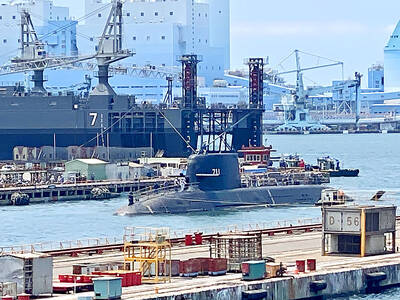
AGING: While Japan has 22 submarines, Taiwan only operates four, two of which were commissioned by the US in 1945 and 1946, and transferred to Taiwan in 1973 Taiwan would need at least 12 submarines to reach modern fleet capabilities, CSBC Corp, Taiwan chairman Chen Cheng-hung (陳政宏) said in an interview broadcast on Friday, citing a US assessment. CSBC is testing the nation’s first indigenous defense submarine, the Hai Kun (海鯤, Narwhal), which is scheduled to be delivered to the navy next month or in July. The Hai Kun has completed torpedo-firing tests and is scheduled to undergo overnight sea trials, Chen said on an SET TV military affairs program. Taiwan would require at least 12 submarines to establish a modern submarine force after assessing the nation’s operational environment and defense

A white king snake that frightened passengers and caused a stir on a Taipei MRT train on Friday evening has been claimed by its owner, who would be fined, Taipei Rapid Transit Corp (TRTC) said yesterday. A person on Threads posted that he thought he was lucky to find an empty row of seats on Friday after boarding a train on the Bannan (Blue) Line, only to spot a white snake with black stripes after sitting down. Startled, he jumped up, he wrote, describing the encounter as “terrifying.” “Taipei’s rat control plan: Release snakes on the metro,” one person wrote in reply, referring
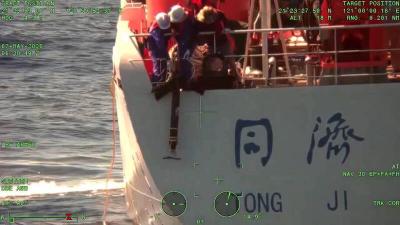
The coast guard today said that it had disrupted "illegal" operations by a Chinese research ship in waters close to the nation and driven it away, part of what Taipei sees a provocative pattern of China's stepped up maritime activities. The coast guard said that it on Thursday last week detected the Chinese ship Tongji (同濟號), which was commissioned only last year, 29 nautical miles (54km) southeast of the southern tip of Taiwan, although just outside restricted waters. The ship was observed lowering ropes into the water, suspected to be the deployment of scientific instruments for "illegal" survey operations, and the coast
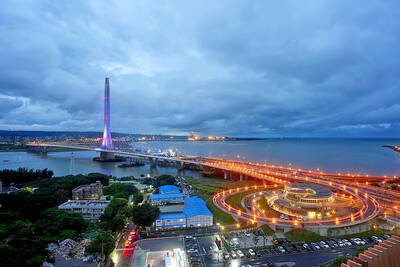
An inauguration ceremony was held yesterday for the Danjiang Bridge, the world’s longest single-mast asymmetric cable-stayed bridge, ahead of its official opening to traffic on Tuesday, marking a major milestone after nearly three decades of planning and construction. At the ceremony in New Taipei City attended by President William Lai (賴清德), Premier Cho Jung-tai (卓榮泰), Minister of Transportation and Communications Chen Shih-kai (陳世凱) and New Taipei City Mayor Hou Yu-ih (侯友宜), the bridge was hailed as both an engineering landmark and a long-awaited regional transport link connecting Tamsui (淡水) and Bali (八里)


 RSS
RSS