


On a hot, dusty highway some 70km from Delhi, a human column snakes its way towards the Indian capital carrying a unique message of defiance to the country's leaders: "Give us back our land."
Some 25,000 of India's poorest people -- tribal peoples, "untouchables" and landless laborers -- have stopped traffic for nearly three weeks on the road that links Delhi and Agra, home to the Taj Mahal. Headed by a group of chanting Buddhist monks, the marchers say they aim to shame the government into keeping its promise to redistribute land.
The human train has been eating, living and washing by the road since the beginning of the month and by the end of the week will arrive at the Indian parliament, vowing to remain a public embarrassment until the government relents. Last week three marchers were killed by a speeding lorry.
With fists and voices raised, the scene is a world away from Indian newspaper headlines about the country's new luxury goods market or its soaring stock markets. Nowhere is this process of concentrating wealth in a tiny segment of the population more visible than in the ground beneath Indians' feet.
India has one of most iniquitous systems of land ownership in the world. Last week India's biggest real estate baron made a paper fortune of US$1 billion in a single day.
Most of the marchers say their dire condition is because they have no deeds to their land. Unable to grow produce on their ancestral land and with no deed to access state welfare services, the villagers are now fighting a losing war against poverty.
"I haven't got any rights on my land," said Prem Bai from the central Indian state of Madhya Pradesh. "I have got four boys and can hardly manage the family with few days' work laboring on others' fields. If we go to forests then the forest department arrests us."
Some say their land is being grabbed by local mafias and corrupt officials. Shikari Baiga, 25, says land his family was cultivating was grabbed by local officials to grow biofuels on.
"I was put in jail for one year for demanding our land back. Fourteen families lost 75 acres [30 hectares]. But they tell us: Where are your [deeds]? We can do nothing. That is why we are going to Delhi to get justice."
The march is the brainchild of veteran Gandhian P.V. Rajagopal, who built a name by persuading bandits in central India to lay down their arms in the 1970s.
Rajagopal says the human caravan is a warning shot.
Rajagopal says there is a rising tide of violence in the country as the poor "are being driven out of villages and slums in cities."
In the country's rush to industrialize, he said, "we've seen alarming examples of outsiders seizing land on vast scales while the local rural poor are denied land. The result will be bloodshed and violence on a massive scale unless the government acts."
The issue is increasingly an explosive one in India, where incomplete reforms have left much of the country in the hands of a few. Extreme leftwing groups have tapped the rising anger in rural areas to wage low-intensity guerrilla wars.
In March an attempt to hand over 9,000 hectares of farmland to big business ended in pitched battles and half a dozen villagers dead in Bengal.
Some say that the problem lies in the Indian state's indifference to its poorest people, the "tribals" and the Dalites, or "untouchables."
"There are 120 million people who have no rights in this country," said Balkrishna Renake, chairman of India's national commission for denotified and nomadic tribes. "They are still waiting in independent India for the right to vote, to have schools and teachers, and for their land."

Hungarian authorities temporarily detained seven Ukrainian citizens and seized two armored cars carrying tens of millions of euros in cash across Hungary on suspicion of money laundering, officials said on Friday. The Ukrainians were released on Friday, following their detention on Thursday, but Hungarian officials held onto the cash, prompting Ukraine to accuse Hungary’s Russia-friendly government of illegally seizing the money. “We will not tolerate this state banditism,” Ukrainian Minister of Foreign Affairs Andrii Sybiha said. The seven detained Ukrainians were employees of the Ukrainian state-owned Oschadbank, who were traveling in the two armored cars that were carrying the money between Austria and

Kosovar President Vjosa Osmani on Friday after dissolving the Kosovar parliament said a snap election should be held as soon as possible to avoid another prolonged political crisis in the Balkan country at a time of global turmoil. Osmani said it is important for Kosovo to wrap up the upcoming election process and form functional institutions for political stability as the war rages in the Middle East. “Precisely because the geopolitical situation is that complex, it is important to finish this electoral process which is coming up,” she said. “It is very hard now to imagine what will happen next.” Kosovo, which declared

MORE BANS: Australia last year required sites to remove accounts held by under-16s, with a few countries pushing for similar action at an EU level and India considering its own ban Indonesia on Friday said it would ban social media access for children under 16, citing threats from online pornography, cyberbullying, online fraud and Internet addiction. “Accounts belonging to children under 16 on high-risk platforms will start to be deactivated, beginning with YouTube, TikTok, Facebook, Instagram, Threads, X, Bigo Live and Roblox,” Indonesian Minister of Communications and Digital Meutya Hafid said. “The government is stepping in so that parents no longer have to fight alone against the giants of the algorithm. Implementation will begin on March 28, 2026,” she said. The social media ban would be introduced in stages “until all platforms fulfill their
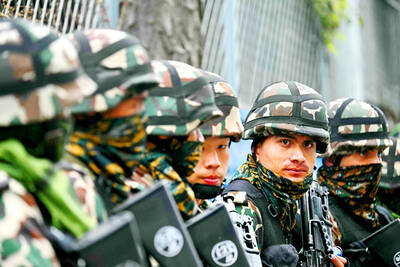
Counting was under way in Nepal yesterday, after a high-stakes parliamentary election to reshape the country’s leadership following protests last year that toppled the government. Key figures vying for power include former Nepalese prime minister K. P. Sharma Oli, rapper-turned-mayor Balendra Shah, who is bidding for the youth vote, and newly elected Nepali Congress party leader Gagan Thapa. In Kathmandu’s tea shops and city squares, people were glued to their phones, checking results as early trends flashed up — suggesting Shah’s centrist Rastriya Swatantra Party (RSP) was ahead. Nepalese Election Commission spokesman Prakash Nyupane said the counting was ongoing “in a peaceful manner”


 RSS
RSS