


Elections to decide Nepal's future were postponed indefinitely yesterday, ministers said, as government and Maoists squabbled over the election systems and the monarchy's fate.
The polls scheduled for Nov. 22 were a key element of a peace deal sealed last year that ended a civil war launched in 1996 by the Maoists, who are demanding the abolition of the monarchy.
"The seven party leaders [of the government] have agreed to postpone the constituent assembly elections for an indefinite period," Peace and Reconstruction Minister Ram Chanda Poudel said.
Voters were to elect a body to rewrite Nepal's Constitution and decide the fate of the Himalayan country's embattled monarchy.
"The government has decided to call a special session of parliament on Oct. 11" to discuss the Maoists' demands, Finance Minister Ram Sharan Mahat said.
The seven parties in the coalition government issued a joint statement shortly after the postponement was announced, urging impoverished Nepal's donors to continue their support of the peace process.
"We regret the postponement of the elections but we want to assure people that we are committed to hold constituent assembly elections and a new date will be fixed soon," the statement said. "We hope that the international community and the United Nations will continue their support of the ongoing peace process."
The head of the UN mission to Nepal's peace process said the postponement was disappointing and the political parties and Maoists needed to prepare in earnest for rescheduled elections.
"What is important now is that the political parties maintain their alliance and reach political agreements to create the conditions for a credible constituent assembly election," UN representative Ian Martin said.
"I have no doubt that the UN and member states will remain committed to supporting the Nepal peace process," he added.
As part of last November's peace deal, the UN was invited to supervise Maoist weapons and soldiers who were confined to camps around the country as well as assist in the polls.
A spokesman said Nepal's Election Commission was ready to hold the Nov. 22 polls and the delay was worrying.
"We had everything in place. The decision by the political parties has created a lot of confusion. The election commission is meeting regarding what to do next," said Laxman Bhattarai, the election commission spokesman.
The fiercely republican Maoists have been pushing hard for the immediate abolition of the monarchy as well as change to the election system.
After agreeing to polls with a mixed first-past-the-post and proportional representation system, the ex-rebels demanded full proportional voting.
They vowed to disrupt next month's ballot if mainstream parties refused their demands.
Analysts say the ultra-leftists have grown fearful of the elections as popular support has plummeted because of their continued strong-arm tactics and bloody unrest in the southern Terai region.
The delay could open the way to further unrest and other repercussions, a political analyst warned.
"The postponement has created an atmosphere of uncertainty and the very legitimacy and credibility of the government has come into question," said Kapil Shrestha, a political science professor at Nepal's Tribhuvan University.

PARLIAMENT CHAOS: Police forcibly removed Brazilian Deputy Glauber Braga after he called the legislation part of a ‘coup offensive’ and occupied the speaker’s chair Brazil’s lower house of Congress early yesterday approved a bill that could slash former Brazilian president Jair Bolsonaro’s prison sentence for plotting a coup, after efforts by a lawmaker to disrupt the proceedings sparked chaos in parliament. Bolsonaro has been serving a 27-year term since last month after his conviction for a scheme to stop Brazilian President Luiz Inacio Lula da Silva from taking office after the 2022 election. Lawmakers had been discussing a bill that would significantly reduce sentences for several crimes, including attempting a coup d’etat — opening up the prospect that Bolsonaro, 70, could have his sentence cut to

A powerful magnitude 7.6 earthquake shook Japan’s northeast region late on Monday, prompting tsunami warnings and orders for residents to evacuate. A tsunami as high as three metres (10 feet) could hit Japan’s northeastern coast after an earthquake with an estimated magnitude of 7.6 occurred offshore at 11:15 p.m. (1415 GMT), the Japan Meteorological Agency (JMA) said. Tsunami warnings were issued for the prefectures of Hokkaido, Aomori and Iwate, and a tsunami of 40cm had been observed at Aomori’s Mutsu Ogawara and Hokkaido’s Urakawa ports before midnight, JMA said. The epicentre of the quake was 80 km (50 miles) off the coast of
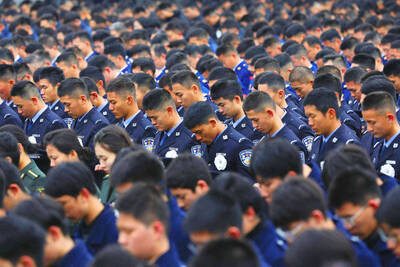
China yesterday held a low-key memorial ceremony for the 1937 Nanjing Massacre, with Chinese President Xi Jinping (習近平) not attending, despite a diplomatic crisis between Beijing and Tokyo over Taiwan. Beijing has raged at Tokyo since Japanese Prime Minister Sanae Takaichi last month said that a hypothetical Chinese attack on Taiwan could trigger a military response from Japan. China and Japan have long sparred over their painful history. China consistently reminds its people of the 1937 Nanjing Massacre, in which it says Japanese troops killed 300,000 people in what was then its capital. A post-World War II Allied tribunal put the death toll

A passerby could hear the cacophony from miles away in the Argentine capital, the unmistakable sound of 2,397 dogs barking — and breaking the unofficial world record for the largest-ever gathering of golden retrievers. Excitement pulsed through Bosques de Palermo, a sprawling park in Buenos Aires, as golden retriever-owners from all over Argentina transformed the park’s grassy expanse into a sea of bright yellow fur. Dog owners of all ages, their clothes covered in dog hair and stained with slobber, plopped down on picnic blankets with their beloved goldens to take in the surreal sight of so many other, exceptionally similar-looking ones.


 RSS
RSS