


Plans to send Turkana Boy, a unique hominid skeleton, and other prehistoric jewels from Kenyan museums for exhibition in the US have sparked heated debate among Kenya's scientific community.
The trip will bring in a much-needed windfall to Kenya's cash-strapped museums but the fossils' discoverers and researchers -- led by world-renowned Kenyan paleo-anthropologist Richard Leakey -- fear it could cause irreparable damage to the relics.
"We have government approval and will send the fossils to the Chicago Field Museum next year ready for the exhibition planned for 2009," National Museums of Kenya (NMK) Director-General Idle Omar Farah said.
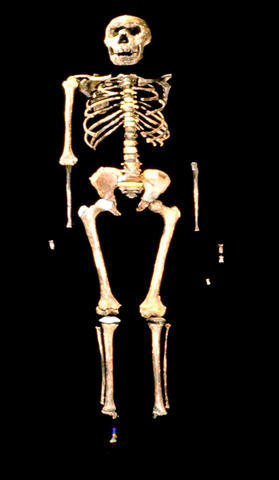
PHOTO: AFP
But Richard Leakey's daughter Louise Leakey was among those who are outraged.
"It is like prostituting the Kenyan fossils for money. It is like corruption," she said.
The fossils include the 1.5-million-year-old Turkana Boy, as well as 2.5-million-year-old stone tools, a monkey fossil dating back 17 million years and a one-of-its-kind fossil of a horned giraffe.
The prehistoric treasures are slated to be transported to two other US museums after being put on display in Chicago.
"We decided that since we have fossils, we should use them to raise 2.5 million euros [US$3.5 million] which will be part of the NMK's Endowment Fund that will be used in research," NMK head of sites and monuments Kibunjia Mzalendo said. "The fossil is the only complete skeleton of Homo erectus available in the world. Furthermore, it has never been seen outside this country."
The NMK says it was forced to exhibit the fossils after the government slashed funding 15 percent, but the scientists opposing the move warned that the trans-Atlantic voyage endangers further research.
"These fossils are priceless and irreplaceable. They are also very fragile and they might break if transported. In addition, fossils are there for scientific study," Louise Leakey said.
"It is sad they are planning to display them in the US to raise money for the museums, which can get money from elsewhere," she said. "People will stop fossil studies if they know that any new discovery will be taken elsewhere for exhibitions."
In August, the 3.2-million-year old Ethiopian fossil Lucy, a 1974 discovery that revealed our forefathers walked upright before they developed a big brain, was taken to the US Houston Museum of Natural Science.
"If we start sending these fossils out of the country, Kenya and Ethiopia cease to be places where you can study fossils. It immediately changes the role of the museum as a place you can study fossils," Richard Leakey told Science Magazine.
But a Kenyan scientist, who requested anonymity, disagreed.
"We want to share our heritage with the rest of the world. After all, these fossils are usually kept in strongrooms where even a Kenyan cannot see them. Let them go and generate money for the museum," the scientist said.
"The decision is more or less made," he said. "Leakey's fossil-hunting gang takes the fossils like personal items."
Critics have also argued that the trip would violate a 1989 deal in which scientists from 23 nations agreed not to transport original fossils from their homeland unless there is a compelling scientific reason.
"The agreement was not binding on state level," Mzalendo said.
Farah also argued the exhibition would advance research.
"The fossils will be subjected to scientific techniques not available in Kenya. While in the US, we shall organize a symposium of scientists to exchange ideas," he said.
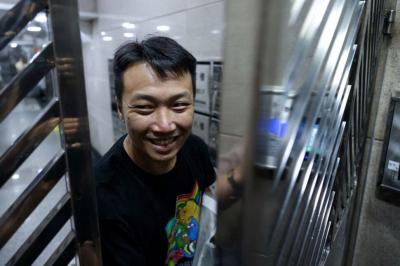
Four people jailed in the landmark Hong Kong national security trial of "47 democrats" accused of conspiracy to commit subversion were freed today after more than four years behind bars, the second group to be released in a month. Among those freed was long-time political and LGBTQ activist Jimmy Sham (岑子杰), who also led one of Hong Kong’s largest pro-democracy groups, the Civil Human Rights Front, which disbanded in 2021. "Let me spend some time with my family," Sham said after arriving at his home in the Kowloon district of Jordan. "I don’t know how to plan ahead because, to me, it feels

Poland is set to hold a presidential runoff election today between two candidates offering starkly different visions for the country’s future. The winner would succeed Polish President Andrzej Duda, a conservative who is finishing his second and final term. The outcome would determine whether Poland embraces a nationalist populist trajectory or pivots more fully toward liberal, pro-European policies. An exit poll by Ipsos would be released when polls close today at 9pm local time, with a margin of error of plus or minus 2 percentage points. Final results are expected tomorrow. Whoever wins can be expected to either help or hinder the
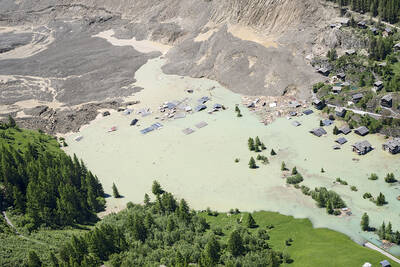
The collapse of the Swiss Birch glacier serves as a chilling warning of the escalating dangers faced by communities worldwide living under the shadow of fragile ice, particularly in Asia, experts said. Footage of the collapse on Wednesday showed a huge cloud of ice and rubble hurtling down the mountainside into the hamlet of Blatten. Swiss Development Cooperation disaster risk reduction adviser Ali Neumann said that while the role of climate change in the case of Blatten “still needs to be investigated,” the wider impacts were clear on the cryosphere — the part of the world covered by frozen water. “Climate change and

DENIAL: Musk said that the ‘New York Times was lying their ass off,’ after it reported he used so much drugs that he developed bladder problems Elon Musk on Saturday denied a report that he used ketamine and other drugs extensively last year on the US presidential campaign trail. The New York Times on Friday reported that the billionaire adviser to US President Donald Trump used so much ketamine, a powerful anesthetic, that he developed bladder problems. The newspaper said the world’s richest person also took ecstasy and mushrooms, and traveled with a pill box last year, adding that it was not known whether Musk also took drugs while heading the so-called US Department of Government Efficiency (DOGE) after Trump took power in January. In a


 RSS
RSS