


Seven years after fleeing Peru, former president Alberto Fujimori was back in Lima on Saturday to face trial on charges of corruption and responsibility in death squad massacres during his rule.
Fujimori, 69, was immediately flown by helicopter to a temporary detention facility at the Special Police Operations Directorate (DIREOS) after landing in Lima following his extradition from Chile.
Fujimori had resigned by fax from a Tokyo hotel in 2000 after a 10-year presidency that ended with a corruption scandal and was followed by a long legal battle by the Peruvian government to secure his extradition.
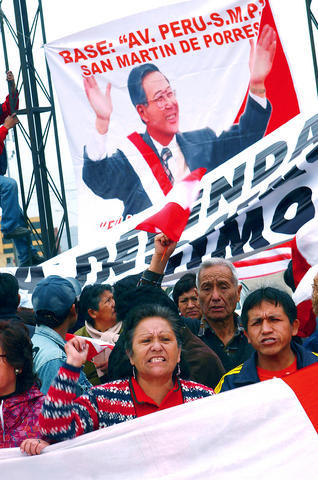
PHOTO: AFP
Japan, which granted him citizenship because his parents were Japanese, refused to send him to Peru, but he landed unexpectedly in Chile's capital Santiago in November 2005 in a bid to make a political comeback.
Chilean authorities kept him under house arrest for the better part of his 22 months there until the Chilean Supreme Court ordered his extradition on Friday on charges that could put him in jail for decades.
At DIREOS headquarters, Fujimori will be held in a special detention facility made with reinforced concrete walls and bullet-proof windows that has a bedroom, a study and a bathroom.
He will be allowed to go out on the patio for two hours a day and will have access to newspapers and magazines but no television. During visits, he will have to speak to his family and attorneys through a window.
Hundreds of "Fujimoristas" had gathered at the Jorge Chavez International Airport to welcome their hero with a banner reading "We Defend the Innocence of Fujimori."
But Fujimori's police airplane landed in a military airport in another part of the capital.
"It was a dirty trick by the government," his daughter, Keiko Fujimori, who is a member of Congress, told the supporters before leaving with a disheartened look.
Peruvian authorities have charged Fujimori with corruption and responsibility in the killings of 15 people in Lima's Barrios Altos neighborhood in 1991 and of nine students and a professor at La Cantuta University in 1992.
The killings were carried out by a death squad composed of military soldiers during the Fujimori government's campaign against the Maoist Shining Path insurgency.
Fujimori drew both praise and criticism during his 1990 to 2000 presidency over his strongarm tactics to crush the Shining Path movement in a war that human rights groups say left 70,000 dead or missing.
He had hoped to make a triumphant political comeback, but now could face up to 30 years behind bars for the human rights cases and 10 years for the corruption charges.
Peruvian Foreign Minister Jose Garcia Belaunde said his government will send a new extradition request to Chile in order to charge Fujimori with ordering the killing of 42 suspected Shining Path members after a prison riot in 1992.
In addition to the human rights cases, the Chilean judges recognized a series of corruption charges, including one over the alleged misuse of US$15 million in public funds.
Fujimori's return could pose a problem for Peruvian President Alan Garcia, whose APRA party, lacking a majority, had a tacit alliance with the 13 "Fujimorista" lawmakers in the 120-member unicameral Congress.
Analysts say Fujimori's detention could test the support of his Alliance for the Future party to the government.
Fujimori, who still enjoys support among the poorest Peruvians, said before departing he hoped for a fair trial and predicted he would be greeted with strong popular support.
"I say that Fujimorism is going to mobilize, it is going to be strong. Fujimorism has deep popular roots. These people are going to support me," he said in an interview with Chile's El Mercurio newspaper.

Former Nicaraguan president Violeta Chamorro, who brought peace to Nicaragua after years of war and was the first woman elected president in the Americas, died on Saturday at the age of 95, her family said. Chamorro, who ruled the poor Central American country from 1990 to 1997, “died in peace, surrounded by the affection and love of her children,” said a statement issued by her four children. As president, Chamorro ended a civil war that had raged for much of the 1980s as US-backed rebels known as the “Contras” fought the leftist Sandinista government. That conflict made Nicaragua one of
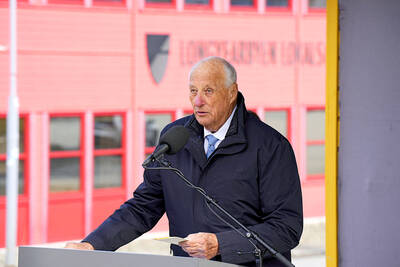
COMPETITION: The US and Russia make up about 90 percent of the world stockpile and are adding new versions, while China’s nuclear force is steadily rising, SIPRI said Most of the world’s nuclear-armed states continued to modernize their arsenals last year, setting the stage for a new nuclear arms race, the Stockholm International Peace Research Institute (SIPRI) said yesterday. Nuclear powers including the US and Russia — which account for about 90 percent of the world’s stockpile — had spent time last year “upgrading existing weapons and adding newer versions,” researchers said. Since the end of the Cold War, old warheads have generally been dismantled quicker than new ones have been deployed, resulting in a decrease in the overall number of warheads. However, SIPRI said that the trend was likely
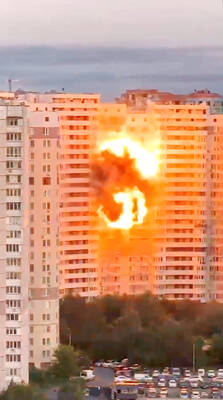
BOMBARDMENT: Moscow sent more than 440 drones and 32 missiles, Volodymyr Zelenskiy said, in ‘one of the most terrifying strikes’ on the capital in recent months A nighttime Russian missile and drone bombardment of Ukraine killed at least 15 people and injured 116 while they slept in their homes, local officials said yesterday, with the main barrage centering on the capital, Kyiv. Kyiv City Military Administration head Tymur Tkachenko said 14 people were killed and 99 were injured as explosions echoed across the city for hours during the night. The bombardment demolished a nine-story residential building, destroying dozens of apartments. Emergency workers were at the scene to rescue people from under the rubble. Russia flung more than 440 drones and 32 missiles at Ukraine, Ukrainian President Volodymyr Zelenskiy
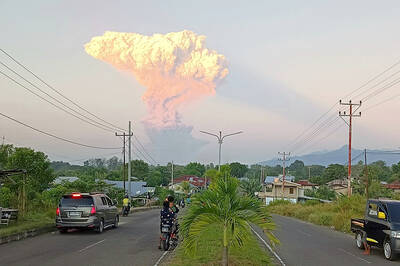
Indonesia’s Mount Lewotobi Laki-Laki yesterday erupted again with giant ash and smoke plumes after forcing evacuations of villages and flight cancelations, including to and from the resort island of Bali. Several eruptions sent ash up to 5km into the sky on Tuesday evening to yesterday afternoon. An eruption on Tuesday afternoon sent thick, gray clouds 10km into the sky that expanded into a mushroom-shaped ash cloud visible as much as 150km kilometers away. The eruption alert was raised on Tuesday to the highest level and the danger zone where people are recommended to leave was expanded to 8km from the crater. Officers also


 RSS
RSS