


A sleek piece of Cold War history was put on display at the CIA yesterday -- the once supersecret A-12 spy plane, which flew higher and faster than any other manned aircraft to spy on North Vietnam and North Korea.
"It was a beautiful airplane," said Ken Collins, a retired air force colonel and one of only six pilots to fly the A-12s.
Collins and other veterans gathered at CIA headquarters to reminisce about aircraft which shattered records for speed and altitude in the secrecy of a 1960s CIA program codenamed Oxcart.
A black, needle-nosed missile of a plane with curved wings that anticipated modern stealth aircraft, the A-12 hit speeds of more than 2,200mph (3,540kph), or more than 3.2 times the speed of sound.
It cruised at altitudes between 80,000 feet (24,400m) and 90,000 feet, so high that the earth's curvature was visible from its cockpit.
"A marvel of aeronautical engineering, the A-12 literally took people's breath away when they first saw it fly," said CIA director Michael Hayden, an air force general.
The aircraft was so fast that it took only about 12 minutes to traverse North Vietnam.
Temperatures on the edge of the cockpit windshield would rise to as high as 680?F (360?C), Collins said.
And as the plane blasted through Mach 2.5, two-and-a-half times the speed of sound, it would be slammed by shock waves so violent that the planes would pitch and yaw, and sometimes stall.
But Collins, who flew six missions over North Vietnam, told reporters "it was a beautiful airplane to land, and just technically a fantastic airplane to fly."
The A-12 on display on the grounds of the CIA -- which was known as "Article 128" -- is one 15 A-12s built. Only nine survive. Five were lost to crashes, and two pilots were killed.
Collins recalled ejecting and parachuting from an A-12 over Utah when a computer failure caused his aircraft to stall, pitch and go "flat upside down."
The A-12 was designed by Lockheed at its famous Skunk Works facility as a successor to the U-2, which had become increasingly vulnerable to Soviet air defense missiles.
"The goal was an aircraft that could outrun any Soviet missile," Hayden said.
They began operations in 1965, but flew combat missions out of Kadena Air Base in Okinawa for only two years before they were retired in 1968.
Ironically, the U-2 is still flying over Iraq and Afghanistan, though even it is now being eclipsed by high-flying drones called Global Hawks.
No A-12s were shot down, even though the Soviet Union learned of the outlines of the program and Russian and Chinese radars were able to track it.
"We were fired at frequently. They could track us. People kept changing our defense systems. But they kept coming up with new stuff," Collins said.
"But they never got the SAM [surface-to-air missiles] high and fast enough to get us. [We were] pretty comfortable up at 85,000 feet at 2,200 miles an hour," he said.
The CIA did not acknowledge the program's existence until 20 years after its last mission, and only this week declassified documents related to the program and published an official history of Oxcart.
Codenamed "Black Shield," the A-12s last missions were flown in 1968 over North Korea after the capture of the USS Pueblo, a US electronic surveillance vessel seized in international waters.
Hayden credited the photographs taken by the A-12s with two key intelligence findings.
Missions in 1967 found that North Vietnam had no surface-to-surface missiles, easing US fears of an escalation.
And an A-12 photographed the USS Pueblo in a North Korean port three days after it was seized on Jan. 23, 1968.

Kouri Richins, a Utah mother who published a children’s book about grief after the death of her husband is to serve a life sentence for his murder without the possibility of parole, a judge ruled on Wednesday. Richins was convicted in March of aggravated murder for lacing a cocktail given to her husband, Eric Richins, with five times the lethal dose of fentanyl at their home near Park City in 2022. A jury also found her guilty of four other felonies, including insurance fraud, forgery and attempted murder for trying to poison her husband weeks earlier on Feb. 14, 2022, with a

‘PERSONAL MISTAKES’: Eileen Wang has agreed to plead guilty to the felony, which comes with a maximum sentence of 10 years in federal prison A southern California mayor has agreed to plead guilty to acting as an illegal agent for the Chinese government and has resigned from her city position, officials said on Monday. Eileen Wang (王愛琳), mayor of Arcadia, was charged last month with one count of acting in the US as an illegal agent of a foreign government. She was accused of doing the bidding of Chinese officials, such as sharing articles favorable to Beijing, without prior notification to the US government as required by law. The 58-year-old was elected in November 2022 to a five-person city council, from which the mayor is selected
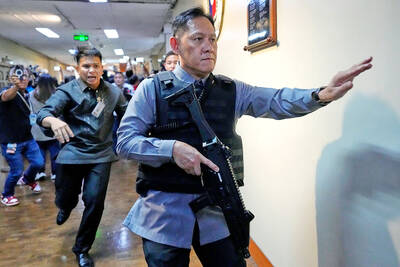
DELA ROSA CASE: The whereabouts of the senator, who is wanted by the ICC, was unclear, while President Marcos faces a political test over the senate situation Philippine authorities yesterday were seeking confirmation of reports that a top politician wanted by the International Criminal Court (ICC) had fled, a day after gunfire rang out at the Philippine Senate where he had taken refuge fearing his arrest. Senator Ronald “Bato” dela Rosa, the former national police chief and top enforcer of former Philippine president Rodrigo Duterte’s “war on drugs,” has been under Senate protection and is wanted for crimes against humanity, the same charges Duterte is accused of. “Several sources confirmed that the senator, Senator Bato, is no longer in the Senate premises, but we are still getting confirmation,” Presidential

HELP DENIED? The US Department of State said that the Cuban leadership refuses to allow the US to provide aid to Cubans, ‘who are in desperate need of assistance’ US Secretary of State Marco Rubio on Wednesday said that Cuba’s leadership must change, as Washington renewed an offer of US$100 million in aid if the communist nation agrees to cooperate. Cuba has been suffering severe economic tumult led by an energy shortage that plunged 65 percent of the country into darkness on Tuesday. Cuba’s leaders have blamed US sanctions, but Rubio, a Cuban American and critic of the government established by Fidel Castro, said the system was to blame, including corruption by the military. “It’s a broken, nonfunctional economy, and it’s impossible to change it. I wish it were different,” he told


 RSS
RSS