


The US military in Iraq said it has captured an insurgent believed linked to the killing of a Sunni tribal leader, as violence killed at least 20 people yesterday after al-Qaeda warned of a bloody Ramadan.
The suspected al-Qaeda fighter was detained near Balad north of Baghdad on Saturday, two days after Sheikh Abdul-Sattar Abu Risha was killed in a car bomb near his home in western Anbar Province, a military statement said.
Abu Risha, a Sunni sheikh, had spearheaded the fight against al-Qaeda in Anbar and was a key ally of the US in its battle against the Iraqi affiliate of Osama bin Laden's jihadist network.
The US military named the detained Iraqi man as Fallah Khalifa Hiyas Fayyas al-Jumayli and said he had also been involved in a plot to kill tribal leaders in Anbar.
"He is also reportedly responsible for car bomb and suicide vest attacks in Anbar Province, and is closely allied with senior al-Qaeda in Iraq leaders in the region," the statement said.
The Islamic State of Iraq, which is affiliated to al-Qaeda, claimed responsibility for Abu Risha's killing in an Internet statement on Friday, and warned it would target all Sunni leaders who support US troops in Iraq.
It also vowed a new offensive during the Muslim holy month of Ramadan.
In Baghdad, the relative calm which had prevailed since the holy month began on Thursday was shattered when a car bomb ripped through crowds outside an electrical goods shopping mall yesterday, killing two people and wounding seven, security and medical officials said.
Insurgents then opened fire on security forces as they rushed to the scene in the mainly Sunni area of Mansour, the officials said. Seven civilians were killed and 12 wounded in the firefights.
Iraq's political landscape too was looking rocky yesterday, following the defection of Shiite cleric Moqtada al-Sadr's political movement from the ruling Shiite coalition head by Iraqi Prime Minister Nuri al-Maliki.
A senior Sadr official said the decision to withdraw the bloc's 32 MPs from the United Iraqi Alliance (UIA) -- announced late on Saturday -- was not aimed, however, at ousting the beleaguered premier.
"We have absolutely no intention of pushing Prime Minister Maliki out," Liwa Sumaysim, head of the political committee of the Sadr group, said in Najaf.
Other Sadr officials complained that Maliki had stopped consulting them over decisions and ordered an inquiry into the movement's Mahdi Army militia, widely blamed for violence during a Shiite pilgrimage in the shrine city of Karbala last month that killed 52 people.
Abbas al-Bayati, a Turkmen Shiite lawmaker and member of the UIA, said the alliance would try to persuade the Sadr bloc to return.
"We will not neglect the Sadr movement and will keep open channels of dialogue with them to listen to them and understand the reasons for their withdrawal," he said.
The UIA initially comprised four key Shiite factions -- the Sadr group, the Supreme Iraqi Islamic Council (SIIC), the Dawa party and the Fadhila party -- and held 130 of the 275 seats in parliament.
However, the number dropped to 115 when the Fadhila party pulled out in March. The Sadr bloc has 32 seats in parliament.
Maliki's government can now only count on the support of 136 lawmakers, including 53 from two Kurdish groups.

Four people jailed in the landmark Hong Kong national security trial of "47 democrats" accused of conspiracy to commit subversion were freed today after more than four years behind bars, the second group to be released in a month. Among those freed was long-time political and LGBTQ activist Jimmy Sham (岑子杰), who also led one of Hong Kong’s largest pro-democracy groups, the Civil Human Rights Front, which disbanded in 2021. "Let me spend some time with my family," Sham said after arriving at his home in the Kowloon district of Jordan. "I don’t know how to plan ahead because, to me, it feels

Poland is set to hold a presidential runoff election today between two candidates offering starkly different visions for the country’s future. The winner would succeed Polish President Andrzej Duda, a conservative who is finishing his second and final term. The outcome would determine whether Poland embraces a nationalist populist trajectory or pivots more fully toward liberal, pro-European policies. An exit poll by Ipsos would be released when polls close today at 9pm local time, with a margin of error of plus or minus 2 percentage points. Final results are expected tomorrow. Whoever wins can be expected to either help or hinder the
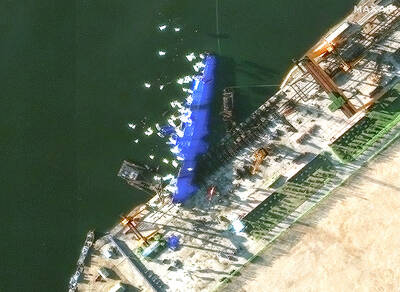
North Korea has detained another official over last week’s failed launch of a warship, which damaged the naval destroyer, state media reported yesterday. Pyongyang announced “a serious accident” at Wednesday last week’s launch ceremony, which crushed sections of the bottom of the new destroyer. North Korean leader Kim Jong-un called the mishap a “criminal act caused by absolute carelessness.” Ri Hyong-son, vice department director of the Munitions Industry Department of the Party Central Committee, was summoned and detained on Sunday, the Korean Central News Agency (KCNA) reported. He was “greatly responsible for the occurrence of the serious accident,” it said. Ri is the fourth person
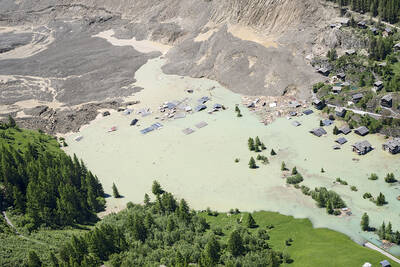
The collapse of the Swiss Birch glacier serves as a chilling warning of the escalating dangers faced by communities worldwide living under the shadow of fragile ice, particularly in Asia, experts said. Footage of the collapse on Wednesday showed a huge cloud of ice and rubble hurtling down the mountainside into the hamlet of Blatten. Swiss Development Cooperation disaster risk reduction adviser Ali Neumann said that while the role of climate change in the case of Blatten “still needs to be investigated,” the wider impacts were clear on the cryosphere — the part of the world covered by frozen water. “Climate change and


 RSS
RSS