


Iraq war commander General David Petraeus is poised to mount a staunch defense of the US troop surge strategy today, in one of the most dramatic appearances of a witness before Congress in years.
The talismanic general faces a hostile barrage from Democrats over if and when troops can come home from a four-year war that has killed more than 3,700 US soldiers, tens of thousands of Iraqis and cost half a trillion US dollars.
Joined by US Ambassador to Baghdad Ryan Crocker, Petraeus will swap Baghdad's stifling heat for cool congressional committee rooms today and tomorrow, to compliment a report on the war which US President George W. Bush must deliver by Saturday.
He will argue the contentious strategy to surge 28,500 extra troops into war-battered Iraq announced in January, has slashed sectarian violence and should be extended.
But he also is expected to accept gradual cuts in the 168,000 strong US garrison in Iraq, beginning early next year -- though the troop reductions he has in mind will likely not satisfy the anti-war Democrats.
"My sense is that we have achieved tactical momentum and wrested the initiative from our enemies in a number of areas of Iraq," Petraeus wrote in a letter to US forces.
But he admitted political reconciliation in Baghdad had not "worked out as we had hoped" though he was optimistic "a stable and secure Iraq" was possible.
Democrats have for months seen Petraeus's testimony as a landmark moment in the war, and hoped to use it to fracture Republican support for Bush.
But they appear to have been outflanked by the White House during last month, and the threat of a Republican revolt seems to have faded.
Democrats will claim sacrifices made by US soldiers were in vain, with no sign the Iraqi government has made the progress that the surge was designed to promote.
Petraeus's expected contention that sectarian violence is receding in Iraq will also be under fire, after a US official auditor cast doubt on the figures on Friday.
Democrats are under pressure from grass roots supporters who helped them capture Congress last year, but slim majorities and Bush's constitutional powers have thwarted their anti-war drive.
Rahm Emanuel, chairman of the House of Representatives Democratic caucus, accused the administration of "cherry-picking" progress in Iraq.
"We don't need a report that wins the Nobel Prize for creative statistics or the Pulitzer for fiction," Emanuel said.
The stage was set for Petraeus by two reports examined in high-stakes congressional hearings last week.
In one, the Government Accountability Office concluded Iraq had failed to meet 11 of 18 benchmarks for political reform.
In a second study, retired marine General James Jones warned US-trained Iraqi forces would not be able to assume combat duties alone for 12 to 18 months.
Faced with such realities, not only Democrats have political concerns -- with congressional elections looming next year, Republicans fear wooing voters while again defending an unpopular war.
Petraeus' testimony will expose chasms in US politics forged by the war.
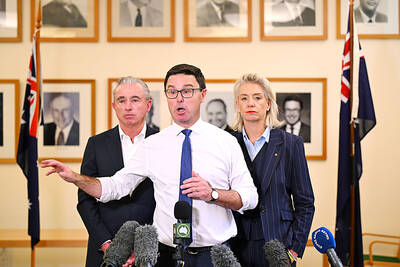
BACKLASH: The National Party quit its decades-long partnership with the Liberal Party after their election loss to center-left Labor, which won a historic third term Australia’s National Party has split from its conservative coalition partner of more than 60 years, the Liberal Party, citing policy differences over renewable energy and after a resounding loss at a national election this month. “Its time to have a break,” Nationals leader David Littleproud told reporters yesterday. The split shows the pressure on Australia’s conservative parties after Prime Minister Anthony Albanese’s center-left Labor party won a historic second term in the May 3 election, powered by a voter backlash against US President Donald Trump’s policies. Under the long-standing partnership in state and federal politics, the Liberal and National coalition had shared power

A Croatian town has come up with a novel solution to solve the issue of working parents when there are no public childcare spaces available: pay grandparents to do it. Samobor, near the capital, Zagreb, has become the first in the country to run a “Grandmother-Grandfather Service,” which pays 360 euros (US$400) a month per child. The scheme allows grandparents to top up their pension, but the authorities also hope it will boost family ties and tackle social isolation as the population ages. “The benefits are multiple,” Samobor Mayor Petra Skrobot told reporters. “Pensions are rather low and for parents it is sometimes

CONTROVERSY: During the performance of Israel’s entrant Yuval Raphael’s song ‘New Day Will Rise,’ loud whistles were heard and two people tried to get on stage Austria’s JJ yesterday won the Eurovision Song Contest, with his operatic song Wasted Love triumphing at the world’s biggest live music television event. After votes from national juries around Europe and viewers from across the continent and beyond, JJ gave Austria its first victory since bearded drag performer Conchita Wurst’s 2014 triumph. After the nail-biting drama as the votes were revealed running into yesterday morning, Austria finished with 436 points, ahead of Israel — whose participation drew protests — on 357 and Estonia on 356. “Thank you to you, Europe, for making my dreams come true,” 24-year-old countertenor JJ, whose

Two people died and 19 others were injured after a Mexican Navy training ship hit the Brooklyn Bridge, New York City Mayor Eric Adams said yesterday. The ship snapped all three of its masts as it collided with the New York City landmark late on Saturday, while onlookers enjoying the balmy spring evening watched in horror. “At this time, of the 277 on board, 19 sustained injuries, 2 of which remain in critical condition, and 2 more have sadly passed away from their injuries,” Adams posted on X. Footage shared online showed the Mexican Navy ship Cuauhtemoc, its sails furled


 RSS
RSS