


Islamic separatist insurgents in southern Thailand have undermined any claims of legitimacy with their widespread deadly attacks on civilians, a respected human-rights group charged in a report issued yesterday.
The New York-based group Human Rights Watch said that the separatists carried out more than 3,000 attacks on civilians from January 2004 through last month. During the same period, they staged some 500 attacks against military personnel and installations, and a similar number against police.
Civilian casualties constitute nearly 90 percent of the more than 2,400 dead and 4,000 people injured as a result of militant attacks, said the group's 104-page report, No One is Safe: Insurgent Attacks on Civilians in Thailand's Southern Border Provinces.
"Militants have carried out a broad campaign of violence and fear, often targeting civilians, killing or injuring large numbers while they were going about their daily activities on the way to work, picking up their children from school, herding cattle, buying food in a market, eating in a restaurant," the report said.
Other civilians were killed by indiscriminate attacks such as bombings aimed at security forces in populated places.
The report suggested that peace may be years away, citing some insurgents as saying that their secretive group has no intention of giving up armed struggle for three to five years, when they believe they will be in a stronger position to hold political negotiations.
"Increasingly, they claim that the southern border provinces are not the land of Buddhist Thais, but a religious `conflict zone' which must be divided between ethnic Malay Muslims and `infidels,'" the report said, explaining that the separatists seek to liberate by force the area they call Patani Darulsalam -- Islamic Land of Patani -- from Buddhist Thai occupation.
Thailand's three southernmost provinces of Yala, Narathiwat and Pattani are the only ones with Muslim majorities in Buddhist-dominated Thailand. The area was annexed by Thailand about a century ago, and southern Muslims have long chafed at government abuses, exploitation and corruption, occasionally launching armed rebellion.
Brad Adams, Asia director at Human Rights Watch, said: "Violence against civilians is being used by separatist militants to scare Buddhist Thais away from these provinces, keep ethnic Malay Muslims under control, and discredit the Thai authorities. But it is illegal and morally indefensible to deliberately target civilians in any circumstances."
Spreading terror seems the main goal of some attacks, the report said, citing at least 29 beheading victims and more than 40 Buddhist Thais and ethnic Malay Muslims who have been hacked to death with machetes over the past 43 months.
The resurgence of large scale separatist militancy, marked by a January 2004 raid on an army depot in Narathiwat was met by government forces "committing serious and widespread abuses against suspected militants and their supporters," the report said.
These included the use of disproportionate force against sometimes unarmed protesters, arbitrary arrests, torture, "disappearances," and extrajudicial killings, all of which further fueled the insurgency, it said.
The insurgents have never publicly announced their identity or goals.
But the report identifies them as village-based militants called Pejuang Kemerdekaan Patani -- Patani Freedom Fighters -- in a loose network known as BRN-Coordinate, or National Revolution Front-Coordinate.
The report said: "Senior members of BRN-Coordinate have told Human Rights Watch that, at present, they are not interested in dialogue with the Thai authorities."
It added that some members said that "they believe that at least three to five more years of the kind of violence that has taken place since 2004 is necessary before they are in a strong enough position to come into public view and participate in any kind of political process."
BRN-Coordinate carries out ideological, political, and military struggle "primarily through a wide network of religious teachers, schools, and students," the report said.

Australians were downloading virtual private networks (VPNs) in droves, while one of the world’s largest porn distributors said it was blocking users from its platforms as the country yesterday rolled out sweeping online age restriction. Australia in December became the first country to impose a nationwide ban on teenagers using social media. A separate law now requires artificial intelligence (AI)-powered chatbot services to keep certain content — including pornography, extreme violence and self-harm and eating disorder material — from minors or face fines of up to A$49.5 million (US$34.6 million). The country also joined Britain, France and dozens of US states requiring

Hungarian authorities temporarily detained seven Ukrainian citizens and seized two armored cars carrying tens of millions of euros in cash across Hungary on suspicion of money laundering, officials said on Friday. The Ukrainians were released on Friday, following their detention on Thursday, but Hungarian officials held onto the cash, prompting Ukraine to accuse Hungary’s Russia-friendly government of illegally seizing the money. “We will not tolerate this state banditism,” Ukrainian Minister of Foreign Affairs Andrii Sybiha said. The seven detained Ukrainians were employees of the Ukrainian state-owned Oschadbank, who were traveling in the two armored cars that were carrying the money between Austria and
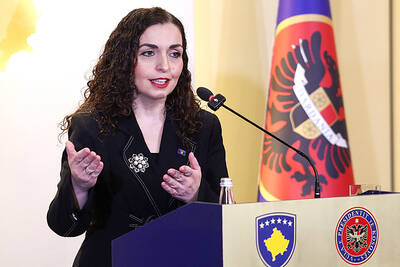
Kosovar President Vjosa Osmani on Friday after dissolving the Kosovar parliament said a snap election should be held as soon as possible to avoid another prolonged political crisis in the Balkan country at a time of global turmoil. Osmani said it is important for Kosovo to wrap up the upcoming election process and form functional institutions for political stability as the war rages in the Middle East. “Precisely because the geopolitical situation is that complex, it is important to finish this electoral process which is coming up,” she said. “It is very hard now to imagine what will happen next.” Kosovo, which declared

MORE BANS: Australia last year required sites to remove accounts held by under-16s, with a few countries pushing for similar action at an EU level and India considering its own ban Indonesia on Friday said it would ban social media access for children under 16, citing threats from online pornography, cyberbullying, online fraud and Internet addiction. “Accounts belonging to children under 16 on high-risk platforms will start to be deactivated, beginning with YouTube, TikTok, Facebook, Instagram, Threads, X, Bigo Live and Roblox,” Indonesian Minister of Communications and Digital Meutya Hafid said. “The government is stepping in so that parents no longer have to fight alone against the giants of the algorithm. Implementation will begin on March 28, 2026,” she said. The social media ban would be introduced in stages “until all platforms fulfill their


 RSS
RSS