


This year's US troop buildup has succeeded in bringing violence in Baghdad down from peak levels, but the death toll from sectarian attacks around the country is running nearly double the pace from a year ago.
Some of the recent bloodshed appears the result of militant fighters drifting into parts of northern Iraq, where they have fled after US-led offensives. Baghdad, however, still accounts for slightly more than half of all war-related killings -- the same percentage as a year ago, according to figures compiled by the Associated Press.
The tallies and trends offer a sobering snapshot after an additional 30,000 US troops began campaigns in February to regain control of the Baghdad area.
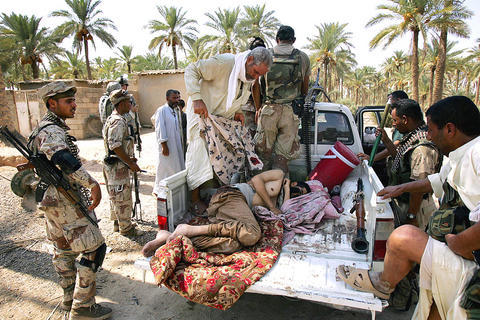
PHOTO: AFP
It also highlights one of the major themes expected in next month's Iraq progress report to the US Congress: Some military headway, but extremist factions are far from broken. In street-level terms, it means life for average Iraqis appears to be even more perilous and unpredictable.
The AP tracking includes Iraqi civilians, officials, police and security forces killed in attacks such as gunfights and bombings, which are frequently blamed on Sunni suicide strikes. It also includes execution-style killings -- largely the work of Shiite death squads.
The figures are considered a minimum based on AP reporting. The true numbers are likely higher, as many killings go unreported or uncounted. Insurgent deaths are not a part of the Iraqi count. The findings include:
Iraq is suffering about double the number of war-related deaths throughout the country compared with last year -- an average daily toll of 33 last year, and 62 so far this year.
Nearly 1,000 more people have been killed in violence across Iraq in the first eight months of this year than in all of last year. So far this year, about 14,800 people have died in war-related attacks and sectarian murders. AP reporting accounted for 13,811 deaths last year. The UN and other sources placed last year's toll far higher.
Baghdad has gone from representing 76 percent of all civilian and police war-related deaths in Iraq in January to 52 percent last month, bringing it back to the same spot it was roughly a year ago.
According to the Iraqi Red Crescent Organization, the number of displaced Iraqis has more than doubled since the start of the year, from 447,337 on Jan. 1 to 1.14 million on July 31.
However, US Brigadier General Richard Sherlock, deputy director for operational planning for the Pentagon's Joint Chiefs of Staff, said violence in Iraq "has continued to decline and is at the lowest level since June 2006." He offered no statistics to back his claim, but in a briefing with reporters at the Pentagon on Friday he warned insurgents might try to intensify attacks in Iraq to coincide with three milestones: the sixth anniversary of the Sept. 11 attacks, the beginning of Ramadan and the report to the US Congress.
The US military did not get all the additional US forces into Iraq until June 15, so it would be premature to draw a final statistical picture of the effect of the surge.
But initial calculations validate fears that the Baghdad crackdown would push militants into districts north of the capital, including Diyala Province where US and Iraqi soldiers have conducted major operation to clear its main city, Baqubah, of al-Qaeda in Iraq fighters.
Last month the AP figures show 35 percent of all war-related killings occurred in northern provinces. Last year it was 22 percent.
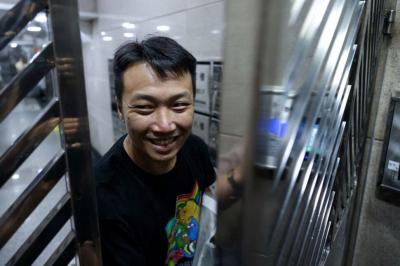
Four people jailed in the landmark Hong Kong national security trial of "47 democrats" accused of conspiracy to commit subversion were freed today after more than four years behind bars, the second group to be released in a month. Among those freed was long-time political and LGBTQ activist Jimmy Sham (岑子杰), who also led one of Hong Kong’s largest pro-democracy groups, the Civil Human Rights Front, which disbanded in 2021. "Let me spend some time with my family," Sham said after arriving at his home in the Kowloon district of Jordan. "I don’t know how to plan ahead because, to me, it feels

Poland is set to hold a presidential runoff election today between two candidates offering starkly different visions for the country’s future. The winner would succeed Polish President Andrzej Duda, a conservative who is finishing his second and final term. The outcome would determine whether Poland embraces a nationalist populist trajectory or pivots more fully toward liberal, pro-European policies. An exit poll by Ipsos would be released when polls close today at 9pm local time, with a margin of error of plus or minus 2 percentage points. Final results are expected tomorrow. Whoever wins can be expected to either help or hinder the
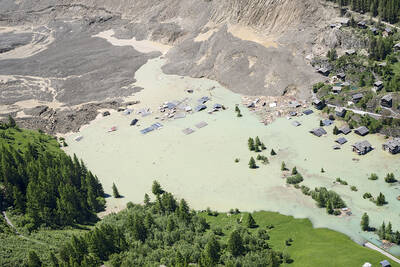
The collapse of the Swiss Birch glacier serves as a chilling warning of the escalating dangers faced by communities worldwide living under the shadow of fragile ice, particularly in Asia, experts said. Footage of the collapse on Wednesday showed a huge cloud of ice and rubble hurtling down the mountainside into the hamlet of Blatten. Swiss Development Cooperation disaster risk reduction adviser Ali Neumann said that while the role of climate change in the case of Blatten “still needs to be investigated,” the wider impacts were clear on the cryosphere — the part of the world covered by frozen water. “Climate change and
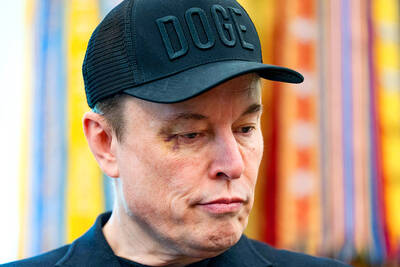
DENIAL: Musk said that the ‘New York Times was lying their ass off,’ after it reported he used so much drugs that he developed bladder problems Elon Musk on Saturday denied a report that he used ketamine and other drugs extensively last year on the US presidential campaign trail. The New York Times on Friday reported that the billionaire adviser to US President Donald Trump used so much ketamine, a powerful anesthetic, that he developed bladder problems. The newspaper said the world’s richest person also took ecstasy and mushrooms, and traveled with a pill box last year, adding that it was not known whether Musk also took drugs while heading the so-called US Department of Government Efficiency (DOGE) after Trump took power in January. In a


 RSS
RSS