


A court ruling this month has thrown the spotlight on what some consider a quintessentially British pastime: streaking, or running around naked in public, preferably with a large crowd watching.
Serial streaker Mark Roberts, 42, managed to avoid a court order banning him from exposing himself at public events last Tuesday.
Over the years, Roberts has stripped off at events including Golf's Ryder Cup, the UEFA and European Cup football finals, the Super Bowl in the US and, more chillingly, the Winter Olympics in Italy.
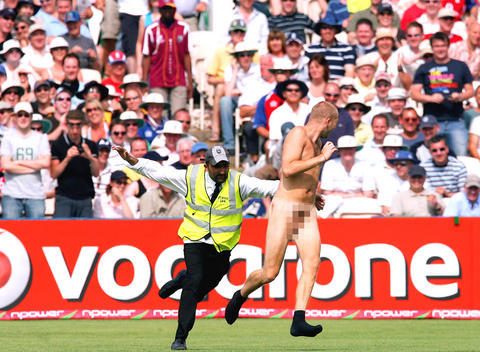
PHOTO: AFP
But he is not the only one: big British sporting events, particularly in the summer, have long been the scene of public clothes-shedding.
"Ever since the kindly Lady Godiva rode naked through the streets to help the people of Coventry, the British have had a soft spot for streakers," the Independent said, alongside a photo spread of top past streaking moments.
These include the almost-iconic picture of 25-year-old Australian accountant Michael O'Brian -- bearded, arms held out by police and with a strategically placed bobby's helmet -- at Twickenham rugby ground in 1974.
Cricket fans were briefly diverted from slow ball action on a stiflingly hot afternoon at Lord's in 1975 when Michael Angelow ran onto the pitch and leapt acrobatically over the stumps, stark naked.
There has even been celebrity streaking. Scottish comedian Billy Connolly stripped off and ran round London's Piccadilly Circus naked as a charity stunt in 2001, watched by over 12 million TV viewers.
Serial streaker Roberts had faced being slapped with an anti-social behavior order after he breached security at the last hole of the British Open Golf Championship last year.
But his lawyer, Laurence Lee, pointed out that his client, who over the years had performed some 380 streaks, had not offended in the past year.
"My client has turned over a new fig leaf. He accepts that some people might be offended," he said.
Judge Nick Sanders rejected the police application with the explanation: "What Mister Roberts does may be annoying but, in my opinion, it does not amount to anti-social behavior."
Speaking afterwards, Roberts was unrepentant.
"I thought it was absolutely ridiculous, accusing me of anti-social behavior. What I do is something totally the opposite. I try to entertain people," he said.
Of course, he enjoys the adrenalin rush. He recalled his first-ever streak in 1993 at the Rugby Sevens in Hong Kong, the result of a drunken bet the night before.
"I ran out onto the pitch and there were 65,000 screaming their heads off with excitement," he said, also recounting being chased by police at half-time in the 2004 Super Bowl.
Doctor Glenn Wilson, of the Institute of Psychiatry in London, said streaking is the result of a basic urge in a certain personality type.
"There is an ancient urge, it's like `daddy, mummy look at me' as a child jumps into a swimming pool. We all crave attention, some more than others," he said.
Also fueling the phenomenon is the premium that is put on fame in the modern world, in particular in the modern celebrity-obsessed culture of countries like Britain, he said.
"Fame equals exposure. It's not a case of great achievements in art or science or the military that counts for fame any more, it is simply exposure in the tabloids or on television," he said.
Not everyone is sure that streaking is entirely harmless, however.
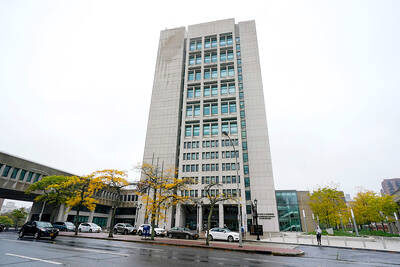
A coalition of civil rights groups on Tuesday asked a New York State judge to order one of its largest suburban counties to stop its deployment of nearly 600 license plate readers, calling it a warrantless and “indiscriminate surveillance system” that violates the state constitution. The class action lawsuit also alleged that Westchester County never got proper authorization to launch the program, which has amassed a database of 1.6 billion plate scans that has been shared with more than 50 outside law enforcement agencies. The complaint said the network “records the long-term travel patterns, daily habits, and intimate information of millions of
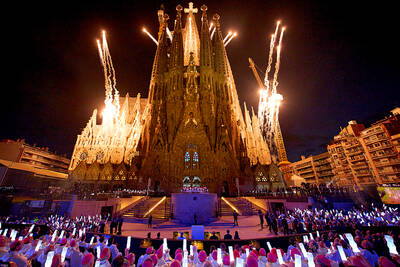
Pope Leo XIV on Wednesday blessed a giant new tower at Barcelona’s famed Sagrada Familia Basilica after celebrating mass inside what is now the world’s tallest church. A fireworks and light show illuminated the exterior of the temple at the end of the ceremony, bathing the unfinished basilica in shifting colours that highlighted its towering spires. A choir of 600 singers performed at the service which lasted around 90 minutes and was attended by Spanish Prime Minister Pedro Sanchez as well as King Felipe VI and Queen Letizia. The stained-glass windows in various colours shone brightly in between the tree-like

Voters in Switzerland yesterday cast their ballots on an initiative championed by the top right-wing party to cap the Alpine country’s population at 10 million. As of press time last night, early results showed that Swiss voters were leaning against it. The populist Swiss People’s Party, which has the most seats in parliament, has stirred up and fostered anti-migration sentiment over the years, notably about an influx of workers from the neighboring EU. Critics called the bid a self-inflicted wound, saying the boom in migration over the past generation has brought foreign labor and skills to sectors such as healthcare, finance, pharmaceuticals

Scientists have discovered communities of marine life — including jellyfish, tubeworms and brittle stars — thriving on a whale graveyard. The graveyards form when whale carcasses fall to the sea floor, becoming a sustaining snack for nearby critters. This one, which is up to 7km below the surface of the southeastern Indian Ocean, spans the largest area, and is so far the deepest found. A whale’s sheer size and the unique chemistry of its bones are the keys to forming these unique underwater neighborhoods, said Song Xikun (宋希坤), a biologist with the Chinese Academy of Sciences’ Institute of Deep-sea Science and Engineering


 RSS
RSS