


Pakistani helicopter gunships launched new assaults yesterday on al-Qaeda and Taliban hideouts in the mountainous northwest as President Pervez Musharraf prepared to address a peace summit in Kabul.
Cobra helicopters killed three suspected militants, pounding what was believed to be their base after a firefight yesterday in Mir Ali town in North Waziristan tribal district, the military said.
"A security convoy was passing when an improvised explosive device planted by militants exploded, causing no harm to the security personnel," chief military spokesman Major General Waheed Arshad said.
"Armed miscreants then attacked security men with automatic weapons that injured a soldier," Arshad said. "In retaliatory firing by helicopters three miscreants were killed."
The continuing violence in the tribal area comes amid a joint tribal gathering organized by Pakistan and the Afghan government in Kabul to discuss ways to counter the al-Qaeda and Taliban threat.
Musharraf canceled his trip on Thursday to the inaugural session of the "peace jirga" which is being attended by around 700 tribal elders from the border regions.
The jirga is scheduled to end today and the foreign ministry in Islamabad said late on Friday the president had agreed "in principle" to address the closing session.
Musharraf's decision to attend the talk-fest followed a conversation with US Secretary of State Condoleezza Rice who telephoned him on Thursday to discuss the jirga as well as reports he was considering imposing a state of emergency, the foreign ministry said.
The turnaround also followed a call late on Friday from Afghan President Hamid Karzai, who again urged him to attend the gathering.
Relations between Karzai and Musharraf have been strained over the resurgence of the Taliban, which was driven from government by a US-led coalition in 2001 after having been helped to power by Pakistan in 1996.
The border regions have become an intense headache for Musharraf, who is facing accusations from Washington and at home that not enough is being done to root out the terrorist presence on the Pakistani side of the border.
He has been angered by the accusations, and suggestions of unilateral US airstrikes on the region.
While the Kabul jirga, brokered by US President George W. Bush during a meeting in Washington in September with Karzai and Musharraf, had meant to bring together representatives of all the tribal regions, elders from two of the most volatile areas boycotted.
North and South Waziristan refused to send delegates, citing the lack of Taliban representation and saying that without all parties to the problem being present, no solution could be reached.
North and South Waziristan, two of Pakistan's seven border tribal areas, have become notorious hideouts for operatives of both the Taliban and al-Qaeda, which use the region to plan assaults in Pakistan, Afghanistan and worldwide.
Pakistani media have reported that Taliban and al-Qaeda operatives intimidate and sometimes murder people who oppose their presence.
Arshad earlier said security forces were focussing on squeezing them out.
"We are responding with greater force against militant attacks on security forces now," Arshad said on Friday. "The action is not being done under any outside pressure. We know al-Qaeda is present in the region, there are Taliban elements and their local supporters and we are acting against them in our own national interest."
Musharraf on Thursday decided not to impose a state of emergency, ignoring the advice of aides who wanted strong action to prevent more instability in the troubled nation.

‘CROSSING THE LINE’: China’s embassy in Seoul criticized US Forces Korea Commander General Xavier Brunson, asking if his ‘hostile’ remarks were authorized by Washington South Korea and the US are in talks over recent public remarks by the commander of US Forces Korea, Seoul’s presidential office said yesterday, after the comments drew sharp criticism from China. In a recent podcast interview, US Forces Korea Commander General Xavier Brunson described South Korea as “the dagger in the heart of Asia” from China’s east coast, prompting the Chinese embassy in Seoul to say that he had “truly crossed the line.” The interview came amid growing speculation that Washington might seek to expand the role of US Forces Korea in countering the growing regional influence of China, a key

Through the noise of rushing papers and whirring belts at a print factory in Kyoto, two creators watch their photo essay come to life in broadsheet form — part of an effort to win new audiences in the age of artificial intelligence (AI). Despite the decline of the publishing industry, self-publication and handmade “zine” magazines are growing in popularity in Japan, reflecting the nation’s enduring love of paper in the digital era. While speaking to Agence France-Presse at the plant, his hands black with ink, one of the creators, Kazuma Obara, said: “I think [paper] is a medium that engages all five

Australian researchers have trained lab-grown brain cells on a silicon computer chip to play the 1990s shooter game Doom and said they are just scratching the surface of what the neurons could be capable of doing. It is the science-fiction work of biotech boffins at Cortical Labs, who researched and developed the technology that harnesses the workings of the brain’s networking system. Each so-called “biological computer” contains about 200,000 living human brain cells, grown from stem cells that were harvested from blood donations. Having mastered the simple computer game Pong, where a paddle is moved up and down to send a ball
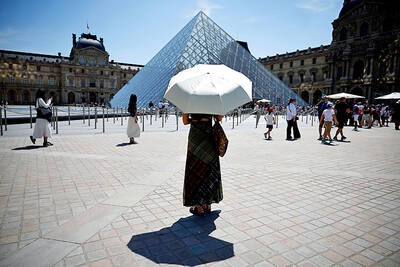
France experienced its hottest spring on record, the French weather service said on Tuesday, after an exceptional early heat wave that also broke highs for the season in England and Wales. Meteo-France said the average nationwide temperature over March to May was 13.8°C — about 1.7°C above the norm, and surpassing records set in 2011 and 2020. “The warmest spring since records began in 1900,” it said in a bulletin. All three months were warmer than average, but the onset of an “unprecedented heatwave” late last month pushed the mercury to highs typically seen at the height of the summer. “Our country had never


 RSS
RSS