


The world of stem-cell research was set reeling two years ago when its most successful practitioner, the South Korean scientist Hwang Woo-suk, was found to have fabricated much of his work. But according to a new post-mortem of his research, he did achieve a scientific first, though not the one he claimed.
Hwang said he had derived embryonic stem cells from the adult cells of a patient, but the claim was discredited after parts of his research were found to have been faked. A team of Boston scientists has re-examined stocks of Hwang's purported embryonic stem cells and arrived at another conclusion bound to make waves among research worldwide: Hwang's embryonic stem cells were the product of parthenogenesis, or virgin birth, meaning they were derived from an unfertilized egg.
A team led by Kitai Kim and George Daley of Children's Hospital Boston reported this conclusion yesterday in the journal Cell Stem Cell.
Embryonic stem cells derived through parthenogenesis cannot develop normally, so they are free of ethical objections. The cells could perhaps help treat degenerative diseases in women capable of supplying eggs, should effective treatments ever be developed.
Other researchers have since developed embryonic stem cells from parthenogenetic eggs, but Hwang's team would have been the first to do so if its members had recognized what they had done.
John Gearhart, a stem-cell expert at Johns Hopkins University who had a ringside view of the Hwang affair as a member of the journal Science's advisory board, said parthenogenesis had always been a possibility.
"I'm delighted there was an explanation that didn't involve fraud," Gearhart said.
Hwang soared to prominence after asserting in a report in Science in 2004 that he had developed embryonic stem cells from a patient, the first hurdle in the idea of rebuilding patients' tissues with their own cells.
He said he had removed the nucleus from an unfertilized human egg and inserted a new nucleus from the adult cell of the patient. The egg developed into an embryo, from which his team claimed to have developed embryonic stem cells.
The editors of Science, the journal that published his claim, later retracted the article because the South Korean committee that investigated Hwang's work found that the supporting data had been faked.
As to the source of Hwang's embryonic stem cells, the South Korean committee said parthenogenesis was possible. But this could not be proved with the methods then available.
Hwang seems unlikely to get much scientific credit for developing embryonic cells via parthenogenesis because he lied in his 2004 article.
"It becomes an historic irony that Hwang was the first to produce the parthenogenetic stem cell but didn't appreciate what he had," Daley said.

Australians were downloading virtual private networks (VPNs) in droves, while one of the world’s largest porn distributors said it was blocking users from its platforms as the country yesterday rolled out sweeping online age restriction. Australia in December became the first country to impose a nationwide ban on teenagers using social media. A separate law now requires artificial intelligence (AI)-powered chatbot services to keep certain content — including pornography, extreme violence and self-harm and eating disorder material — from minors or face fines of up to A$49.5 million (US$34.6 million). The country also joined Britain, France and dozens of US states requiring

ACTIONABLE ADVICE: The majority of chatbots tested provided guidance on weapons, tactics and target selections, with Perplexity and Meta AI deemed to be the least safe From school shootings to synagogue bombings, leading artificial intelligence (AI) chatbots helped researchers plot violent attacks, according to a study published on Wednesday that highlighted the technology’s potential for real-world harm. Researchers from the nonprofit watchdog Center for Countering Digital Hate and CNN posed as 13-year-old boys in the US and Ireland to test 10 chatbots, including ChatGPT, Google Gemini, Perplexity, Deepseek and Meta AI. Eight of the chatbots assisted the make-believe attackers in more than half the responses, providing advice on “locations to target” and “weapons to use” in an attack, the study said. The chatbots had become a “powerful accelerant for
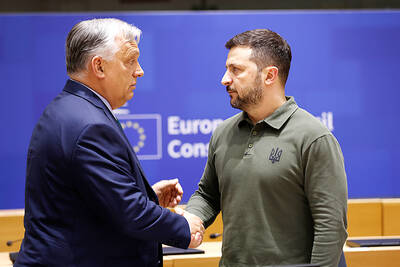
Hungarian authorities temporarily detained seven Ukrainian citizens and seized two armored cars carrying tens of millions of euros in cash across Hungary on suspicion of money laundering, officials said on Friday. The Ukrainians were released on Friday, following their detention on Thursday, but Hungarian officials held onto the cash, prompting Ukraine to accuse Hungary’s Russia-friendly government of illegally seizing the money. “We will not tolerate this state banditism,” Ukrainian Minister of Foreign Affairs Andrii Sybiha said. The seven detained Ukrainians were employees of the Ukrainian state-owned Oschadbank, who were traveling in the two armored cars that were carrying the money between Austria and
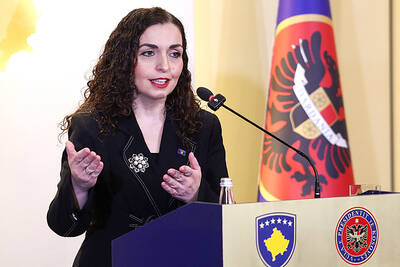
Kosovar President Vjosa Osmani on Friday after dissolving the Kosovar parliament said a snap election should be held as soon as possible to avoid another prolonged political crisis in the Balkan country at a time of global turmoil. Osmani said it is important for Kosovo to wrap up the upcoming election process and form functional institutions for political stability as the war rages in the Middle East. “Precisely because the geopolitical situation is that complex, it is important to finish this electoral process which is coming up,” she said. “It is very hard now to imagine what will happen next.” Kosovo, which declared


 RSS
RSS