


US President George W. Bush's defense chief and top diplomat headed yesterday on a vital mission to the Middle East to seek Arab support for Iraq and discuss weapons sales to regional allies.
Amid growing calls at home to withdraw US forces in Iraq, Secretary of State Condoleezza Rice and Secretary of Defense Robert Gates were also expected to reaffirm Washington's commitment to regional security against possible threats from Iran and its nuclear program.
In addition, Washington is expected to underline concerns that some Sunni Arab nations are offering financial aid to foreign fighters, fueling the insurgency against the fragile Shiite-led, US-backed government in Baghdad.

PHOTO: AFP
On the trip, Rice and Gates will make rare joint visits to Egypt and Saudi Arabia before separate trips to other parts of the region.
US Ambassador to the UN Zalmay Khalilzad complained on Sunday that some neighbors of Iraq, including Saudi Arabia, were undermining efforts to stabilize the war-ravaged nation.
Khalilzad acknowledged on CNN that he was also referring to Saudi Arabia when he wrote in an opinion piece in the New York Times last week that "Several of Iraq's neighbors -- not only Syria and Iran but also some friends of the United States -- are pursuing destabilizing policies."
"Yes, well, there is no question that ... Saudi Arabia and a number of other countries are not doing all they can to help us in Iraq," Khalilzad, the former US ambassador to Iraq, told the US news network.
Washington is particularly concerned that its most powerful Sunni Arab ally, Saudi Arabia, is bankrolling Sunni militants and serving as a conduit for them to stoke the insurgency in Iraq.
Aside from Saudi Arabia, foreign fighters flowing into Iraq via US arch-enemy Syria come from Qatar and Yemen, among other Middle East allies, US officials said earlier this week.
Gates and Rice will "discuss the ways in which Iraq's neighbors can help advance the cause of security and stability in that country," State Department spokesman Sean McCormack said.
The duo "are going to be talking to the Saudis as well as others about what they might do" in supporting the Iraqi government, not only on the security front but also diplomatically and financially, McCormack said.
Their "historical differences and tensions are going to need to be overcome," he said.
In a bid to soothe concerns of the pro-Western Sunni nations worried about Shiite Iran, Washington is also expected to discuss military aid packages and arms sales with them.
The arms deals worth a reported US$20 billion, an administration official said, are aimed at shoring up US allies in the Middle East and countering "a more aggressive Iran."
US allies in the Gulf are "very concerned about what our commitment and the possibility of withdrawal from Iraq means for the region," a Pentagon official said.
Gates will reassure them that "regardless of what happens in the near term in Iraq, that our commitment in the region remains firm, remains steadfast and that in fact we are looking to enhance and develop it."
Meanwhile, Israeli Prime Minister Ehud Olmert announced on Sunday a new US$30 billion US defense package to preserve Israel's regional military superiority.
A senior State Department official said US allies in the Gulf did not trust Washington and were unlikely to commit to any course of action.
"Our credibility is in tatters," the official said, speaking on condition of anonymity.
"That doesn't mean they are not concerned about Iran. It just means they just don't know what we are going to do," the official added.
In Egypt, Rice and Gates are to meet ministers of the Gulf Cooperation Council countries -- Saudi Arabia, the United Arab Emirates, Kuwait, Qatar, Bahrain and Oman -- as well as Jordan and Egypt in the Red Sea resort of Sharm El Sheikh.
Rice will travel separately to Jerusalem and Ramallah for meetings with Israeli and Palestinian officials.

Le Tuan Binh keeps his Moroccan soldier father’s tombstone at his village home north of Hanoi, a treasured reminder of a man whose community in Vietnam has been largely forgotten. Mzid Ben Ali, or “Mohammed” as Binh calls him, was one of tens of thousands of North Africans who served in the French army as it battled to maintain its colonial rule of Indochina. He fought for France against the Viet Minh independence movement in the 1950s, before leaving the military — as either a defector or a captive — and making a life for himself in Vietnam. “It’s very emotional for me,”

The Chinese Communist Party’s (CCP) Central Committee is to gather in July for a key meeting known as a plenum, the third since the body of elite decisionmakers was elected in 2022, focusing on reforms amid “challenges” at home and complexities broad. Plenums are important events on China’s political calendar that require the attendance of all of the Central Committee, comprising 205 members and 171 alternate members with Chinese President Xi Jinping (習近平) at the helm. The Central Committee typically holds seven plenums between party congresses, which are held once every five years. The current central committee members were elected at the
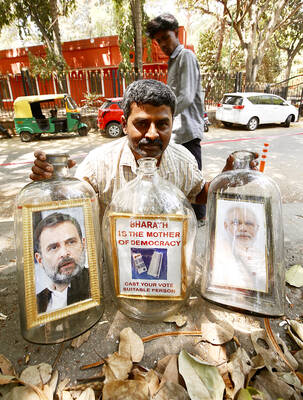
Indian Prime Minister Narendra Modi reaffirmed his pledge to replace India’s religion-based marriage and inheritance laws with a uniform civil code if he returns to office for a third term, a move that some minority groups have opposed. In an interview with the Times of India listing his agenda, Modi said his government would push for making the code a reality. “It is clear that separate laws for communities are detrimental to the health of society,” he said in the interview published yesterday. “We cannot be a nation where one community is progressing with the support of the Constitution while the other

CODIFYING DISCRIMINATION: Transgender people would be sentenced to three years in prison, while same-sex relations could land a person in jail for more than a decade Iraq’s parliament on Saturday passed a bill criminalizing same-sex relations, which would receive a sentence of up to 15 years in prison, in a move rights groups condemned as an “attack on human rights.” Transgender people would be sentenced to three years’ jail under the amendments to a 1988 anti-prostitution law, which were adopted during a session attended by 170 of 329 lawmakers. A previous draft had proposed capital punishment for same-sex relations, in what campaigners had called a “dangerous” escalation. The new amendments enable courts to sentence people engaging in same-sex relations to 10 to 15 years in prison, according to the


 RSS
RSS