


With the clock ticking toward a sundown deadline for the lives of their 23 South Korean hostages, the Taliban said yesterday that a German captive held in Afghanistan was very sick.
The rebel group has called for both Berlin and Seoul to pull their troops out of the war-battered country and for the release of 33 insurgents held prisoner by Afghan authorities.
A deadline set by the Taliban, after which they say they will start killing the South Koreans, expires at 2:30pm GMT. The rebels, remnants of the hardline regime toppled by US-led troops in 2001, have already extended it twice.
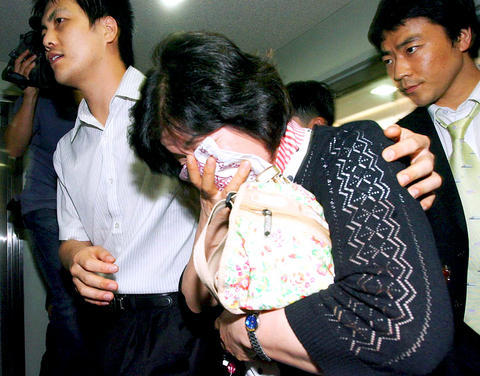
PHOTO: AP
The bullet-riddled body of one of two German hostages seized separately from the Koreans last week was found on a road on Sunday, and Taliban spokesman Yousuf Ahmadi said the second was now drifting in and out of consciousness.
"The German is very badly sick. He has got diabetes," Ahmadi said by telephone from an unknown location.
It was impossible to verify the claim independently.
"Most of the time he's unconscious and we have to carry him on a stretcher from one place to another," Ahmadi said.
He said a deadline on the fate of the German had yet to be decided by Taliban commanders.
Government troops have surrounded the area where the insurgents are believed to be holed up, as Afghan officials have sought to negotiate the release of the largest group of foreign hostages held in the country since 2001.
The Taliban have demanded direct negotiations with a South Korean crisis team that flew into Kabul on Sunday. Seoul has stressed that it will pull out its 200 soldiers serving with a US-led coalition by year's end as planned.
But a police commander involved in the talks said they were faltering.
"The problem is that the Taliban have conflicting demands -- they change or add to their demands every time," said Alishah Ahmadzai, police chief of the southern province of Ghanzi where the Koreans are being held.
He added that they would keepe"negotiating with the abductors to come to common ground to win their release."
Interior ministry spokesman Zemarai Bashary said that authorities were using "different methods and tactics" to secure the release of the hostages, but would not give details, citing security reasons.
In Seoul, President Roh Moo-hyun urged South Koreans to remain calm after the group of young and mainly female Christian aid workers spent a fifth night in captivity.
"I would appreciate if the government, families, those concerned and the public all take a calm and cool-headed attitude in handling this problem," Roh told a Cabinet meeting, according to his office.
"It is not time to be either recklessly optimistic or pessimistic beforehand about the results" of the talks, Roh said.
German Chancellor Angela Merkel has said "it is our mission" to save the country's second hostage but warned that Berlin would "not accept blackmail" from the insurgents, warning that this would be dangerous.
The Taliban have been battling US and NATO-led forces since their 2001 ouster, increasingly using Iraq-style tactics such as kidnappings, remotely triggered roadside bombs and suicide attacks.

‘CROSSING THE LINE’: China’s embassy in Seoul criticized US Forces Korea Commander General Xavier Brunson, asking if his ‘hostile’ remarks were authorized by Washington South Korea and the US are in talks over recent public remarks by the commander of US Forces Korea, Seoul’s presidential office said yesterday, after the comments drew sharp criticism from China. In a recent podcast interview, US Forces Korea Commander General Xavier Brunson described South Korea as “the dagger in the heart of Asia” from China’s east coast, prompting the Chinese embassy in Seoul to say that he had “truly crossed the line.” The interview came amid growing speculation that Washington might seek to expand the role of US Forces Korea in countering the growing regional influence of China, a key

Through the noise of rushing papers and whirring belts at a print factory in Kyoto, two creators watch their photo essay come to life in broadsheet form — part of an effort to win new audiences in the age of artificial intelligence (AI). Despite the decline of the publishing industry, self-publication and handmade “zine” magazines are growing in popularity in Japan, reflecting the nation’s enduring love of paper in the digital era. While speaking to Agence France-Presse at the plant, his hands black with ink, one of the creators, Kazuma Obara, said: “I think [paper] is a medium that engages all five

Australian researchers have trained lab-grown brain cells on a silicon computer chip to play the 1990s shooter game Doom and said they are just scratching the surface of what the neurons could be capable of doing. It is the science-fiction work of biotech boffins at Cortical Labs, who researched and developed the technology that harnesses the workings of the brain’s networking system. Each so-called “biological computer” contains about 200,000 living human brain cells, grown from stem cells that were harvested from blood donations. Having mastered the simple computer game Pong, where a paddle is moved up and down to send a ball

France experienced its hottest spring on record, the French weather service said on Tuesday, after an exceptional early heat wave that also broke highs for the season in England and Wales. Meteo-France said the average nationwide temperature over March to May was 13.8°C — about 1.7°C above the norm, and surpassing records set in 2011 and 2020. “The warmest spring since records began in 1900,” it said in a bulletin. All three months were warmer than average, but the onset of an “unprecedented heatwave” late last month pushed the mercury to highs typically seen at the height of the summer. “Our country had never


 RSS
RSS