


The United Arab Emirates is planning to send troops to Afghanistan to fight alongside Canadians at Ottawa's behest to put a "Muslim face" on the NATO-led coalition, media reported on Friday.
The Toronto Star, citing unnamed sources, said Prime Minister Stephen Harper's government had been urging the tiny Arab nation to contribute soldiers and equipment to help stabilize war-torn Afghanistan.
Canadian authorities were not immediately available to provide comment.
If the report is accurate, the Afghanistan deployment is believed to be a first for an Arab nation and a diplomatic coup for Canada.
The UAE was one of only three countries that recognized the hard-line Taliban government that seized control of most of Afghanistan in 1996 and was forced out in a US-led invasion in late 2001.
The Toronto daily said the UAE tactical force would be small and mostly symbolic, and serve under Canadian commanders once they arrived on the field in Arghanistan.
The UAE could also send a variety of machinery to assist in teh effort. Possibilties include four tanks, several armored reconnaissance vehicles, two self-propelled 155mm guns as well as a detachment of unmanned aerial vehicles, according to a military briefing note obtained by the newspaper.
"The UAE is capable of bringing considerable financial support to development projects and would provide a Muslim face to the International Security Assistance Force operations, providing a counterpoint to insurgent rhetoric," the note said.

Through the noise of rushing papers and whirring belts at a print factory in Kyoto, two creators watch their photo essay come to life in broadsheet form — part of an effort to win new audiences in the age of artificial intelligence (AI). Despite the decline of the publishing industry, self-publication and handmade “zine” magazines are growing in popularity in Japan, reflecting the nation’s enduring love of paper in the digital era. While speaking to Agence France-Presse at the plant, his hands black with ink, one of the creators, Kazuma Obara, said: “I think [paper] is a medium that engages all five

‘CROSSING THE LINE’: China’s embassy in Seoul criticized US Forces Korea Commander General Xavier Brunson, asking if his ‘hostile’ remarks were authorized by Washington South Korea and the US are in talks over recent public remarks by the commander of US Forces Korea, Seoul’s presidential office said yesterday, after the comments drew sharp criticism from China. In a recent podcast interview, US Forces Korea Commander General Xavier Brunson described South Korea as “the dagger in the heart of Asia” from China’s east coast, prompting the Chinese embassy in Seoul to say that he had “truly crossed the line.” The interview came amid growing speculation that Washington might seek to expand the role of US Forces Korea in countering the growing regional influence of China, a key
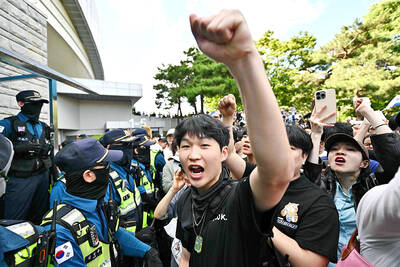
‘ABSURD MISTAKE’: The election commission said that there had been a failure to anticipate turnout after 14 polling stations ran short of ballot papers South Korean riot police yesterday cleared protesters from a Seoul polling station after a 35-hour blockade sparked by a shortage of ballot papers during local elections earlier this week. Wednesday’s election was the first nationwide vote since South Korean President Lee Jae-myung took office following the ouster of Yoon Suk-yeol over his short-lived martial law declaration. Lee’s ruling Democratic Party swept most races, but failed to flip the crucial Seoul mayoral seat. The South Korean National Election Commission apologized, blaming a failure to anticipate turnout after 14 polling stations in Seoul ran short of ballot papers. Some polling stations stayed open until 10pm to

Australian researchers have trained lab-grown brain cells on a silicon computer chip to play the 1990s shooter game Doom and said they are just scratching the surface of what the neurons could be capable of doing. It is the science-fiction work of biotech boffins at Cortical Labs, who researched and developed the technology that harnesses the workings of the brain’s networking system. Each so-called “biological computer” contains about 200,000 living human brain cells, grown from stem cells that were harvested from blood donations. Having mastered the simple computer game Pong, where a paddle is moved up and down to send a ball


 RSS
RSS