


Attorneys for the Roman Catholic Church in Los Angeles and hundreds of people sexually abused by priests were to appear in court on Monday to file a US$660 million settlement, the biggest in US history.
Lawyers for the Los Angeles archdiocese and 508 victims of abuse dating back to the 1940s thrashed out the massive deal on the eve of a potentially explosive court case. However, it must be approved by a Los Angeles Superior Court judge.
The deal is the largest settlement by any Roman Catholic archdiocese to sex abuse victims in the US.
Archdiocese head Cardinal Roger Mahony -- who has been accused by angry victims of attempting to cover up pedophilia cases during his tenure -- told a press conference on Sunday that the cases should never have happened.
"This long journey has now come to an end, and a new chapter of that journey is beginning," Mahony said.
"Once again I apologize to anyone who has been offended, who's been abused by priests, by deacons, by religious men and women or by lay people ... It should not have happened and should not ever happen again."
Mahony said he was haunted by the fact that victims would never be able to reclaim their innocence.
"It is the one part of the settlement process I find so frustrating, because the one thing I wish I could give the victims, I cannot," he said.
Ray Boucher, the lead attorney for the victims, said the settlement was "long overdue."
"Some of the victims have waited more than five decades for a chance at reconciliation and resolution," Boucher said. "This is a down payment on that debt long overdue."
Abuse cases across the country have cost Roman Catholic churches around US$2.1 billion to date. Several priests have been convicted and at least four dioceses have gone bankrupt paying civil penalties.
The Los Angeles church is expected to sell off assets from its estimated US$4 billion in real estate holdings to pay for the settlement.
The church had already settled 46 cases in December for $US60 million.
John Manly, a lawyer who represented around 50 victims who now stand to receive payouts of US$1.2 million to US$1.3 million each, said the archdiocese had settled to avoid the embarrassment of a court case.
Manly said the release of internal documents as part of the settlement would raise questions over the leadership of Mahony.
"I think when people see the documents and see what he knew and what he did they will be stunned," Manly said.
Victims accuse Mahony of allegedly covering up evidence of child molestation by transferring priests to other churches and for trying to keep the abuse reports secret.
"Cardinal Mahony paying out money is great, but where is the accountability from the hierarchy of the church?" Manly said. "They will continue their lives as normal; the victims still have to deal with a lifetime of problems."
Manly questioned why Mahony had not been held to account.
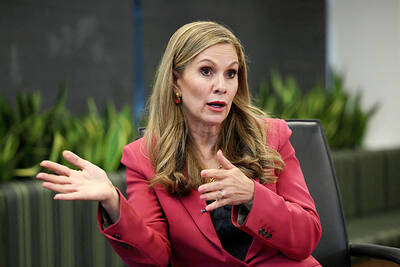
Australians were downloading virtual private networks (VPNs) in droves, while one of the world’s largest porn distributors said it was blocking users from its platforms as the country yesterday rolled out sweeping online age restriction. Australia in December became the first country to impose a nationwide ban on teenagers using social media. A separate law now requires artificial intelligence (AI)-powered chatbot services to keep certain content — including pornography, extreme violence and self-harm and eating disorder material — from minors or face fines of up to A$49.5 million (US$34.6 million). The country also joined Britain, France and dozens of US states requiring
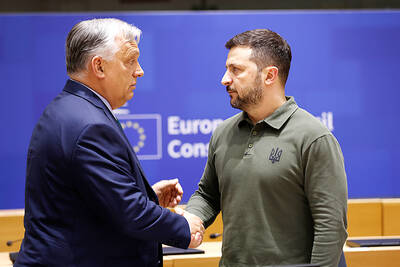
Hungarian authorities temporarily detained seven Ukrainian citizens and seized two armored cars carrying tens of millions of euros in cash across Hungary on suspicion of money laundering, officials said on Friday. The Ukrainians were released on Friday, following their detention on Thursday, but Hungarian officials held onto the cash, prompting Ukraine to accuse Hungary’s Russia-friendly government of illegally seizing the money. “We will not tolerate this state banditism,” Ukrainian Minister of Foreign Affairs Andrii Sybiha said. The seven detained Ukrainians were employees of the Ukrainian state-owned Oschadbank, who were traveling in the two armored cars that were carrying the money between Austria and
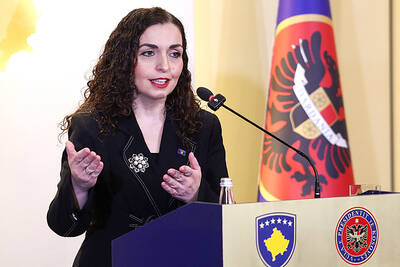
Kosovar President Vjosa Osmani on Friday after dissolving the Kosovar parliament said a snap election should be held as soon as possible to avoid another prolonged political crisis in the Balkan country at a time of global turmoil. Osmani said it is important for Kosovo to wrap up the upcoming election process and form functional institutions for political stability as the war rages in the Middle East. “Precisely because the geopolitical situation is that complex, it is important to finish this electoral process which is coming up,” she said. “It is very hard now to imagine what will happen next.” Kosovo, which declared

MORE BANS: Australia last year required sites to remove accounts held by under-16s, with a few countries pushing for similar action at an EU level and India considering its own ban Indonesia on Friday said it would ban social media access for children under 16, citing threats from online pornography, cyberbullying, online fraud and Internet addiction. “Accounts belonging to children under 16 on high-risk platforms will start to be deactivated, beginning with YouTube, TikTok, Facebook, Instagram, Threads, X, Bigo Live and Roblox,” Indonesian Minister of Communications and Digital Meutya Hafid said. “The government is stepping in so that parents no longer have to fight alone against the giants of the algorithm. Implementation will begin on March 28, 2026,” she said. The social media ban would be introduced in stages “until all platforms fulfill their


 RSS
RSS