

A suicide truck bomber ripped the heart out of a northern Iraqi village yesterday, killing at least 105 people and demolishing dozens of homes and shops, police and medics said.
Ambulances and private cars ferried dozens of bloodied corpses and wounded civilians to clinics in the nearby town of Tuz Khurmatu and the provincial capital Kirkuk, where desperate relatives waited for news of the missing.
Officials were stunned by the scale of the blast, which devastated the main market in Emerli, a small rural community of people from Iraq's Shiite Turkmen minority living in an area notorious for al-Qaeda militants.
"I heard the cries of my child, then I heard nothing else until I woke in hospital," sobbed middle-aged housewife Sukaina Abdul Razak, whose clay brick home collapsed when the blast ripped through the village.
"I don't know the fate of my husband and my family. They were all in the kitchen, but I was in my room," she said, as she was treated for head injuries in Kirkuk's overcrowded emergency room.
Shrapnel from the blast killed shoppers hundreds of meters from its epicenter, wounded grocer Hussein Abu Al-Hussein Akbar Aziz said in Kirkuk.
"We have never seen an attack like that in Emerli. The whole village was shrouded in smoke and dust," he said, grimacing from a leg injury. "I was serving a woman and her child in my shop. They were both killed."
Lieutenant Colonel Saman Hamid, commander of the security coordination center in nearby Tuz Khurmatu, said: "105 Iraqis were killed and five are missing, we have registered their names. There are more than 250 wounded."
The casualty toll was confirmed by Wissam Abdullah, director of the main local hospital, who said the wounded had been taken to at least six emergency rooms up to 100km away around the the region.
The chief local civilian administrator, Hamad Rasheed, said he had seen reports that up to 125 people could be confirmed dead after rescuers finish digging through the rubble of dozens of buildings.
"The security reports that I have received from the scene confirm that 115 were killed, five are missing and around five more were collected as loose flesh. Some 40 homes, 20 shops and 10 vehicles were destroyed," Rasheed said.
"The corpses were under the debris of the collapsed buildings. Some were burnt and others were torn apart. This is a big disaster for the town, all of the casualties were civilians," he said.
Abdullah said the dead and wounded had been brought to the emergency room at his hospital in Tuz Khurmatu, to two hospitals in the provincial capital Kirkuk and two more as far away as the Kurdish city of Sulaimaniyah.
The attack was the deadliest to hit Iraq since since April 18, when 190 people were killed in a spate of car bombings against Shiite districts of Baghdad.
Police Captain Nuzad Abdallah said the early morning attack occurred when the market was crowded with people. Three children were brought alive out of the debris but died before they could be taken for medical treatment.
Another car bomb attack against a military checkpoint in Baghdad killed at least three people and wounded 10, medics at the city's Ibn Nafees hospital said. A defense official said up to six people could have been killed.
The bombings came as the US military announced the deaths of eight soldiers over the previous two days and the British of two, and against a backdrop of mounting domestic opposition to the international troop presence.
Iraq is in the grip of several overlapping conflicts between religious and political factions, but the suicide car bomb is a hallmark of Sunni extremists such as those affiliated with al-Qaeda or Ansar al-Sunna.
The attacks appear designed to foment sectarian and ethnic violence and undermine Iraqi Prime Minister Nouri al-Maliki's coalition government, which is working with US forces to quell the fighting.

Former British prime minister Rishi Sunak on Wednesday urged so-called middle powers to become a “poisonous shrimp” to carve out strategic economic leverage in a more turbulent global environment. Sunak drew from a metaphor by former Singaporean prime minister Lee Kuan Yew (李光耀): A big fish will eat a smaller fish, and the smaller fish will eat the shrimp. Lee made the point a year after the Asian nation’s independence in 1966 that the city-state needed to build up its defense mechanisms — like a shrimp that stings — so it would be left alone by predators. “He was thinking about what Singapore’s

POLL POSITION: Democrats criticized the timing of the raid, saying that the US justice department historically avoids public investigations within 60 days of an election Federal agents on Monday searched the home of Democratic US Representative Ilhan Omar, a startling escalation in a criminal investigation that brings renewed focus to the frequent target of White House derision in the final weeks of her re-election bid. The search of the Minnesota congresswoman’s home so close to next month’s midterm contests that would determine control of the US House and the Senate was swiftly condemned by top Democrats in Congress, who raised questions about the timing given longstanding US Department of Justice (DOJ) protocol to avoid overt investigative steps involving political candidates in the direct run-up to an
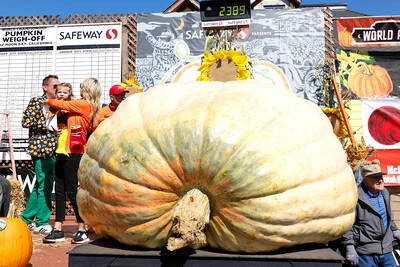
A Rhode Island pumpkin grower appears to have broken the world record for the heaviest pumpkin, with his giant squash topping the record by nearly 136kg. Ron Wallace of Greene, Rhode Island, weighed his pumpkin on Saturday at a contest in New England and is waiting for the Guinness World Records to confirm he smashed the record, set about a week earlier by a grower in England. Wallace said he has been in contact with Guinness officials who say his record is on track to be verified. “It’s truly massive, it was a pleasure to grow,” Wallace said on Monday. Guinness World Records lists
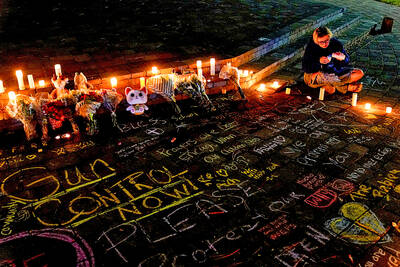
A 16-year-old on Thursday shot his way through locked doors to get into an elementary school in Bend, Oregon, killing three children and a teacher. He was then shot by a person at the scene who followed him inside, authorities said. The suspect was found dead inside the school minutes after the shooting was first reported, Bend Police Chief Mike Krantz said. The three children killed were aged 5, 8 and 11. Another child, 7, and a teacher, 54, were injured and taken to the hospital in critical condition, he said. The first 911 call came just before 1pm from a person in


 RSS
RSS