


Warrior horsemen who once struck fear into the hearts of nomads and czars alike, Russia's Cossacks are looking to seize power again -- this time through peaceful means.
In newly opened schools scattered across their historic homeland in Russia's south, young Cossacks are learning spectacular horse riding and sword fighting techniques in an attempt to revive a culture smothered by decades of Bolshevik repression.
"We did not succeed in seizing power in our traditional homeland when we had the chance" after the Soviet collapse, said Colonel Yury Dyakov, a top official in the Don Cossack leadership.
"Today we have another objective, to create an elite cadre to claim political power through civilized means," he said.
Emerging in the southern steppe in the 16th century, the Cossacks were former slaves who turned to militarism to survive on the Russian frontier.
Developing into armed groups who served the czars in colonizing Siberia and the Far East, the Cossacks were later crushed as counterrevolutionaries by the Bolsheviks after the 1917 Revolution.
Today there are officially 600,000 Cossacks in Russia -- spread across their traditional lands along the Volga, Dnepr and Terek rivers and in the Ural mountains -- although their leaders claim there are 10 times more.
The Don Cossacks alone boast 150,000 members, and a Cossack leader, or ataman, is deputy to the governor of the surrounding Rostov region.
To shore up their ancient culture, the Cossacks have opened six schools in the Rostov area since 1991 to hone a new generation of warriors. Some 1,500 boys aged 10 to 17 attend.
The corridors of the Alexander III school in Novocherkassk are again teeming with young Cossacks after an earlier generation of students was sent into exile 80 years ago.
Today the uniformed boarders wake at 6:30am and file to the canteen for a prayer and a modest breakfast.
"We prepare these young people to serve the state and the fatherland. Our objective is to form Russia's future elite," said principal Yury Fileyev, a former officer.
In addition to the ordinary Russian curriculum, the 300 boys study Cossack culture, Orthodox religion and the legendary riding and weapons skills of their forefathers.
"When I am older, I will become a soldier and defend my motherland," said Pasha Fyodorov, 13, who like many of his schoolmates hopes to continue in a military university.
Entry to the Cossack schools is tough, with as many as 10 boys competing for each place in a battery of physical and personality tests.
When they graduate, many follow their czarist ancestors in serving the government in Moscow.
Some 1,200 Don Cossacks are involved in law enforcement in Rostov region, after a 2005 federal law provided the legal foundation for their service in the army and police force, said Dyakov, senior Don Cossack official for military liaisons.
"Our men also serve in the special forces, the Northern and Black Sea fleets and in the presidential regiment in Moscow," he said.
Alongside the Cossack tradition of service to the state is a reputation for brutality they earned while fighting ethnic minorities on Russia's borders.
After the Soviet collapse, Cossack volunteers reclaimed their military heritage, fighting alongside pro-Russian separatists in Moldova's Transdnestr and Georgia's Abkhazia and Ossetia regions, as well as battling the independence movement in the Russian province of Chechnya.
There is no ethnic requirement to enter the Cossack academy, but those recruited are expected to be Orthodox believers, Dyakov said, noting that there was a group of Cossacks in his region from Armenia, an Orthodox ally of Russia.
Over the years the Cossacks have occasionally challenged the leadership in Moscow, with some Cossack regiments rebelling against Nicholas II in 1917.
Today's Don Cossacks are clear about where their allegiance lies.
"We work closely with United Russia," the fiercely pro-Kremlin party of power, said Igor Kazarezov, deputy to the region's top ataman, as a large photograph of Russian President Vladimir Putin loomed above him.
"We support the policies of President Putin," he said.
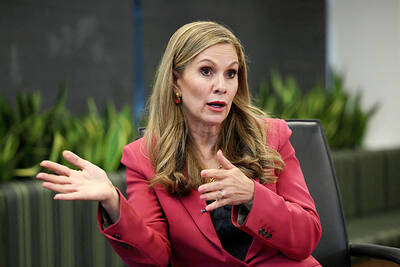
Australians were downloading virtual private networks (VPNs) in droves, while one of the world’s largest porn distributors said it was blocking users from its platforms as the country yesterday rolled out sweeping online age restriction. Australia in December became the first country to impose a nationwide ban on teenagers using social media. A separate law now requires artificial intelligence (AI)-powered chatbot services to keep certain content — including pornography, extreme violence and self-harm and eating disorder material — from minors or face fines of up to A$49.5 million (US$34.6 million). The country also joined Britain, France and dozens of US states requiring
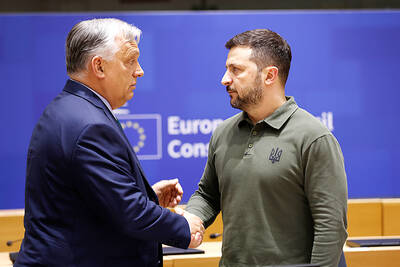
Hungarian authorities temporarily detained seven Ukrainian citizens and seized two armored cars carrying tens of millions of euros in cash across Hungary on suspicion of money laundering, officials said on Friday. The Ukrainians were released on Friday, following their detention on Thursday, but Hungarian officials held onto the cash, prompting Ukraine to accuse Hungary’s Russia-friendly government of illegally seizing the money. “We will not tolerate this state banditism,” Ukrainian Minister of Foreign Affairs Andrii Sybiha said. The seven detained Ukrainians were employees of the Ukrainian state-owned Oschadbank, who were traveling in the two armored cars that were carrying the money between Austria and
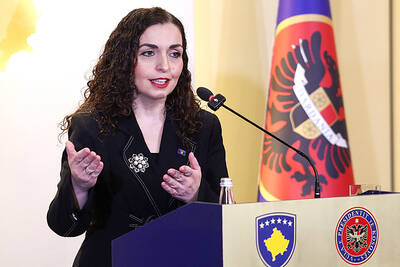
Kosovar President Vjosa Osmani on Friday after dissolving the Kosovar parliament said a snap election should be held as soon as possible to avoid another prolonged political crisis in the Balkan country at a time of global turmoil. Osmani said it is important for Kosovo to wrap up the upcoming election process and form functional institutions for political stability as the war rages in the Middle East. “Precisely because the geopolitical situation is that complex, it is important to finish this electoral process which is coming up,” she said. “It is very hard now to imagine what will happen next.” Kosovo, which declared

MORE BANS: Australia last year required sites to remove accounts held by under-16s, with a few countries pushing for similar action at an EU level and India considering its own ban Indonesia on Friday said it would ban social media access for children under 16, citing threats from online pornography, cyberbullying, online fraud and Internet addiction. “Accounts belonging to children under 16 on high-risk platforms will start to be deactivated, beginning with YouTube, TikTok, Facebook, Instagram, Threads, X, Bigo Live and Roblox,” Indonesian Minister of Communications and Digital Meutya Hafid said. “The government is stepping in so that parents no longer have to fight alone against the giants of the algorithm. Implementation will begin on March 28, 2026,” she said. The social media ban would be introduced in stages “until all platforms fulfill their


 RSS
RSS