


Elder statesman Shimon Peres was elected Israel's ninth president yesterday in a race that capped his six-decade political career, but was overshadowed by rape allegations against the sitting president.
Peres, of the ruling Kadima Party, won the support of 86 of parliament's 120 members in a second round of yea-or-nay voting in which he stood alone. His two rivals, Reuven Rivlin of the hawkish Likud and Colette Avital of the centrist Labor, withdrew from the race after he seized a commanding lead in the first round.
The new president, an 83-year-old Nobel Peace Prize winner who has held all of Israel's top civilian posts, but failed in all his bids for elected office, is to be sworn into office on July 15 for a seven-year term.
In a speech to lawmakers following his victory, Peres said he saw his new role as a unifier of Israel's fractured society.
"The president's role is not to deal with politics and partisanship, but to represent what unites us in a strong voice," he said.
Peres had been seen as a shoo-in to win the post in 2000 -- only to lose in a stunning upset to the now-disgraced Moshe Katsav, a political backbencher with the blessing of a prominent rabbi.
The office of president, conceived as a ceremonial post held by a prominent statesman or thinker, has been tainted by allegations that Katsav raped or otherwise sexually assaulted four women employees.
Katsav has not been formally charged, pending a final hearing before the attorney general, but has stepped down temporarily to fight the allegations.
Israelis hope that Peres, with his international stature, will be able to rehabilitate the position.
Speaking at parliament ahead of the vote, Prime Minister Ehud Olmert said "the history, actions and contributions of Shimon Peres to the State of Israel" made him "a model" for the ideal presidential candidate.
A top aide to Israel's first prime minister, David Ben-Gurion, Peres was elected to parliament in 1959, then held a series of top posts, including the premiership, as well as minister of defense, finance and foreign affairs. He served as prime minister in a caretaker role in the 1970s, and once in the 1980s under a rotation agreement with political opponent Yitzhak Shamir after a general election failed to produce a clear winner. He served in the post again in the 1990s after Yitzhak Rabin was assassinated.
BARAK'S COMEBACK
In other developments, former prime minister Ehud Barak won the leadership of the dovish Labor Party yesterday in a dramatic political comeback -- six years after was tossed out of office in a humiliating election defeat.
Barak, 65, a former commando and army chief of staff who is the nation's most decorated soldier, faced off in Tuesday's race against political newcomer Ami Ayalon, a former navy commander and head of Israel's internal security service.
Barak won by a margin of 6 percentage points, party officials announced early yesterday.
At a victory gathering early yesterday at party headquarters in Tel Aviv, Barak called for unity and pledged to restore Israel's military might and deterrent power. He also pledged a policy that "combines uncompromising security, protecting Israel's solidarity and democracy, a determined pursuit of real peace, the reinforcement of the rule of law and healing Israeli society."
Barak is unlikely to immediately pull Labor out of its partnership in Olmert's coalition. He is expected to become defense minister.

A humanoid robot that won a half-marathon race for robots in Beijing on Sunday ran faster than the human world record in a show of China’s technological leaps. The winner from Honor, a Chinese smartphone maker, completed the 21km race in 50 minutes and 26 seconds, said a WeChat post by the Beijing Economic-Technological Development Area, also known as Beijing E-Town, where the race began. That was faster than the human world record holder, Ugandan Jacob Kiplimo, who finished the same distance in about 57 minutes in March at the Lisbon road race. The performance by the robot marked a significant step forward
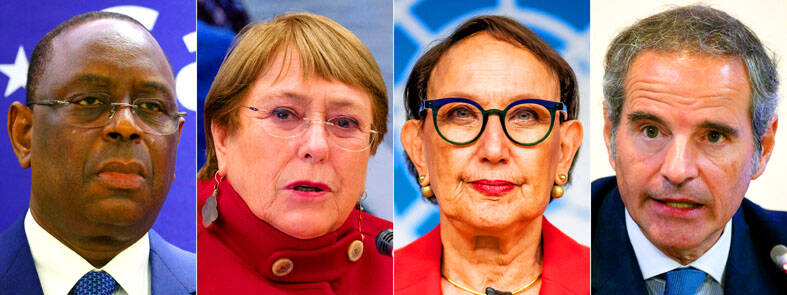
Four contenders are squaring up to succeed Antonio Guterres as secretary-general of the UN, which faces unprecedented global instability, wars and its own crushing budget crisis. Chile’s Michelle Bachelet, Argentina’s Rafael Grossi, Costa Rica’s Rebeca Grynspan and Senegal’s Macky Sall are each to face grillings by 193 member states and non-governmental organizations for three hours today and tomorrow. It is only the second time the UN has held a public question-and-answer, a format created in 2016 to boost transparency. Ultimately the five permanent members of the UN’s top body, the Security Council, hold the power, wielding vetoes over who leads the

An earthquake registering a preliminary magnitude of 7.7 off northern Japan on Monday prompted a short-lived tsunami alert and the advisory of a higher risk of a possible mega-quake for coastal areas there. The Cabinet Office and the Japan Meteorological Agency said there was a 1% chance for a mega-quake, compared to a 0.1% chance during normal times, in the next week or so following the powerful quake near the Chishima and Japan trenches. Officials said the advisory was not a quake prediction but urged residents in 182 towns along the northeastern coasts to raise their preparedness while continuing their daily lives. Prime
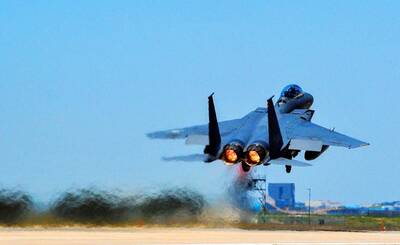
South Korea’s air force yesterday apologized for a 2021 midair collision involving two fighter jets, a day after auditors said the pilots were taking selfies and filming during the flight and held them responsible for the accident. “We sincerely apologize to the public for the concern caused by the accident that occurred in 2021,” an air force spokesman told a news conference, adding that one of the pilots involved had been suspended from flying duties, received severe disciplinary action and has since left the military. The apology followed a report released on Wednesday by the South Korean Board of Audit and Inspection,


 RSS
RSS