


For years, Brazil's government has gotten into the Carnival spirit by handing out tens of millions of free condoms on the streets.
Now the world's largest Roman Catholic country is helping to make birth control pills more affordable, subsidizing a program that will allow people to buy a year's supply for about US$2.40.
Weeks after Pope Benedict XVI used a five-day visit to the nation to denounce government-backed contraception efforts, Brazilian President Luiz Inacio Lula da Silva announced the new program to give masses of poor Brazilians access to birth control pills that better-off citizens take for granted.
"It gives them the same right that the wealthy have to plan the number of children they want," Silva told about 150 doctors and women's rights advocates on Monday.
Brazil already hands out free birth control pills at government-run pharmacies. But many poor people don't go to those pharmacies, so Silva's administration decided to offer the pills at drastically reduced prices at private drug stores, Health Minister Jose Gomes Temporao said.
Under the new program, anyone can buy the pills by simply showing a government-issued identification card that almost all Brazilians carry. The number of outlets selling the pills will start at 3,500 and is expected to rise to 10,000 by the end of this year.
When the US$51 million program is fully under way, the government expects to be handing out 50 million packages of birth control pills each year.
Each government-subsidized package -- with enough pills to last a month -- will cost 0.40 Brazilian reals (US$0.20). They now retail for 5 reals to 50 reals.
The Health Ministry said it does not plan to subsidize condoms at private drug stores, but Brazil already distributes 254 million free condoms a year, many as part of an anti-AIDS program, with a special push just before Carnival celebrations.
Temporao also said the government plans to increase the number of free vasectomies performed at state hospitals.
During his visit to Brazil earlier this month, Benedict repeatedly railed against legalized contraception as a threat to "the future of the peoples" of Latin America.
But advocates for women's rights applauded Silva's decision, saying it was long overdue, although some worried whether Brasilia would follow through.
"Too often, Brazil makes really wonderful laws that remain on paper because there is no political will," said Mary Luci Faria, who coordinates women's programs in Sao Paulo.
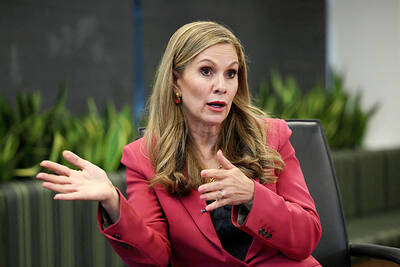
Australians were downloading virtual private networks (VPNs) in droves, while one of the world’s largest porn distributors said it was blocking users from its platforms as the country yesterday rolled out sweeping online age restriction. Australia in December became the first country to impose a nationwide ban on teenagers using social media. A separate law now requires artificial intelligence (AI)-powered chatbot services to keep certain content — including pornography, extreme violence and self-harm and eating disorder material — from minors or face fines of up to A$49.5 million (US$34.6 million). The country also joined Britain, France and dozens of US states requiring
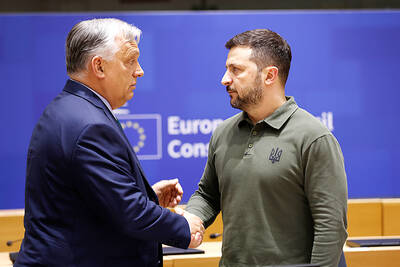
Hungarian authorities temporarily detained seven Ukrainian citizens and seized two armored cars carrying tens of millions of euros in cash across Hungary on suspicion of money laundering, officials said on Friday. The Ukrainians were released on Friday, following their detention on Thursday, but Hungarian officials held onto the cash, prompting Ukraine to accuse Hungary’s Russia-friendly government of illegally seizing the money. “We will not tolerate this state banditism,” Ukrainian Minister of Foreign Affairs Andrii Sybiha said. The seven detained Ukrainians were employees of the Ukrainian state-owned Oschadbank, who were traveling in the two armored cars that were carrying the money between Austria and
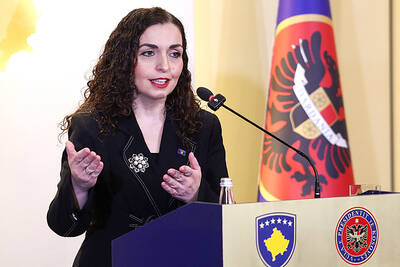
Kosovar President Vjosa Osmani on Friday after dissolving the Kosovar parliament said a snap election should be held as soon as possible to avoid another prolonged political crisis in the Balkan country at a time of global turmoil. Osmani said it is important for Kosovo to wrap up the upcoming election process and form functional institutions for political stability as the war rages in the Middle East. “Precisely because the geopolitical situation is that complex, it is important to finish this electoral process which is coming up,” she said. “It is very hard now to imagine what will happen next.” Kosovo, which declared

MORE BANS: Australia last year required sites to remove accounts held by under-16s, with a few countries pushing for similar action at an EU level and India considering its own ban Indonesia on Friday said it would ban social media access for children under 16, citing threats from online pornography, cyberbullying, online fraud and Internet addiction. “Accounts belonging to children under 16 on high-risk platforms will start to be deactivated, beginning with YouTube, TikTok, Facebook, Instagram, Threads, X, Bigo Live and Roblox,” Indonesian Minister of Communications and Digital Meutya Hafid said. “The government is stepping in so that parents no longer have to fight alone against the giants of the algorithm. Implementation will begin on March 28, 2026,” she said. The social media ban would be introduced in stages “until all platforms fulfill their


 RSS
RSS