


US special forces operations that killed 90 Afghan civilians have caused friction with the US' NATO partners, who are concerned that such deaths hurt the standing of Western troops fighting the Taliban insurgency.
The deaths involved troops from the 12,000-member US-led coalition and not NATO's 37,000-member International Security Assistance Force, but NATO officials fear that Afghans and others don't understand the distinction.
Mounting civilian casualties have already dented support for the international mission, sparking angry demonstrations and a warning from Afghan President Hamid Karzai that Afghans can no longer accept them.
PHOTO: AFP
German Defense Minister Franz Josef Jung said on Wednesday that the operations by US-led troops show the need for restraint.
"We have to do everything to avoid civilians from being affected," Jung said on Germany's ZDF television. "We are in talks with our American friends about this."
Insurgency-related violence has spiked this year, with more than 1,800 people killed, according to an Associated Press count based on US, NATO and Afghan reports.
They include about 135 civilians killed by US or NATO action, a figure that also could undermine support in Western countries, especially in Europe, for the deployment. About 135 civilians have also been killed by Taliban suicide bombs and attacks.
NATO's counterinsurgency strategy focuses on separating fighters from the general population and strengthening the Afghan government. The US-led coalition's counterterrorism mission involves taking out al-Qaeda or Taliban leaders and cells of skilled fighters.
While troops from the two missions communicate often and at times work together, they operate under different command structures and don't always coordinate.
US operations have created "a fallout that is negative because the collateral damage and particularly the civilian casualties are seen as unduly high, certainly by the Afghan people. This is of concern to us," said Daan Everts, the senior NATO civilian in Afghanistan.
Everts said there is not a "complete disconnect" between the coalition and ISAF, but that there is "room for more coordination and consultation that would prevent possible mishaps."
Reports of killing Taliban militants are often received badly in European capitals where officials want to sell the mission as reconstruction and development, not just military might.
NATO Secretary General Jaap de Hoop Scheffer alluded to possible fissures in the 26-member alliance at a news conference with US President George W. Bush on Monday, saying Afghanistan is a front line in the fight against terrorism "that should not become a fault line."
Bush said that the Taliban like "to surround themselves with innocent civilians."
"Obviously, to the extent that the United States is working with our NATO allies in combat, we care deeply about protecting innocent life," Bush said.

Through the noise of rushing papers and whirring belts at a print factory in Kyoto, two creators watch their photo essay come to life in broadsheet form — part of an effort to win new audiences in the age of artificial intelligence (AI). Despite the decline of the publishing industry, self-publication and handmade “zine” magazines are growing in popularity in Japan, reflecting the nation’s enduring love of paper in the digital era. While speaking to Agence France-Presse at the plant, his hands black with ink, one of the creators, Kazuma Obara, said: “I think [paper] is a medium that engages all five
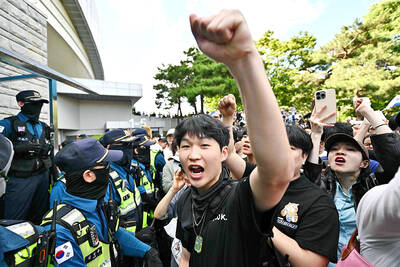
‘ABSURD MISTAKE’: The election commission said that there had been a failure to anticipate turnout after 14 polling stations ran short of ballot papers South Korean riot police yesterday cleared protesters from a Seoul polling station after a 35-hour blockade sparked by a shortage of ballot papers during local elections earlier this week. Wednesday’s election was the first nationwide vote since South Korean President Lee Jae-myung took office following the ouster of Yoon Suk-yeol over his short-lived martial law declaration. Lee’s ruling Democratic Party swept most races, but failed to flip the crucial Seoul mayoral seat. The South Korean National Election Commission apologized, blaming a failure to anticipate turnout after 14 polling stations in Seoul ran short of ballot papers. Some polling stations stayed open until 10pm to

Australian researchers have trained lab-grown brain cells on a silicon computer chip to play the 1990s shooter game Doom and said they are just scratching the surface of what the neurons could be capable of doing. It is the science-fiction work of biotech boffins at Cortical Labs, who researched and developed the technology that harnesses the workings of the brain’s networking system. Each so-called “biological computer” contains about 200,000 living human brain cells, grown from stem cells that were harvested from blood donations. Having mastered the simple computer game Pong, where a paddle is moved up and down to send a ball

France experienced its hottest spring on record, the French weather service said on Tuesday, after an exceptional early heat wave that also broke highs for the season in England and Wales. Meteo-France said the average nationwide temperature over March to May was 13.8°C — about 1.7°C above the norm, and surpassing records set in 2011 and 2020. “The warmest spring since records began in 1900,” it said in a bulletin. All three months were warmer than average, but the onset of an “unprecedented heatwave” late last month pushed the mercury to highs typically seen at the height of the summer. “Our country had never


 RSS
RSS