


China is studying how it can control who takes power in Hong Kong when the city switches to full democracy, a media report said yesterday, highlighting Beijing's fears for reform.
The Ta Kung Pao said Chinese Communist Party bosses were looking into an electoral system where it would nominate a slate of candidates to prevent victory by anyone deemed "unacceptable" and avoid a constitutional crisis.
RIGHTS RESERVED
China must reserve the "most important" right to appoint a chief executive and important officials for Hong Kong, the Beijing-backed newspaper reported, citing a source at the National People's Congress (NPC).
It also acknowledged that there would be a crisis if the central government does not appoint the candidate that Hong Kong people vote for.
"Whichever candidates Hong Kong nominates should first be communicated with the central government," the NPC source was quoted as saying. "The central government clearly stated that whom it does not accept will not be appointed."
The source also said there would be no legal obstacle to introducing universal suffrage in 2012, when the next leader will be selected, but it would proceed "gradually" and depend on the "actual situation" of Hong Kong, the newspaper reported.
Beijing appoints the territory's leaders under the Basic Law mini-Constitution, which has governed the territory since it returned to Chinese rule in 1997. It stipulates that leaders must eventually be elected by direct popular vote and Chief Executive Donald Tsang (
BIG DIVIDE
Hong Kong's political scene has been dominated by a feud between those who back swift reforms and those who support a wait-and-see approach.
China is reluctant to allow sudden change for fear it will destabilize its wealthiest city.
The city's democrats have been calling for the government to lay out a timetable for full democracy. Leaders are currently selected by a panel of pro-Beijing elites and only half of the legislature are directly voted for.

Former Nicaraguan president Violeta Chamorro, who brought peace to Nicaragua after years of war and was the first woman elected president in the Americas, died on Saturday at the age of 95, her family said. Chamorro, who ruled the poor Central American country from 1990 to 1997, “died in peace, surrounded by the affection and love of her children,” said a statement issued by her four children. As president, Chamorro ended a civil war that had raged for much of the 1980s as US-backed rebels known as the “Contras” fought the leftist Sandinista government. That conflict made Nicaragua one of
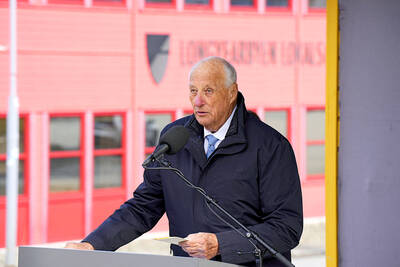
COMPETITION: The US and Russia make up about 90 percent of the world stockpile and are adding new versions, while China’s nuclear force is steadily rising, SIPRI said Most of the world’s nuclear-armed states continued to modernize their arsenals last year, setting the stage for a new nuclear arms race, the Stockholm International Peace Research Institute (SIPRI) said yesterday. Nuclear powers including the US and Russia — which account for about 90 percent of the world’s stockpile — had spent time last year “upgrading existing weapons and adding newer versions,” researchers said. Since the end of the Cold War, old warheads have generally been dismantled quicker than new ones have been deployed, resulting in a decrease in the overall number of warheads. However, SIPRI said that the trend was likely
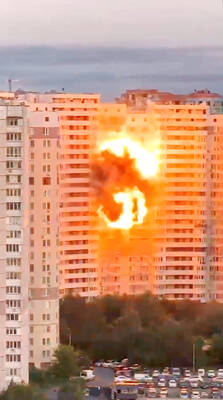
BOMBARDMENT: Moscow sent more than 440 drones and 32 missiles, Volodymyr Zelenskiy said, in ‘one of the most terrifying strikes’ on the capital in recent months A nighttime Russian missile and drone bombardment of Ukraine killed at least 15 people and injured 116 while they slept in their homes, local officials said yesterday, with the main barrage centering on the capital, Kyiv. Kyiv City Military Administration head Tymur Tkachenko said 14 people were killed and 99 were injured as explosions echoed across the city for hours during the night. The bombardment demolished a nine-story residential building, destroying dozens of apartments. Emergency workers were at the scene to rescue people from under the rubble. Russia flung more than 440 drones and 32 missiles at Ukraine, Ukrainian President Volodymyr Zelenskiy
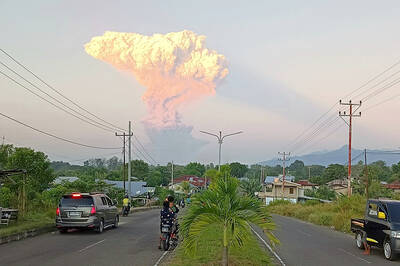
Indonesia’s Mount Lewotobi Laki-Laki yesterday erupted again with giant ash and smoke plumes after forcing evacuations of villages and flight cancelations, including to and from the resort island of Bali. Several eruptions sent ash up to 5km into the sky on Tuesday evening to yesterday afternoon. An eruption on Tuesday afternoon sent thick, gray clouds 10km into the sky that expanded into a mushroom-shaped ash cloud visible as much as 150km kilometers away. The eruption alert was raised on Tuesday to the highest level and the danger zone where people are recommended to leave was expanded to 8km from the crater. Officers also


 RSS
RSS