


Iraqi officials struck a local ceasefire deal with radical cleric Moqtada al-Sadr's Mehdi Army militia yesterday after clashes in the southern city left 12 dead.
Fighting erupted in Nasiriyah late on Tuesday after police arrested two members of the militia. By the time order was restored, two soldiers, nine civilians and the commander of the city's anti-terrorist unit were dead.
"Everyone now agrees only government forces should carry guns on the street. Mehdi Army fighters have withdrawn and security has been restored," said former governor Sheikh Sabri Al-Remaidh, who took part in peace talks.
As night fell yesterday a strict curfew was still in place in the city, but police were patrolling the streets unopposed.
One of those killed was Lieutenant Colonel Jawad Abdel Kadhim, who had headed the city's anti-terrorist police, police and medical sources said.
"The clashes have killed two Iraqi soldiers and nine civilians," in and around the city, said Hadi Badr, Nasiriyah's public health chief.
Badr said that 91 policemen, soldiers and civilians had been wounded.
He said two Mehdi Army fighters received treatment in the city's hospital, but that other wounded militiamen were taken elsewhere.
Security officials said the fighting broke out after local police arrested two militiamen accused of targeting US-led and Iraqi forces with makeshift bombs and mortars.
A delegation from the Mehdi Army, which commands widespread popularity among Shiites in Baghdad and across the south of the country, demanded the police release the two men, but were turned down, sparking the battle.
"They burned all the vehicles in front of one of the provincial government buildings in the center of the city, but the governor was in another building next to it," Iraqi police Colonel Rahim Ali said.
Police moved quickly to close off roads leading into and out of Nasiriyah and declared a city-wide curfew in a bid to quell the violence.
Nasiriyah is in Dhi Qar, a province that is now considered stable enough for Iraqi officials to take charge of security without US or British oversight.
Meanwhile, US aircraft dropped leaflets seeking information about three US soldiers feared captured by al-Qaeda, as troops intensified the search despite a warning from the terror group that the hunt will endanger the captives' lives.
The US command said the searchers were trying to isolate areas where they suspect the captives may have been taken after the pre-dawn ambush on Saturday in which four US troops and an Iraqi soldier were killed.
"The captors don't have freedom of movement," said Major Kenny Mintz of San Diego. "If they have the soldiers, they can't move them from where they are. We're doing a deliberate search of the areas."
On Monday, an al-Qaeda front group -- the Islamic State of Iraq -- warned the US in a Web statement to call off the hunt "if you want their safety."
The warning could indicate that the presence of about 4,000 US and Iraqi troops in the thinly populated farming area 30km south of Baghdad is making it difficult for the captors to move the Americans to a secure location.
In a statement on Tuesday, the US command said US soldiers have questioned more than 450 people and detained at least 11 since the search began last weekend.
Trucks with loudspeakers were also roaming the area urging local residents to come forward with any information.

‘CROSSING THE LINE’: China’s embassy in Seoul criticized US Forces Korea Commander General Xavier Brunson, asking if his ‘hostile’ remarks were authorized by Washington South Korea and the US are in talks over recent public remarks by the commander of US Forces Korea, Seoul’s presidential office said yesterday, after the comments drew sharp criticism from China. In a recent podcast interview, US Forces Korea Commander General Xavier Brunson described South Korea as “the dagger in the heart of Asia” from China’s east coast, prompting the Chinese embassy in Seoul to say that he had “truly crossed the line.” The interview came amid growing speculation that Washington might seek to expand the role of US Forces Korea in countering the growing regional influence of China, a key

Through the noise of rushing papers and whirring belts at a print factory in Kyoto, two creators watch their photo essay come to life in broadsheet form — part of an effort to win new audiences in the age of artificial intelligence (AI). Despite the decline of the publishing industry, self-publication and handmade “zine” magazines are growing in popularity in Japan, reflecting the nation’s enduring love of paper in the digital era. While speaking to Agence France-Presse at the plant, his hands black with ink, one of the creators, Kazuma Obara, said: “I think [paper] is a medium that engages all five

Australian researchers have trained lab-grown brain cells on a silicon computer chip to play the 1990s shooter game Doom and said they are just scratching the surface of what the neurons could be capable of doing. It is the science-fiction work of biotech boffins at Cortical Labs, who researched and developed the technology that harnesses the workings of the brain’s networking system. Each so-called “biological computer” contains about 200,000 living human brain cells, grown from stem cells that were harvested from blood donations. Having mastered the simple computer game Pong, where a paddle is moved up and down to send a ball
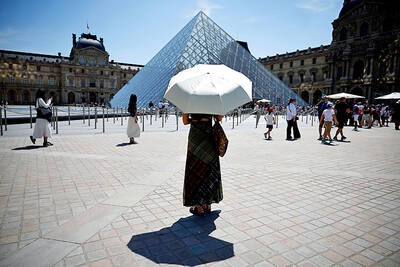
France experienced its hottest spring on record, the French weather service said on Tuesday, after an exceptional early heat wave that also broke highs for the season in England and Wales. Meteo-France said the average nationwide temperature over March to May was 13.8°C — about 1.7°C above the norm, and surpassing records set in 2011 and 2020. “The warmest spring since records began in 1900,” it said in a bulletin. All three months were warmer than average, but the onset of an “unprecedented heatwave” late last month pushed the mercury to highs typically seen at the height of the summer. “Our country had never


 RSS
RSS