


British Prime Minister Tony Blair, a major player on the world stage for a decade, won widespread praise on Thursday for defending Kosovo, fighting global warming and overseeing peace in Northern Ireland -- but criticism for championing the US-led invasion of Iraq.
Blair announced on Thursday he would resign on June 27 as prime minister and leader of Britain's Labour Party.
US President George W. Bush was effusive about Blair, a crucial ally in the Iraq war, calling him a man who kept his word.
"When Tony Blair tells you something, as we say in Texas, you can take it to the bank," Bush said.
Bush also had kind words for Blair's expected replacement, Chancellor of the Exchequer Gordon Brown, saying he "found him to be an easy-to-talk-to, good thinker."
Former US president Bill Clinton said: "Blair revitalized his party, modernized his country's economy and its approach to social problems, took the lead on global issues from climate change to debt relief to doubling aid to Africa, to the quest for peace in Northern Ireland and Kosovo and started the global Third Way political movement."
"I am glad he was there and grateful for our friendship," Clinton said in a statement.
"Tony Blair has taken Britain from the fringes to the mainstream of the European Union," European Commission President Jose Manuel Barroso said. "[Blair] leaves an impressive legacy including his commitment to enlargement, energy policy, his promotion of action against climate change and for fighting poverty in Africa."
But many viewed the Iraq war as a serious mistake by Blair, and criticized him for not questioning the US insistence on toppling the late Iraqi leader Saddam Hussein.
Swedish Prime Minister Fredrik Reinfeldt called Blair a "jovial, easygoing person" and a "fantastic speaker."
Staying in office for 10 years was a major accomplishment, Reinfeldt said, adding that "to do it in a country with the British press is an accomplishment in its own right."
Reinfeldt said the Iraq war led to Blair's eventual demise, and that his decision to join the 2003 invasion was likely influenced by the notion that "every British prime minister has a historical duty to be very close to the American administration."
"It is no easy task to make fundamentally different policy assessments [from the US] on important foreign policy matters," he said.
White House press secretary Tony Snow called Blair "an extraordinary leader," and praised him for maintaining "a long tradition of an alliance that is of extraordinary strategic importance."
In former colony India, Blair won praise for supporting its bid for a permanent seat on the UN Security Council.
In Kosovo, Blair is credited with leading and building international consensus to stop the crackdown by Serb forces on the ethnic Albanian majority in 1999. When he visited the province shortly after British forces deployed in Kosovo following the war, hundreds of thousands of ethnic Albanians gathered to thank him.
"We are grateful and thankful for his extraordinary contribution," said Ulpiana Lama, Kosovo's government spokeswoman. "He made the Kosovo issue in 1999 a priority of foreign policy."
Also see story:
Blair exits with poisoned legacy

Four people jailed in the landmark Hong Kong national security trial of "47 democrats" accused of conspiracy to commit subversion were freed today after more than four years behind bars, the second group to be released in a month. Among those freed was long-time political and LGBTQ activist Jimmy Sham (岑子杰), who also led one of Hong Kong’s largest pro-democracy groups, the Civil Human Rights Front, which disbanded in 2021. "Let me spend some time with my family," Sham said after arriving at his home in the Kowloon district of Jordan. "I don’t know how to plan ahead because, to me, it feels

Poland is set to hold a presidential runoff election today between two candidates offering starkly different visions for the country’s future. The winner would succeed Polish President Andrzej Duda, a conservative who is finishing his second and final term. The outcome would determine whether Poland embraces a nationalist populist trajectory or pivots more fully toward liberal, pro-European policies. An exit poll by Ipsos would be released when polls close today at 9pm local time, with a margin of error of plus or minus 2 percentage points. Final results are expected tomorrow. Whoever wins can be expected to either help or hinder the
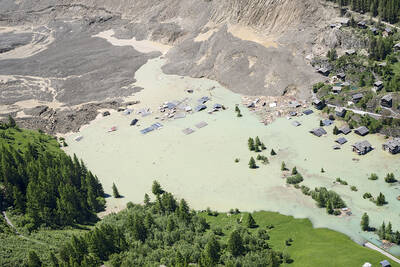
The collapse of the Swiss Birch glacier serves as a chilling warning of the escalating dangers faced by communities worldwide living under the shadow of fragile ice, particularly in Asia, experts said. Footage of the collapse on Wednesday showed a huge cloud of ice and rubble hurtling down the mountainside into the hamlet of Blatten. Swiss Development Cooperation disaster risk reduction adviser Ali Neumann said that while the role of climate change in the case of Blatten “still needs to be investigated,” the wider impacts were clear on the cryosphere — the part of the world covered by frozen water. “Climate change and
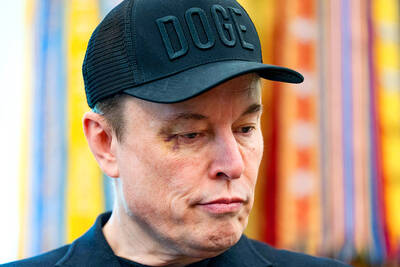
DENIAL: Musk said that the ‘New York Times was lying their ass off,’ after it reported he used so much drugs that he developed bladder problems Elon Musk on Saturday denied a report that he used ketamine and other drugs extensively last year on the US presidential campaign trail. The New York Times on Friday reported that the billionaire adviser to US President Donald Trump used so much ketamine, a powerful anesthetic, that he developed bladder problems. The newspaper said the world’s richest person also took ecstasy and mushrooms, and traveled with a pill box last year, adding that it was not known whether Musk also took drugs while heading the so-called US Department of Government Efficiency (DOGE) after Trump took power in January. In a


 RSS
RSS