


Venezuelan President Hugo Chavez has won friends at home and abroad with his generous spending on social programs ranging from his support for Venezuela's single mothers to deals on fuel for its energy-hungry neighbors in Latin America and the Caribbean.
But Chavez's cash cow, the state oil company Petroleos de Venezuela SA (PDVSA), cannot keep paying the price forever.
The long-term capacity of the world's eighth-largest oil exporter to keep pumping crude is under threat because it is spending more on Chavez's ideological agenda than on badly needed investments, industry analysts say, as the company on Tuesday saw a sharp fall in profits for last year.
PDVSA "is overstretched to capacity with a number of needs," said Patrick Esteruelas, an analyst at the New York-based Eurasia Group. "It simply can't cope at this stage."
The company is borrowing billions from international lenders, while independent estimates show its output falling. US government data shows imports from Venezuela, the US' No. 4 oil supplier, last year hit a 12-year low after dropping 8.2 percent from 2005.
Chavez says exports to the US are dropping because Venezuela is diversifying its oil buyers.
Oil Minister Rafael Ramirez, who is also president of PDVSA, also notes that Venezuela, home to the largest reserves outside the Mideast, is making production cuts ordered by OPEC.
But the decline may also partly reflect the strain put on PDVSA by Chavez's spending.
The health of PDVSA's finances is a subject of debate, mainly because audited financial results have not been publicly released for the past two years.
On Tuesday, PDVSA released unaudited financial results, which showed net earnings fell 26 percent to US$4.77 billion last year -- a year when most major oil companies posted record profits.
During a windfall year when crude prices hit record highs, PDVSA's gross revenues surged to US$101.84 billion, of which PDVSA handed over 36 percent to the state in taxes, royalties and social spending.
PDVSA attributed its loss in profitability to rising costs, including skyrocketing spending on social programs backed by Chavez.

A humanoid robot that won a half-marathon race for robots in Beijing on Sunday ran faster than the human world record in a show of China’s technological leaps. The winner from Honor, a Chinese smartphone maker, completed the 21km race in 50 minutes and 26 seconds, said a WeChat post by the Beijing Economic-Technological Development Area, also known as Beijing E-Town, where the race began. That was faster than the human world record holder, Ugandan Jacob Kiplimo, who finished the same distance in about 57 minutes in March at the Lisbon road race. The performance by the robot marked a significant step forward
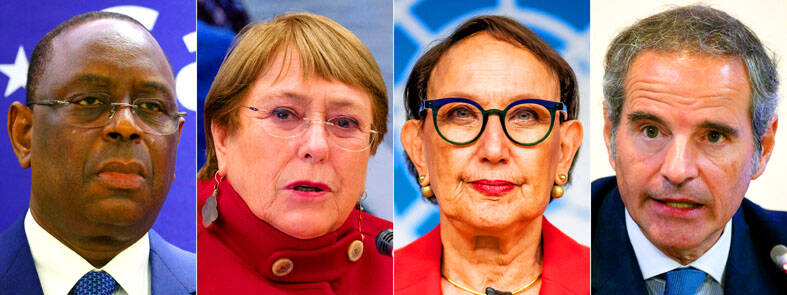
Four contenders are squaring up to succeed Antonio Guterres as secretary-general of the UN, which faces unprecedented global instability, wars and its own crushing budget crisis. Chile’s Michelle Bachelet, Argentina’s Rafael Grossi, Costa Rica’s Rebeca Grynspan and Senegal’s Macky Sall are each to face grillings by 193 member states and non-governmental organizations for three hours today and tomorrow. It is only the second time the UN has held a public question-and-answer, a format created in 2016 to boost transparency. Ultimately the five permanent members of the UN’s top body, the Security Council, hold the power, wielding vetoes over who leads the
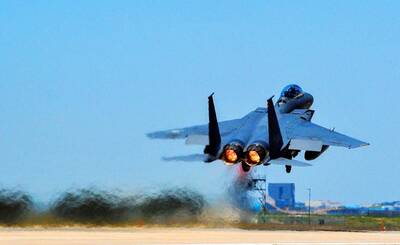
South Korea’s air force yesterday apologized for a 2021 midair collision involving two fighter jets, a day after auditors said the pilots were taking selfies and filming during the flight and held them responsible for the accident. “We sincerely apologize to the public for the concern caused by the accident that occurred in 2021,” an air force spokesman told a news conference, adding that one of the pilots involved had been suspended from flying duties, received severe disciplinary action and has since left the military. The apology followed a report released on Wednesday by the South Korean Board of Audit and Inspection,
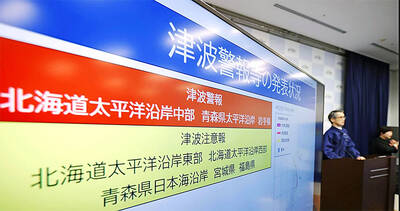
An earthquake registering a preliminary magnitude of 7.7 off northern Japan on Monday prompted a short-lived tsunami alert and the advisory of a higher risk of a possible mega-quake for coastal areas there. The Cabinet Office and the Japan Meteorological Agency said there was a 1% chance for a mega-quake, compared to a 0.1% chance during normal times, in the next week or so following the powerful quake near the Chishima and Japan trenches. Officials said the advisory was not a quake prediction but urged residents in 182 towns along the northeastern coasts to raise their preparedness while continuing their daily lives. Prime


 RSS
RSS