


Iraq's prime minister said he would reshuffle his Cabinet within two weeks and pursue criminal charges against political figures linked to extremists as a sign of his government's resolve to restore stability during the US-led security crackdown in Baghdad.
Prime Minister Nouri al-Maliki also told reporters during an interview on Saturday at his Green Zone office that Iraq will work hard to ensure the success of a regional security conference.
The conference in Baghdad, tentatively set for next weekend, is expected to bring together all of Iraq's neighbors, including Iran and Syria, as well as the US and Britain to find ways to ease this country's security crisis.
Iran has not yet announced whether it will attend, but Iraqi officials believe that Tehran will send a representative.
Al-Maliki has been under pressure from the US to bring order into his factious government of Shiites, Sunnis and Kurds since it took office last May.
Rumors of Cabinet changes have surfaced before, only to disappear because of pressure from coalition members seeking to keep power.
Nevertheless, al-Maliki said there would be a Cabinet reshuffle "either this week or next."
After changes are announced, al-Maliki said he would undertake a "change in the ministerial structure," presumably consolidating and streamlining the 39-member Cabinet.
The prime minister did not say how many Cabinet members would be replaced.
But some officials said that about nine would lose their jobs, including all six Cabinet members loyal to radical anti-US Shiite cleric Moqtada al-Sadr, an al-Maliki ally.
Al-Sadr also controls 30 of the 275 parliament seats, and his support for al-Maliki has been responsible for the government's reluctance to crack down on the cleric's Mehdi Army militia, blamed for much of the Shiite-Sunni slaughter of the past year.
US officials had been urging al-Maliki to cut his ties to al-Sadr and form a new alliance of mainstream Shiites, moderate Sunnis and Kurds. Al-Maliki had been stalling, presumably at the urging of the powerful Shiite clerical hierarchy that wants to maintain Shiite unity.
But pressure for change has mounted since US President George W. Bush ordered 21,500 US troops to Iraq in January despite widespread opposition in Congress and among the US public.
Last month, US and Iraqi troops arrested Deputy Health Minister Hakim al-Zamili, an al-Sadr ally, for allegedly diverting millions of dollars in government funds to the Mehdi Army and allowing death squads to use ambulances and government hospitals to carry out kidnappings and killings.
During the interview, al-Maliki said that other top officials would face prosecution for ties to insurgents -- including members of parliament.
Al-Maliki did not elaborate on the US-Iraqi coordination but said Iraqi judicial authorities were reviewing case files to decide which to refer to an Iraqi investigative judge.
Al-Maliki said he was encouraged by the Iraqi public's response to the new Baghdad security operation -- which has led to a sharp drop in violence.
The prime minister did not say how many politicians and officials might be targeted for formal investigation, an Iraqi legal step that corresponds to a grand jury probe.
But five senior Iraqis -- two of them generals and three from Shiite and Sunni parties -- have said that up to 100 prominent figures could face legal proceedings.
The five spoke on condition of anonymity.
The US hopes the upcoming Baghdad conference will encourage Syria and other Arab countries -- most of them Sunni-led -- to increase their support for Iraqi's leadership.
"In fact the importance of the upcoming conference lies in the fact that the Iraqi government has the ability to serve as a proper venue for solving conflicts," al-Maliki said.
"So we will exert the utmost effort to find solutions to all pending questions, either among regional countries themselves or between them and Iraq, or between them and powers such as the US and Britain and the international community," he said.
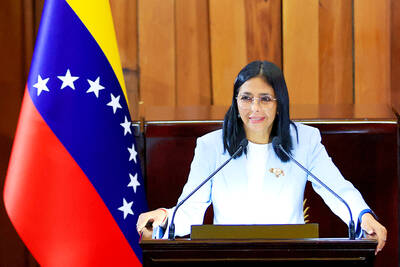
VAGUE: The criteria of the amnesty remain unclear, but it would cover political violence from 1999 to today, and those convicted of murder or drug trafficking would not qualify Venezuelan Acting President Delcy Rodriguez on Friday announced an amnesty bill that could lead to the release of hundreds of prisoners, including opposition leaders, journalists and human rights activists detained for political reasons. The measure had long been sought by the US-backed opposition. It is the latest concession Rodriguez has made since taking the reins of the country on Jan. 3 after the brazen seizure of then-Venezuelan president Nicolas Maduro. Rodriguez told a gathering of justices, magistrates, ministers, military brass and other government leaders that the ruling party-controlled Venezuelan National Assembly would take up the bill with urgency. Rodriguez also announced the shutdown

Chinese President Xi Jinping’s (習近平) purge of his most senior general is driven by his effort to both secure “total control” of his military and root out corruption, US Ambassador to China David Perdue said told Bloomberg Television yesterday. The probe into Zhang Youxia (張又俠), Xi’s second-in-command, announced over the weekend, is a “major development,” Perdue said, citing the family connections the vice chair of China’s apex military commission has with Xi. Chinese authorities said Zhang was being investigated for suspected serious discipline and law violations, without disclosing further details. “I take him at his word that there’s a corruption effort under
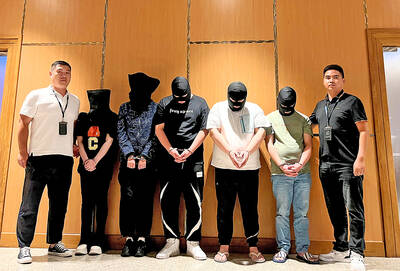
China executed 11 people linked to Myanmar criminal gangs, including “key members” of telecom scam operations, state media reported yesterday, as Beijing toughens its response to the sprawling, transnational industry. Fraud compounds where scammers lure Internet users into fake romantic relationships and cryptocurrency investments have flourished across Southeast Asia, including in Myanmar. Initially largely targeting Chinese speakers, the criminal groups behind the compounds have expanded operations into multiple languages to steal from victims around the world. Those conducting the scams are sometimes willing con artists, and other times trafficked foreign nationals forced to work. In the past few years, Beijing has stepped up cooperation

The dramatic US operation that deposed Venezuelan president Nicolas Maduro this month might have left North Korean leader Kim Jong-un feeling he was also vulnerable to “decapitation,” a former Pyongyang envoy to Havana said. Lee Il-kyu — who served as Pyongyang’s political counselor in Cuba from 2019 until 2023 — said that Washington’s lightning extraction in Caracas was a worst-case scenario for his former boss. “Kim must have felt that a so-called decapitation operation is actually possible,” said Lee, who now works for a state-backed think tank in Seoul. North Korea’s leadership has long accused Washington of seeking to remove it from power


 RSS
RSS