


The top US military commander in the Pacific says it is regrettable that China recently fired a missile into space to shoot down a satellite, noting Beijing has repeatedly vowed to follow a peaceful path to development.
But Navy Admiral William J. Fallon said the incident, in which China destroyed one of its own defunct weather satellites, should not hinder US moves to expand military relations with the growing Asian power. Such bilateral exchanges are needed in part to show Beijing that the US has no plans to invade China but are committed to defending Taiwan as required by US law, he said.
The satellite test was likely part of a People's Liberation Army effort to develop the ability to counter US military power if there is a face-off over Taiwan, Fallon said in an interview on Tuesday.
Satellites have become increasingly important to US forces in recent years. In Afghanistan and Iraq, the US has used satellite technology to deliver precision-guided bombs directly to their targets.
"It's regrettable that we see events like this because there are very few people in the world that have satellites relative to others, and it's pretty obvious why someone would be trying to acquire this capability," Fallon said.
The Jan. 11 missile test, confirmed by Beijing after two weeks of silence, made China only the third country after Russia and the US to shoot down anything in space.
Fallon said the pursuit of such capabilities would seem to contradict statements from Chinese officials that the country wants to grow peacefully.
"Leadership ought to consider carefully its actions and the actions of its subordinates and the messages that they send to others in the world," he said. "China has been very vocal, particularly in recent years, stating its absolute adherence to a peaceful future and to development of the security of itself as its priority.
"If that's the case, then what's with these kind of steps?" he asked.
The admiral spoke a few weeks before he is due to leave his Hawaii headquarters of the last two years to take over as the top commander of US forces in the Middle East.
More activities are being planned for this year, Fallon said, though he did not offer details.

Four contenders are squaring up to succeed Antonio Guterres as secretary-general of the UN, which faces unprecedented global instability, wars and its own crushing budget crisis. Chile’s Michelle Bachelet, Argentina’s Rafael Grossi, Costa Rica’s Rebeca Grynspan and Senegal’s Macky Sall are each to face grillings by 193 member states and non-governmental organizations for three hours today and tomorrow. It is only the second time the UN has held a public question-and-answer, a format created in 2016 to boost transparency. Ultimately the five permanent members of the UN’s top body, the Security Council, hold the power, wielding vetoes over who leads the

A humanoid robot that won a half-marathon race for robots in Beijing on Sunday ran faster than the human world record in a show of China’s technological leaps. The winner from Honor, a Chinese smartphone maker, completed the 21km race in 50 minutes and 26 seconds, said a WeChat post by the Beijing Economic-Technological Development Area, also known as Beijing E-Town, where the race began. That was faster than the human world record holder, Ugandan Jacob Kiplimo, who finished the same distance in about 57 minutes in March at the Lisbon road race. The performance by the robot marked a significant step forward

An earthquake registering a preliminary magnitude of 7.7 off northern Japan on Monday prompted a short-lived tsunami alert and the advisory of a higher risk of a possible mega-quake for coastal areas there. The Cabinet Office and the Japan Meteorological Agency said there was a 1% chance for a mega-quake, compared to a 0.1% chance during normal times, in the next week or so following the powerful quake near the Chishima and Japan trenches. Officials said the advisory was not a quake prediction but urged residents in 182 towns along the northeastern coasts to raise their preparedness while continuing their daily lives. Prime
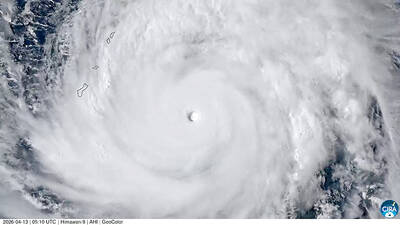
HAZARDOUS CONDITION: The typhoon’s sheer size, with winds extending 443km from its center, slowed down the ability of responders to help communities, an official said The US Coast Guard was searching for six people after losing contact with their disabled boat off the coast of Guam following Typhoon Sinlaku. The crew of the 44m dry cargo vessel, the US-registered Mariana, on Wednesday notified the coast guard that the boat had lost its starboard engine and needed assistance, Petty Officer 3rd Class Avery Tibbets said yesterday. The coast guard set up a one-hour communication schedule with the vessel, but lost contact on Thursday. A Coast Guard HC-130 Hercules aircraft was launched to search for the six people on board, but it had to return to Guam because of


 RSS
RSS