


German Chancellor Angela Merkel and Russian President Vladimir Putin were at odds on Sunday after talks on energy relations amid EU doubts over Moscow's reliability as a supplier.
Merkel stressed the importance of "relations of trust" and called for improved communication on energy between the EU and Russia "in order to avoid tensions, misunderstandings or disappointments."
But Putin defended Russian moves to drastically increase energy prices for neighboring former Soviet countries -- a policy that has led to supply disruptions to Europe through Belarus and Ukraine in the past 12 months.
"Russia is aiming to create common, transparent rules for cooperating with our partners. Our European customers have an interest in this," Putin said, referring to transit through Ukraine and Belarus.
The EU depends on Russia for a quarter of its energy needs. Much of the supply, particularly of natural gas, travels through the neighboring former Soviet republics.
Putin also said, however, that Russia would redouble efforts to build new transport networks to export oil and gas in order to reduce the country's reliance on transit countries.
A Russian embargo on meat imports from Poland -- another issue clouding relations between the EU and Russia -- remained unresolved, despite hopes of a possible breakthrough ahead of the Putin-Merkel meeting.
Poland has vetoed the start of partnership talks between the EU and Russia until the embargo is lifted. Merkel said the meat trade issues "have still not been resolved," while Putin said: "We have to come to an agreement."
Putin also voiced hope for improved ties with the EU.
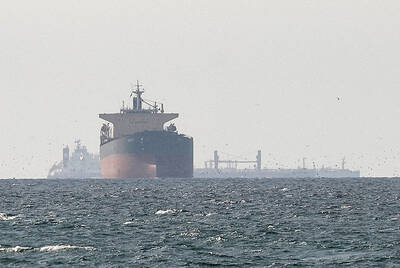
A ship that appears to be taking on the identity of a scrapped gas carrier exited the Strait of Hormuz on Friday, showing how strategies to get through the waterway are evolving as the Middle East war progresses. The vessel identifying as liquefied natural gas (LNG) carrier Jamal left the Strait on Friday morning, ship-tracking data show. However, the same tanker was also recorded as having beached at an Indian demolition yard in October last year, where it is being broken up, according to market participants and port agent’s reports. The ship claiming to be Jamal is likely a zombie vessel that

German Chancellor Friedrich Merz’s conservative Christian Democratic Union (CDU) yesterday faced a regional election battle in Rhineland-Palatinate, now held by the center-left Social Democratic Party (SPD). Merz’s CDU has enjoyed a narrow poll lead over the SPD — their coalition partners at the national level — who have ruled the mid-sized state for 35 years. Polling third is the far-right Alternative for Germany (AfD), which spells a greater threat to the two centrist parties in several state elections in September in the country’s ex-communist east. The picturesque state of Rhineland-Palatinate, bordering France, Belgium and Luxembourg and with a population of about 4 million,

Ugandan wildlife authorities have reintroduced rhinos into a remote protected area where they were once poached into extinction, an event seen by conservationists as a milestone in efforts to support the recovery of a species threatened by poaching. On Tuesday, two southern white rhinos from a private ranch in the East African country were reintroduced into Kidepo Valley National Park in the country’s northeast. Two more rhinos in metallic crates arrived on Thursday. There have been no rhinos in the park since 1983, the result of poaching. However, a private ranch in central Uganda — the Ziwa Rhino Sanctuary — has been
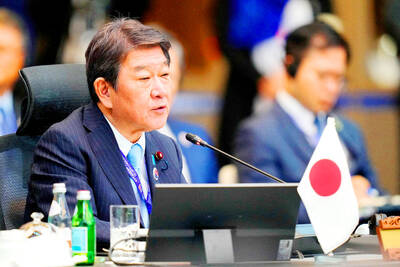
LAW CONSTRAINTS: The US has been pressing allies to send warships to open the Strait, but Tokyo’s military actions are limited under its postwar pacifist constitution Japan could consider deploying its military for minesweeping in the Strait of Hormuz if a ceasefire is reached in the war on Iran, Japanese Minister of Foreign Affairs Toshimitsu Motegi said yesterday. “If there were to be a complete ceasefire, hypothetically speaking, then things like minesweeping could come up,” Motegi said. “This is purely hypothetical, but if a ceasefire were established and naval mines were creating an obstacle, then I think that would be something to consider.” Japan’s military actions are limited under its postwar pacifist constitution, but 2015 security legislation allows Tokyo to use its Self-Defense Forces overseas if an attack,


 RSS
RSS