


A terror suspect under police surveillance has disappeared, Britain's top law-and-order official said on Tuesday.
The suspect was being monitored under the so-called control order regime, British Home Secretary John Reid said in a written statement to parliamentarians.
Under the program, suspects who have not been charged are released from custody but remain under observation and can be electronically tagged, kept under curfew, denied the use of telephones or the Internet, and prohibited from meeting outsiders.
The control order system was created by British Prime Minister Tony Blair's government after Britain's highest court ruled in December 2004 that it was unlawful to detain terrorist suspects indefinitely without trial.
The suspect, whose identity is protected by an anonymity order, absconded earlier this month, Reid said. The man was the third terror suspect to disappear while being monitored under the control order.
"The individual is not believed to represent a direct threat to the public in the UK at this time," Reid said regarding the latest escapee. "Locating the individual is an operational matter for the police."
The government also declined to identify the other two suspects who disappeared while being held under control orders last year.
Reid's announcement came as the government faced criticism for another blunder.
On Sunday, the government said it was ordering a review of all criminal databases after acknowledging that files on hundreds of criminals were not entered into police computers. The government insists the mistake -- caused by a backlog in processing EU records at Britain's Criminal Records Bureau -- did not lead to any violent or sexual offenders being cleared to work with vulnerable people, such as children.
A government spokesman said Reid was writing to Cabinet colleagues to secure agreement for a review of British criminal databases and how information was shared between them.
An unidentified Home Office official was suspended in connection with the mistake after providing information about it to an internal inquiry.
Opposition politicians attacked the government's handling of the files.
Reid took over at the Home Office in May after former Home Secretary Charles Clarke's dismissal when it was revealed that foreign criminals were released from prisons without being considered for deportation.
On Tuesday, David Davis of the opposition Conservative Party, said: "Far from getting a grip since John Reid took over, the Home Office has been marked by murderers walking out of open prisons and suspected terrorists escaping from control orders."
"This latest failure demonstrates what we said some time ago," he said.
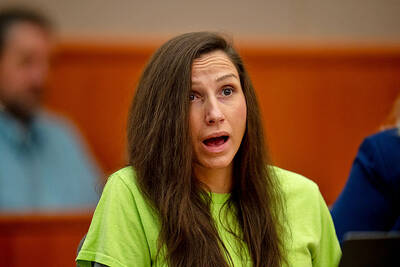
Kouri Richins, a Utah mother who published a children’s book about grief after the death of her husband is to serve a life sentence for his murder without the possibility of parole, a judge ruled on Wednesday. Richins was convicted in March of aggravated murder for lacing a cocktail given to her husband, Eric Richins, with five times the lethal dose of fentanyl at their home near Park City in 2022. A jury also found her guilty of four other felonies, including insurance fraud, forgery and attempted murder for trying to poison her husband weeks earlier on Feb. 14, 2022, with a
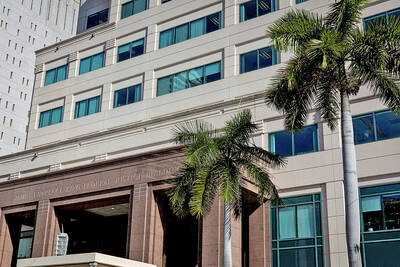
‘GROSS NEGLIGENCE?’ Despite a spleen typically being significantly smaller than a liver, the surgeon said he believed Bryan’s spleen was ‘double the size of what is normal’ A Florida surgeon who is facing criminal charges after allegedly removing a patient’s liver instead of his spleen has said he is “forever traumatized” by that person’s death. In a deposition from November last year that was recently obtained by NBC, 44-year-old Thomas Shaknovsky described the death of 70-year-old William Bryan as an “incredibly unfortunate event that I regret deeply.” Bryan died after the botched surgery; and last month, a grand jury in Tallahassee indicted Shaknovsky on a charge of manslaughter. “I’m forever traumatized by it and hurt by it,” Shaknovsky added, also saying that wrong-site surgeries can happen “during

‘PERSONAL MISTAKES’: Eileen Wang has agreed to plead guilty to the felony, which comes with a maximum sentence of 10 years in federal prison A southern California mayor has agreed to plead guilty to acting as an illegal agent for the Chinese government and has resigned from her city position, officials said on Monday. Eileen Wang (王愛琳), mayor of Arcadia, was charged last month with one count of acting in the US as an illegal agent of a foreign government. She was accused of doing the bidding of Chinese officials, such as sharing articles favorable to Beijing, without prior notification to the US government as required by law. The 58-year-old was elected in November 2022 to a five-person city council, from which the mayor is selected
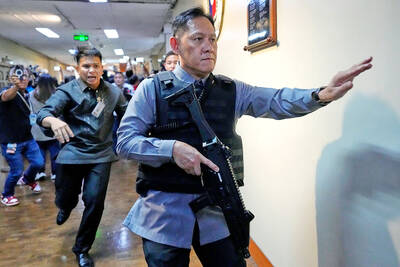
DELA ROSA CASE: The whereabouts of the senator, who is wanted by the ICC, was unclear, while President Marcos faces a political test over the senate situation Philippine authorities yesterday were seeking confirmation of reports that a top politician wanted by the International Criminal Court (ICC) had fled, a day after gunfire rang out at the Philippine Senate where he had taken refuge fearing his arrest. Senator Ronald “Bato” dela Rosa, the former national police chief and top enforcer of former Philippine president Rodrigo Duterte’s “war on drugs,” has been under Senate protection and is wanted for crimes against humanity, the same charges Duterte is accused of. “Several sources confirmed that the senator, Senator Bato, is no longer in the Senate premises, but we are still getting confirmation,” Presidential


 RSS
RSS