


Hoping to turn the millions of people who own digital cameras and camera phones into photojournalists, Yahoo and Reuters are introducing a new effort to showcase photographs and video of news events submitted by the public.
Starting today, the photos and videos submitted will be placed throughout Reuters.com and Yahoo News, the most popular news Web site in the US, according to comScore MediaMetrix.
Reuters said that it would also start to distribute some of the submissions next year to the thousands of print, online and broadcast media outlets that subscribe to its news service.
Reuters said it hoped to develop a service devoted entirely to user-submitted photographs and video.
"There is an ongoing demand for interesting and iconic images," said Chris Ahearn, the president of the Reuters media group.
He said the agency had always bought newsworthy pictures from individuals and part-time contributors known as stringers.
"This is looking out and saying, `What if everybody in the world were my stringers?"' Ahearn said.
The project is among the most ambitious efforts in what has become known as citizen journalism, attempts by bloggers, start-up local news sites and global news organizations like CNN and the BBC to see if readers can also become reporters.
Many news organizations turned to photographs taken by amateurs to supplement coverage of events like the London subway bombing and the Asian tsunami.
Yahoo's news division has already used images that were originally posted on Flickr, the company's photo-sharing site. It created a slide show of images from Thailand after the September coup.
The Yahoo-Reuters project will create a systematic way to incorporate images covering a wider range of subjects into news coverage.
Starting today, users will be able to upload photos and videos to a section of Yahoo called You Witness News (news.yahoo.com/page/youwitnessnews). All of the submissions will appear on Flickr or a similar site for video.
Editors at both Reuters and Yahoo will review the submissions and select some to place on pages with relevant news articles, just as professional photographs and video clips are woven into their news sites today.
Users will not be paid for any images displayed on the Yahoo and Reuters sites. But people whose photos or videos are selected for distribution to Reuters clients will receive a payment.
Ahearn said the company had not yet figured out how to structure those payments. The basic payment may be relatively small, but he said Reuters was likely to pay more to people offering rights to images of major events.
For now, no money is changing hands between Yahoo and Reuters, but if Reuters is able to create a separate news service with the user-created material, it will split the revenue with Yahoo.
Before photographs or videos are used on the Yahoo site or distributed by Reuters, photo editors at Reuters will try to vet them to weed out fraudulent or retouched images.
This is an imperfect process. Last summer, a blogger discovered that photos of the conflict in Lebanon by a freelance photographer working for Reuters had been digitally altered.
Reuters stopped using the photographer and withdrew his work from its archive. The company is now trying to develop software that will help in the detection of digitally altered photographs.
The arrangement with Yahoo is one of several initiatives by Reuters to use the Internet to bring new sources to its news reports.
It has invested US$7 million in Pluck, a company that distributes content from blogs to newspapers and other traditional media outlets.
It has also backed two more experimental ventures: NewAssignment.net, an effort to foster reporting that combines the work of professional journalists with input from online readers, and Global Voices, a collection of blogs from around the world, especially from less-developed countries.
Yahoo has its own ambitious plans for the You Witness News service.
The images received will be used on its sports and entertainment sites. Over time, it wants to expand to local news and high school sports.
And it will consider allowing users to contribute articles as well as images. For now, both Yahoo and Reuters are concerned that they do not have the resources to edit and verify such articles.
"News has special constraints on content quality," said Elizabeth Osder, a senior director for product development at Yahoo. "If we publish text, we want to review it."

Le Tuan Binh keeps his Moroccan soldier father’s tombstone at his village home north of Hanoi, a treasured reminder of a man whose community in Vietnam has been largely forgotten. Mzid Ben Ali, or “Mohammed” as Binh calls him, was one of tens of thousands of North Africans who served in the French army as it battled to maintain its colonial rule of Indochina. He fought for France against the Viet Minh independence movement in the 1950s, before leaving the military — as either a defector or a captive — and making a life for himself in Vietnam. “It’s very emotional for me,”

The Chinese Communist Party’s (CCP) Central Committee is to gather in July for a key meeting known as a plenum, the third since the body of elite decisionmakers was elected in 2022, focusing on reforms amid “challenges” at home and complexities broad. Plenums are important events on China’s political calendar that require the attendance of all of the Central Committee, comprising 205 members and 171 alternate members with Chinese President Xi Jinping (習近平) at the helm. The Central Committee typically holds seven plenums between party congresses, which are held once every five years. The current central committee members were elected at the
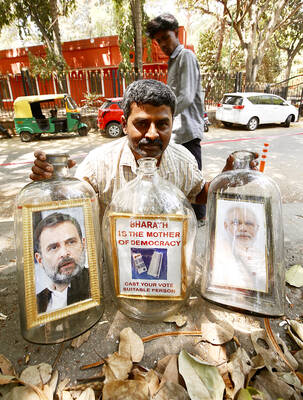
Indian Prime Minister Narendra Modi reaffirmed his pledge to replace India’s religion-based marriage and inheritance laws with a uniform civil code if he returns to office for a third term, a move that some minority groups have opposed. In an interview with the Times of India listing his agenda, Modi said his government would push for making the code a reality. “It is clear that separate laws for communities are detrimental to the health of society,” he said in the interview published yesterday. “We cannot be a nation where one community is progressing with the support of the Constitution while the other

CODIFYING DISCRIMINATION: Transgender people would be sentenced to three years in prison, while same-sex relations could land a person in jail for more than a decade Iraq’s parliament on Saturday passed a bill criminalizing same-sex relations, which would receive a sentence of up to 15 years in prison, in a move rights groups condemned as an “attack on human rights.” Transgender people would be sentenced to three years’ jail under the amendments to a 1988 anti-prostitution law, which were adopted during a session attended by 170 of 329 lawmakers. A previous draft had proposed capital punishment for same-sex relations, in what campaigners had called a “dangerous” escalation. The new amendments enable courts to sentence people engaging in same-sex relations to 10 to 15 years in prison, according to the


 RSS
RSS