


A long-awaited Mexican government report blames "the highest command levels" of three former presidencies for the massacres, tortures and slayings of hundreds of leftists from the 1960s to the early 1980s.
Based partly on declassified Mexican military documents, the report posted on the Internet on Saturday ends a five-year investigation by a special prosecutor named by President Vicente Fox to shed light on past crimes, including a 1968 student massacre and the disappearance of hundreds of leftist activists in the 1970s and early 1980s.
The report states that "the authoritarian regime, at the highest command levels," broke the law and "committed crimes against humanity" that resulted in "massacres, forced disappearances, systematic torture and genocide to try to destroy a sector of society that it considered ideologically to be its enemy."
Special prosecutor Ignacio Carrillo, who was appointed in November 2001, handed his report to Mexico's Attorney General's Office late on Friday. The report was later posted on the Internet for the public, and Carrillo said it would presented at a ceremony with Fox before he leaves office.
The incidents occurred during the administrations of presidents Gustavo Diaz Ordaz, Jose Lopez Portillo and Luis Echeverria.
Asked by reporters if the presidents knew of the atrocities but did nothing, Carrillo replied, "Yes."
Carrillo said the report is only the beginning -- that the Mexican government must prosecute those responsible if it is to prevent such atrocities from occurring in the future. The state also must compensate victims' families, he said.
"This was not about the behavior of certain individuals," Carrillo said. "It was the consequence of an authorized plan to do away with political dissidents."
Until now, many of the cases consisted of little more than witnesses' accounts.
Kate Doyle, a Mexico expert at the Washington-based National Security Archive, a private, nonpartisan research group, said the report is a "powerful development" because for the first time the government "officially lays the blame at the feet of three Mexican presidents."
It "clearly describes in detail how the authoritarian regime" of the Institutional Revolutionary Party, or PRI, "used violence to silence the opposition," while painting an image to the world that it was running a democracy, she said.
Fox vowed to prosecute Mexico's past crimes when he was elected in 2000, ending 71 years of PRI rule.
But the courts have repeatedly blocked Carrillo's efforts to detain Echeverria, the only implicated president who is still living.
Carrillo denounced "the bad conduct of legislators and judges over the years who have promoted impunity with their false distortions of the law and reforms."
In July, a federal judge threw out genocide charges against Echeverria, ruling that a 30-year statute of limitations had run out. Echeverria, 84, had been under house arrest for more than a week on charges that he organized a student massacre as interior secretary in 1968. The charges were the first to have been filed against a former president.
The massacre took place in Mexico City's Tlatelolco Plaza on Oct. 2, just before the capital hosted the Olympics. Officials said 25 people were killed, though human rights activists say as many as 350 may have died. The attack is considered one of the darkest moments of PRI rule.
Carrillo also has attempted to bring charges against Echeverria, president from 1970 to 1976, for a 1971 student massacre and for the disappearance of leftist activists in the southern state of Guerrero.
Echeverria has denied any wrongdoing.
Carrillo's report found the most brutal period allegedly occurred under Echeverria's so-called "Friendship Operation" launched by the military in 1970 in Guerrero.
The report says it has evidence the army conducted illegal searches, arbitrary detentions, torture and burned down villages.

Kouri Richins, a Utah mother who published a children’s book about grief after the death of her husband is to serve a life sentence for his murder without the possibility of parole, a judge ruled on Wednesday. Richins was convicted in March of aggravated murder for lacing a cocktail given to her husband, Eric Richins, with five times the lethal dose of fentanyl at their home near Park City in 2022. A jury also found her guilty of four other felonies, including insurance fraud, forgery and attempted murder for trying to poison her husband weeks earlier on Feb. 14, 2022, with a

‘GROSS NEGLIGENCE?’ Despite a spleen typically being significantly smaller than a liver, the surgeon said he believed Bryan’s spleen was ‘double the size of what is normal’ A Florida surgeon who is facing criminal charges after allegedly removing a patient’s liver instead of his spleen has said he is “forever traumatized” by that person’s death. In a deposition from November last year that was recently obtained by NBC, 44-year-old Thomas Shaknovsky described the death of 70-year-old William Bryan as an “incredibly unfortunate event that I regret deeply.” Bryan died after the botched surgery; and last month, a grand jury in Tallahassee indicted Shaknovsky on a charge of manslaughter. “I’m forever traumatized by it and hurt by it,” Shaknovsky added, also saying that wrong-site surgeries can happen “during

‘PERSONAL MISTAKES’: Eileen Wang has agreed to plead guilty to the felony, which comes with a maximum sentence of 10 years in federal prison A southern California mayor has agreed to plead guilty to acting as an illegal agent for the Chinese government and has resigned from her city position, officials said on Monday. Eileen Wang (王愛琳), mayor of Arcadia, was charged last month with one count of acting in the US as an illegal agent of a foreign government. She was accused of doing the bidding of Chinese officials, such as sharing articles favorable to Beijing, without prior notification to the US government as required by law. The 58-year-old was elected in November 2022 to a five-person city council, from which the mayor is selected
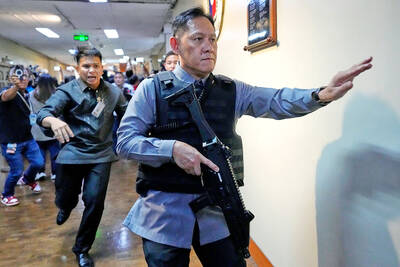
DELA ROSA CASE: The whereabouts of the senator, who is wanted by the ICC, was unclear, while President Marcos faces a political test over the senate situation Philippine authorities yesterday were seeking confirmation of reports that a top politician wanted by the International Criminal Court (ICC) had fled, a day after gunfire rang out at the Philippine Senate where he had taken refuge fearing his arrest. Senator Ronald “Bato” dela Rosa, the former national police chief and top enforcer of former Philippine president Rodrigo Duterte’s “war on drugs,” has been under Senate protection and is wanted for crimes against humanity, the same charges Duterte is accused of. “Several sources confirmed that the senator, Senator Bato, is no longer in the Senate premises, but we are still getting confirmation,” Presidential


 RSS
RSS