


When Peruvian officials set out to spread the wealth, they probably didn't mean mayors should build extravagant town halls and heated swimming pools.
And they almost certainly didn't expect this frigid, wind-swept hamlet high on the Andean plateau to spend its windfall on an erotic sculpture park.
The sexually explicit creations in this isolated village 170km northeast of the capital have become the focus of a furor over public spending that dominated yesterday's nationwide local election and is posing a political headache for President Alan Garcia just four months after he was elected in a stunning comeback.
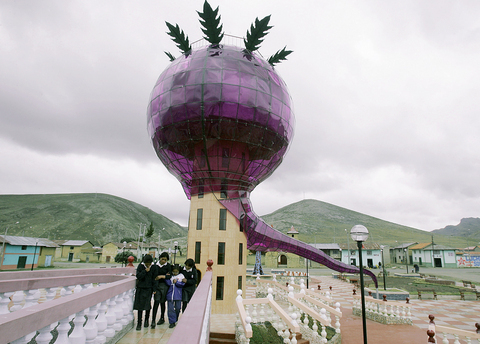
PHOTO: AP
The original idea was to increase revenue-sharing from surging prices for gold, copper, zinc and other minerals, and indeed, municipalities in the mountains and jungles have seen their income from taxes on mining rise more than 1,000 percent during recent years, to nearly US$1 billion this year.
But the extravagances prompted by the cash bonanza have prompted fears of a voter backlash that will elect a more radical brand of leadership from outside the established political system.
People in Huayre are bemused by the uproar. National rulers, they figure, have been squandering their riches for centuries, so what's the big deal if Mayor Alderete hoped to attract tourists by gracing the village's central plaza with outsized images of genitalia and the maca root, a tuber traditionally consumed locally as an aphrodisiac?
The federal government had hoped for more attention to priorities in towns like Huayre, which still lacks paved streets or a sewage system -- typical among Andean towns in a country where half the population lives on less than US$2 a day.
Alderete, an independent who is not running for re-election, said he is aware that his US$158,000 park is being skewered in the media as typical of towns that are misspending their money.
But he says it's the job of the regional government, not the mayor's office, to build infrastructure such as sewer systems so that people don't have to rely on outdoor toilets.
Long governed by strong central regimes, Peru moved to create autonomous regional governments and give them more revenue following the 2001 ouster of Alberto Fujimori's administration.
But many local officials have yet to learn how to handle the new-found power and cash, said Eduardo Ballon, a senior analyst at Peru's Desco think tank.
"There is a wealth of deep-seated problems that cannot be hidden, one of which has to do with the lack of training at the local government level and the limitations for fulfilling functions and duties," he said.
Garcia's center-left Aprista party was the big winner in 2002 regional elections, taking about half of the 24 regional governments. Now he stands to lose ground in the provinces because independents with no direct ties to any national party are expected to become the new caudillos, or strongmen.
In Huayre, meanwhile, the residents seem to be taking the unusual park in their stride, and are still dreaming of an influx of tourists.

When a hiker fell from a 55m waterfall in wild New Zealand bush, rescuers were forced to evacuate the badly hurt woman without her dog, which could not be found. After strangers raised thousands of dollars for a search, border collie Molly was flown to safety by a helicopter pilot who was determined to reunite the pet and the owner. A week earlier, an emergency rescue helicopter found the woman with bruises and lacerations after a fall at a rocky spot at the waterfall on the South Island’s West Coast. She was airlifted on March 24, but they were forced to
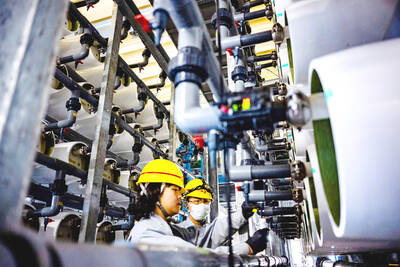
HIGH HOPES: The power source is expected to have a future, as it is not dependent on the weather or light, and could be useful for places with large desalination facilities A Japanese water plant is harnessing the natural process of osmosis to generate renewable energy that could one day become a common power source. The possibility of generating power from osmosis — when water molecules pass from a less salty solution to a more salty one — has long been known. However, actually generating energy from that has proved more complicated, in part due the difficulty of designing the membrane through which the molecules pass. Engineers in Fukuoka, Japan, and their private partners think they might have cracked it, and have opened what is only the world’s second osmotic power plant. It generates

Hundreds of Filipinos and tourists flocked to a sun-bleached field north of Manila yesterday, on Good Friday, to witness one of the country’s most blood-soaked displays of religious fervor, undeterred by rising fuel prices. Scores of bare-chested flagellants with covered faces walked barefoot through the dusty streets of Pampanga Province’s San Fernando as they flogged their backs with bamboo whips in the scorching heat. Agence France-Presse (AFP) journalists said they saw devotees deliberately puncturing their skin with glass shards attached to a small wooden paddle to ensure their bleeding during the ritual, a way to atone for sins and seek miracles from
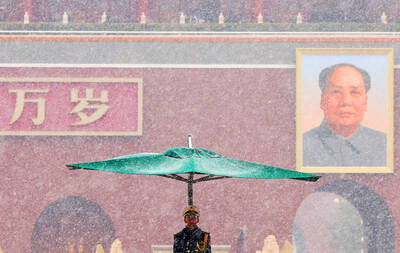
Chinese dissident artist Gao Zhen (高兟), famous for making provocative satirical sculptures of former Chinese leader Mao Zedong (毛澤東), was tried on Monday over accusations of “defaming national heroes and martyrs,” his wife and a rights group said. Gao, 69, who was detained in 2024 during a visit from the US, faces a maximum three-year prison sentence, said his wife, Zhao Yaliang (趙雅良), and Shane Yi, a researcher at the Chinese Human Rights Defenders group which operates outside the nation. The closed-door, one-day trial took place at Sanhe City People’s Court in Hebei Province neighboring the capital, Beijing, and ended without a


 RSS
RSS