


International troops secured the airport in Tonga's riot-scarred capital, but commercial flights allowing frightened foreigners to leave were not expected to resume for another day because of church services in the heavily Christian country, commanders said yesterday.
New Zealand and Australian troops secured Tonga's international airport within hours of arrival on Saturday, erasing the main concern of hundreds of people trapped in the tiny island kingdom.
At least eight people were killed when pro-democracy gangs looted and rioted on Thursday through central Nuku'alofa, leaving residents and foreigners terrified as the kingdom became isolated when the sole airport shut down.
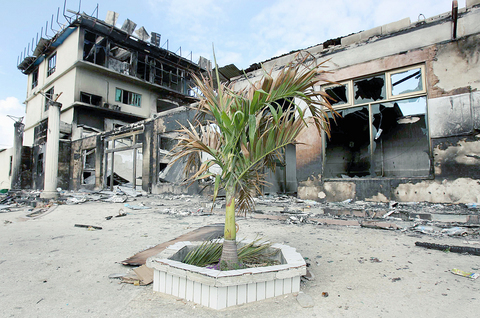
PHOTO: AP
But the situation calmed with confirmation that the airport was secured and flights would resume today.
"The troops are not visible, but people are pleased they are there because they just want to get the aircraft coming in," Tongan journalist Mary Fonua said yesterday.
Prime Minister Fred Sevele yesterday rejected calls for his resignation in the wake of the riot and destruction.
Pro-democracy leaders claim Sevele and his government were responsible for delays in implementing political change that helped foment the violence.
"Government is not to be blamed for what happened on Thursday," he told New Zealand's TV3 News.
"I don't think anyone ever thought, even the instigators of this whole problem never thought, things would get out of hand," Sevele said.
"It's a day of shame for us Tongans," he said.
The riots erupted when the legislators looked likely to adjourn for the year without making a decision on expanding democracy, enraging pro-democracy activists.
Calm was restored on Friday following an emergency meeting of the Cabinet, nobles and elected commoners agreed to meet the pro-democracy demands.
Legislators elected by popular vote will represent the majority in parliament at the next election in 2008, ending centuries of rule by nobles and people appointed by the royal family.
Journalists escorted by the military through the riot scene spoke of the "complete destruction" of the city center.
"The shops not burned have been looted and smashed completely. It's utter devastation," Fonua said.
New Zealand and Australia sent in 110 troops and around 44 police officers at the Tongan government's request.
"We judge that as an adequate number to keep the situation quiet, and hopefully there won't be any more problems and we'll be able to withdraw fairly soon," Australian Foreign Minister Alexander Downer said on ABC TV.
Downer said any of the 300 Australians in Tonga could be evacuated if they wished.
"That's up to them. Some of them feel a bit nervous depending on who they work for ... and others feel perfectly safe," he said.
Eleven people flew to New Zealand on Saturday night on the return flight of a New Zealand Air Force Boeing which ferried troops into Tonga. They included Maliana Sevele, one of the prime minister's daughters, whose supermarket was the first target of the rioters.
She did not want to talk to the media, but a relative told Radio New Zealand Sevele's family feared it was being targeted so she felt the safest thing was to fly to New Zealand until the situation calmed down.
About 34 Australians also sought a seat on a military aircraft returning to Australia.

‘CROSSING THE LINE’: China’s embassy in Seoul criticized US Forces Korea Commander General Xavier Brunson, asking if his ‘hostile’ remarks were authorized by Washington South Korea and the US are in talks over recent public remarks by the commander of US Forces Korea, Seoul’s presidential office said yesterday, after the comments drew sharp criticism from China. In a recent podcast interview, US Forces Korea Commander General Xavier Brunson described South Korea as “the dagger in the heart of Asia” from China’s east coast, prompting the Chinese embassy in Seoul to say that he had “truly crossed the line.” The interview came amid growing speculation that Washington might seek to expand the role of US Forces Korea in countering the growing regional influence of China, a key

Through the noise of rushing papers and whirring belts at a print factory in Kyoto, two creators watch their photo essay come to life in broadsheet form — part of an effort to win new audiences in the age of artificial intelligence (AI). Despite the decline of the publishing industry, self-publication and handmade “zine” magazines are growing in popularity in Japan, reflecting the nation’s enduring love of paper in the digital era. While speaking to Agence France-Presse at the plant, his hands black with ink, one of the creators, Kazuma Obara, said: “I think [paper] is a medium that engages all five

Australian researchers have trained lab-grown brain cells on a silicon computer chip to play the 1990s shooter game Doom and said they are just scratching the surface of what the neurons could be capable of doing. It is the science-fiction work of biotech boffins at Cortical Labs, who researched and developed the technology that harnesses the workings of the brain’s networking system. Each so-called “biological computer” contains about 200,000 living human brain cells, grown from stem cells that were harvested from blood donations. Having mastered the simple computer game Pong, where a paddle is moved up and down to send a ball
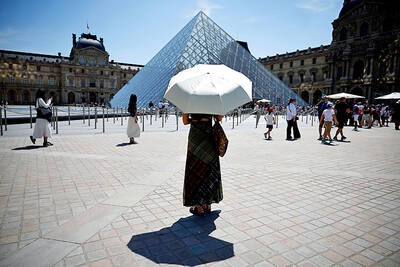
France experienced its hottest spring on record, the French weather service said on Tuesday, after an exceptional early heat wave that also broke highs for the season in England and Wales. Meteo-France said the average nationwide temperature over March to May was 13.8°C — about 1.7°C above the norm, and surpassing records set in 2011 and 2020. “The warmest spring since records began in 1900,” it said in a bulletin. All three months were warmer than average, but the onset of an “unprecedented heatwave” late last month pushed the mercury to highs typically seen at the height of the summer. “Our country had never


 RSS
RSS