


The EU on Thursday announced the launch of a wide-ranging bloc-wide anti-terror project aimed at tackling terrorist financing, investigating the causes of violent radicalization and protecting key infrastructure against attacks.
The European Commission is putting 9 million euros (US$11.4 million) into the fighting fund this year and plans to more than double the figure to 20 million euros annually from next year.
"The actions financed under this project will enhance the European Union's capacity to effectively prevent and respond to terrorist attacks," EU Commissioner for Justice and Security Franco Frattini said.
The bloc has been attempting to beef up anti-terrorist measures since public transport bombings in Madrid in 2004 and London in last year. An alleged threat to blow up transatlantic flights out of London earlier this year using liquid explosives has already led to new airport security measures.
The new scheme "will assist in better protecting critical infrastructures, preventing terrorist financing, the use of explosives and violent radicalization and increase bio-preparedness by training intervention personnel and by identifying key objectives and proper measures to protect our citizens," said Frattini.
Some of the money will be spent on expert groups and studies on the various problems involved as well as streamlining cooperation between member states, and improving information on terror threats and prevention practices for the general population.
Law enforcement cooperation between police and customs officers internationally will also be a focus as will "fighting the use of Internet for terrorist purposes" and protecting witnesses in terrorism cases.
Commission spokesman Friso Roscam Abbing said the wide-reaching project would cover everything from prevention and protection to response, pursuit and prosecution.
Some of the key areas which it is hoped will be tackled early on is the drawing up of a list of key European infrastructure sites regarded as requiring more protection, and therefore more money.
Discussion will also take place on what role Muslim Imams can play in reducing the terrorist threat, as well as ordinary school teachers.
"There is a need to identify and address the factors and causes that are contributing to making people take the path of violence and terror," the spokesman said.
This could eventually mean operatives infiltrating radical groups in the quest for information, he added.
Experts will also look into the so-called "Swiss model" by which investigators can trace explosives back to their source after an explosion by use of a kind of chemical fingerprint.
The move came as Europe's six largest countries meeting in England agreed ways to pre-empt terrorist attacks through sharing intelligence about threats and driving extremists from the Internet.
Among the proposals from the law and order ministers from Britain, France, Germany, Spain, Italy and Poland was the sharing of research into explosives, in particular liquid explosives.
"The G6 focus is on deliverables now," said Roscam Abbing.
"We are starting at a basic level because so much needs to be researched, investigated and this is the reason for our initiative," he added.
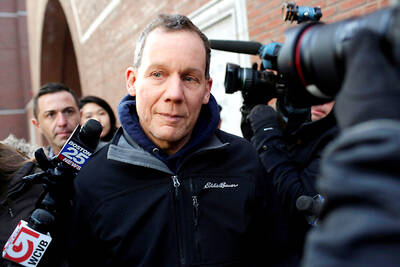
An American scientist convicted of lying to US authorities about payments from China while he was at Harvard University has rebuilt his research lab in Shenzhen, China, to pursue technology the Chinese government has identified as a national priority: embedding electronics into the human brain. Charles Lieber, 67, is among the world’s leading researchers in brain-computer interfaces. The technology has shown promise in treating conditions such as amyotrophic lateral sclerosis and restoring movement in paralyzed people. It also has potential military applications: Scientists at the Chinese People’s Liberation Army have investigated brain interfaces as a way to engineer super soldiers by boosting
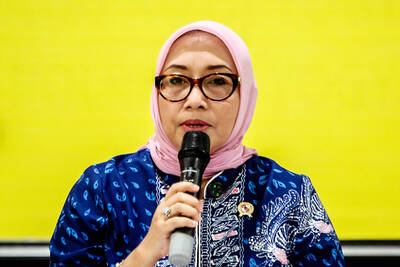
Indonesian police have arrested 13 people after shocking images of alleged abuse against small children at a daycare center went viral, sparking outrage across the nation, officials said on Monday. Police on Friday last week raided Little Aresha, a daycare center in Yogyakarta on Java island, following a report from a former employee. CCTV footage circulating on social media showed children, most younger than two, lying on the floor wearing only diapers, their hands and feet bound with rags. The police have confirmed that the footage is authentic. Police said they also found 20 children crammed into a room just 3m by 3m. “So
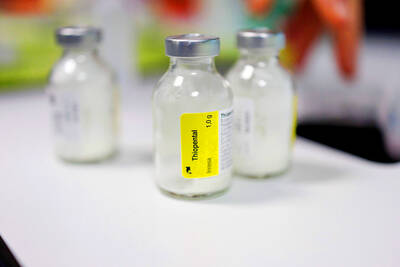
A grieving mother has ended her life at a clinic in Switzerland four years after the death of her only child. Wendy Duffy, 56, a physically healthy woman, died at the Pegasos clinic in Basel after struggling to cope with the death of her 23-year-old son, Marcus. The former care worker, from the West Midlands, England, had previously attempted to take her own life. The case comes as assisted dying would not become law in England and Wales after proposed legislation, branded “hopelessly flawed” by opponents, ran out of time. Ruedi Habegger, the founder of Pegasos, described Duffy’s death as
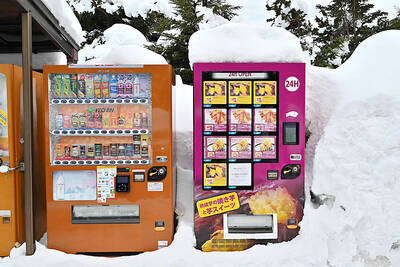
From post offices and parks to stations and even the summit of Mount Fuji, Japan’s vending machines are ubiquitous, but with the rapid pace of inflation cooling demand for their drinks, operators are being forced to rethink the business. Last month beverage giant DyDo Group Holdings announced it would remove about 20,000 vending machines — about 7 percent of their stock nationwide — by January next year, to “reconstruct a profitable network.” Pokka Sapporo Food & Beverage, based in Nagoya, also said last month it would sell its 40,000-machine operation to Osaka-based Lifedrink Co. “The strength of the vending machine


 RSS
RSS