

Indonesia started dumping mud surging from a gas exploration site in central Indonesia into the sea yesterday, hoping to minimize destruction from the disaster that has submerged entire villages and displaced thousands of people.
The mud flow started after an accident occurred deep in a drilling shaft on the seismically charged island of Java four months ago. It now covers more than 450 hectares and is currently being contained by an ever-expanding network of dams.
The government said earlier it would divert the mud into the sea via a river, despite opposition from environmentalists who protested that the mud was toxic.
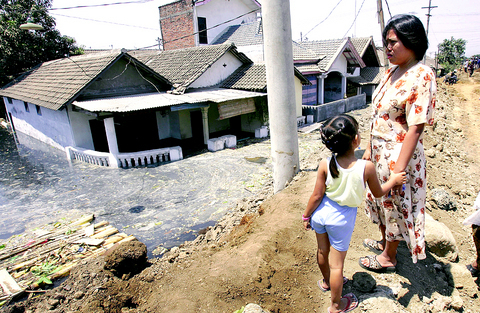
PHOTO: AP
National Mudflow Disaster Commission spokesman Rudi Novrianto said yesterday's channeling was considered a trial aimed at eventually dumping the mud into the sea for 20 hours each day at a rate of 18.5m3 per second.
Experts say the mud volcano is one of the largest ever recorded on land.
The mud is believed to come from a reservoir more than 5km underground that has been pressurized by tectonic activity or by the accumulation of hydrocarbon gases.
The gas exploration company blamed for the accident, Lapindo Brantas, argues that seismic activity might have caused the mud to break the surface.
At least 20 factories and many hectares of rice fields and prawn farms have been destroyed. More than 10,000 people have been displaced by the disaster.
The environment minister, who had earlier threatened to block efforts to dispose of the mud in the sea on grounds it might kill fish, said the mud was not toxic and that he now supported the plan.
Local shrimp farmers worried the dumping would ruin their ponds.
"We did not get any compensation from the company or the president for our losses," said Ali Subhan of the local shrimp farmer association.
Meanwhile, a fire raged at the headquarters of Indonesia's state-owned gas and oil company for hours Monday, gutting the top three floors of the Jakarta skyscraper before it was finally extinguished.
No one was injured in the fire that began at 4am and raged for more than seven hours, said Pertamina's spokesman Mohamad Harun, who had no immediate information about the cause.
Thirty-six fire trucks, nearly 200 firefighters and three helicopters were used to fight the blaze, which sent flames and dark plumes of smoke shooting from the 19th, 20th and 21st floors, home to the management offices, officials said.
Minister of State Enterprises Sugiharto said the fire didn't harm any data crucial to Pertamina's business and one analyst said, even if it did, it should not impact Indonesia's import or export operations.
``Pertamina will have back-up data in other locations,'' said Kurtubi, chairman for the Center of Petroleum & Energy Economic Studies.
The chief of Jakarta's fire department, Martono, said the fire apparently started on the 19th floor of the building and then climbed up. It appeared that the fire detection system malfunctioned, he said.

PLENARY SESSION: Although the SCO says it is ‘not an alliance directed against other states,’ Putin and Xi have repeatedly made anti-Western speeches during its summits Russian President Vladimir Putin and Chinese President Xi Jinping (習近平) are expected tomorrow in Kyrgyzstan for a two-day summit, also attended by Iran’s and India’s leaders, of a regional bloc seeking to be a counter-influence to the West. Around a dozen heads of states would head to the Kyrgyz capital, Bishkek, to mark 25 years of the Shanghai Cooperation Group (SCO). The group brings together Russia, China, India, Pakistan, Iran, four Central Asian countries and Moscow-allied Belarus. Putin and Xi have previously used SCO summits to promote their vision of a multipolar world and present a united front against the

Dozens of Israeli settlers on Saturday attacked the Palestinian village of Qusra in the northern occupied West Bank after nearly three weeks of tension in the area, drawing rare condemnation from Israeli Prime Minister Benjamin Netanyahu. Earlier this month, a group of settlers began blocking supplies from entering Palestinian houses on the outskirts of the village near Nablus, trapping residents inside and drawing unusually strong criticism from the US ambassador. Weeks later, Israeli forces continue to operate in the area while settlers still roam the surrounding hills. On Saturday, Qusra residents and dozens of settlers had descended on the village,

Ontario Premier Doug Ford on Saturday answered US President Donald Trump’s “Lake America” decree with a billboard-sized message on the Canadian shoreline — “Lake Ontario. Now and Always” — as Canadian leaders met Trump’s move with ridicule rather than outrage. Wearing a Canada national soccer team jersey, Ford unveiled the sign near Grimsby and posed for photographs. The message is repeated in French. The display followed Trump’s executive order directing US federal agencies to call Lake Ontario “Lake America.” After months of tariffs, threats to make Canada the 51st US state and personal attacks on its leaders, the reaction in

A swarm of about 700 artificial intelligence (AI) agents created by OpenAI carried out last month’s hack of the open-source platform Hugging Face and in many cases tried to cover their tracks, a pair of reports into the breach said on Wednesday. The coordinated activity by AI agents — programs that run with minimal human supervision — and their attempts to hide it raise questions about how closely AI companies are monitoring tests of increasingly powerful models, and could add fuel to calls for tighter oversight. While some of the rogue behavior has been disclosed or alluded to previously, the two reports


 RSS
RSS