


The US warned the UK it was prepared to seize the key suspect in the biggest anti-terrorism operation in British history and fly him to a secret detention center for interrogation by US agents, even if this meant riding roughshod over its closest ally.
US intelligence agents told their British counterparts they were ready to "render" Rashid Rauf, a British citizen allegedly linked to al-Qaeda in Afghanistan and who was under surveillance in Pakistan, unless he was picked up immediately.
Rauf is the key suspect in the alleged plot to detonate explosives on up to 10 trans-Atlantic planes which was exposed in August and, according to the police, would have brought "mass murder on an unimaginable scale."
The US' demand for Rauf's quick arrest dismayed the British intelligence services, which were worried it could prompt terrorist cells in the UK working on separate plots to bring forward their plans or go underground.
In the weeks preceding his arrest it is understood that the British intelligence agencies, MI5 and MI6, discussed with their US counterparts the best way to dismantle the alleged plot. Britain wanted more time to monitor Rauf, but the US was adamant that Rauf should be arrested immediately.
The revelation casts new light on the nature of the US' relationship with Britain in the war on terror and provides further evidence of its suspicions that Pakistan was not fully committed in the war against al-Qaeda.
US intelligence has harbored fears for many years that Pakistan's intelligence service, the ISI, has not done enough to combat al-Qaeda and as a result was worried it would allow Rauf to flee.
But the British intelligence agencies were concerned that seizing Rauf too soon would compromise further investigations. Although there were allegedly significant amounts of wire-tap evidence, this could not be made use of in a British court, so a decision was taken to continue with Rauf's surveillance.
However, a senior intelligence source has said that US agents had agreed on a plan to seize Rauf and fly him to an interrogation center at a secret location if he remained at large.
Immediately following the US' veiled ultimatum that MI6 should "lift" Rauf, which was communicated to ISI, he was arrested by Pakistani intelligence officials, a move that forced the British police to carry out a series of arrests as they looked to pick up those allegedly linked to him.
Rauf's father, Abdel, was subsequently arrested in Pakistan. Rauf's brother, Tayib, from Birmingham, was arrested and later released without charge.
The intelligence source said the nature of the alleged plot -- which centered on plans to detonate liquid explosive on trans-Atlantic flights departing from London -- had not been at the advanced planning stage.
As the suspects had not bought tickets for their flights, British intelligence felt they could continue to monitor the plot. But the source said the US was operating to a "different timetable" and wanted Rauf picked up immediately.
Tellingly, although British Home Secretary John Reid was full of praise for the part played by Pakistan in uncovering the alleged plot, the US did not pay tribute to the country's role.
US concerns about Pakistan's role in the war on terror were echoed last week.
A leaked document from a Ministry of Defense think tank, the Defense Academy, suggested that Pakistan was sabotaging British efforts in Afghanistan. The report blamed the ISI for "indirectly supporting terrorism and extremism, whether in London on 7/7 or in Afghanistan or Iraq."
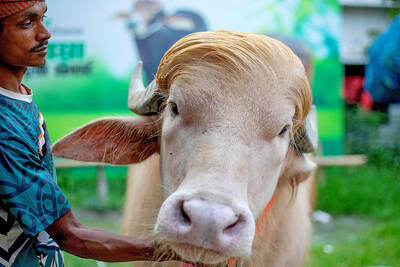
Crowds in Bangladesh are flocking to snap photographs with an unlikely social media star — an albino buffalo with flowing blond hair nicknamed “Donald Trump” that is due to be sacrificed within days. Owner Zia Uddin Mridha, 38, said his brother named the 700kg bull over its flowing helmet of hair resembling the signature look of the US president. “My younger brother picked this name because of the buffalo’s extraordinary hair,” he said at his farm in Narayanganj, just outside the capital, Dhaka. Mridha said that a constant stream of curious visitors — social media fans, onlookers and children — have come throughout

It began as a satirical online project. Now millions of young people in India are flocking to it as an outlet for their frustration. A parody political party called the Cockroach Janta Party, with the insect as its symbol, has exploded across India’s social media by turning absurdist humor into protest. Memes and short videos mocking corruption, joblessness and political dysfunction have flooded social media sites, where millions of users are embracing the cockroach — known for its ability to survive harsh conditions — as a tongue-in-cheek symbol of endurance. The online movement’s rise has been unusually rapid. The Cockroach Janta Party (CJP)
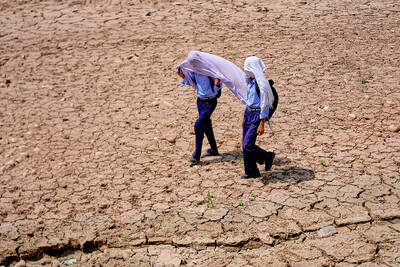
HOTTER: While Indians are accustomed to summer heat, climate change has caused northwestern India to warm faster than other parts of the country, an academic said Roads and markets have emptied during afternoons and some farmers have switched to nighttime work to avoid scorching temperatures as a heat wave grips large parts of India. The India Meteorological Department forecast maximum temperatures for yesterday of about 45°C in the capital, New Delhi, where authorities have opened temporary “cooling zones” to help people cope. The weather department warned that conditions would likely persist across several northern regions in the coming days, with temperatures staying well above seasonal averages. Authorities urged people to stay indoors during the hottest hours and take precautions against heat-related illnesses. India declares a heat wave whenever maximum temperatures
BIGGER ROLE: Beijing has said it maintains an impartial stance on the war in Ukraine, but by training Russian troops, China is far more involved than previously known China’s armed forces secretly trained about 200 Russian military personnel in China late last year, and some have since returned to fight in Ukraine, according to three European intelligence agencies and documents seen by Reuters. While China and Russia have held a number of joint military exercises since Moscow’s full-scale invasion of Ukraine in 2022, Beijing has repeatedly said that it is neutral in the conflict and presents itself as a peace mediator. The covert training sessions, which predominantly focused on the use of drones, were outlined in a dual-language Russian-Chinese agreement signed by senior Russian and Chinese officers in Beijing on


 RSS
RSS