


Fifty-five centimeters from quivering whisker to fat tail, they can chomp through concrete and leap more than 60cm in the air. Sauntering down British streets in broad daylight, they rifle through rubbish and scoff poison as if it was milk chocolate. There is something of the night and also something of the urban myth about the nearly indestructible "super rats" thriving on piles of carelessly discarded foodstuffs. But Britain's pest controllers are adamant: they are receiving more panicky reports of rodent infestation than ever, and it does seem that the rats are evolving.
Over the past five years, the number of infestations of Rattus norvegicus, better known as the brown rat, has steadily increased, according to figures collected by the UK National Pest Technician's Association. Infestation dipped last year by 8 percent but is widely forecast to rise this year, and the association suspects that the true infestation figure only fell last year because fewer people report incidences now that many local authorities charge for pest control services. Meanwhile, people report bigger, and bolder, rats. Pest control professionals recently reported catching one beast in south London that measured 55cm long.
"It's not so much [a] super rat in terms of being 60cm long and 28kg in weight," said Oliver Madge, chief executive officer of the British Pest Control Association. "Food is the key. They have a better reproduction rate and a better chance of survival. [The new rat is] not super -- but it's certainly a strong species coming through because they've got the food and the climate is milder."
But the super rat isn't just a healthier, better-fed rat: "Traditional poisons aren't working," Madge said. "They are eating and feeding from the poison. They can consume what we call a lethal dose and it doesn't kill them."
Experts say the main reason for the rise in the numbers of rats is obvious: society is producing more food waste.
The rats are not the only scavengers whose numbers are increasing. It is not quite an ecosystem that has evolved around the rubbish bin but it is not far off, and various species certainly give each other a helping paw when it comes to raiding our trash. Old-fashioned black binbags are easily ripped open by urban foxes or cats, for example, encouraging mice and rats to feast on what is inside. Virtually rodent-proof wheelie bins are a different matter -- but this is where the squirrels have a role to play.
"It is very difficult for rats to get inside a wheelie bin, but squirrels have learned how to flip the lids open if there is a lip on the bin. They are very dextrous," Madge said.

BOMBARDMENT: Moscow sent more than 440 drones and 32 missiles, Volodymyr Zelenskiy said, in ‘one of the most terrifying strikes’ on the capital in recent months A nighttime Russian missile and drone bombardment of Ukraine killed at least 15 people and injured 116 while they slept in their homes, local officials said yesterday, with the main barrage centering on the capital, Kyiv. Kyiv City Military Administration head Tymur Tkachenko said 14 people were killed and 99 were injured as explosions echoed across the city for hours during the night. The bombardment demolished a nine-story residential building, destroying dozens of apartments. Emergency workers were at the scene to rescue people from under the rubble. Russia flung more than 440 drones and 32 missiles at Ukraine, Ukrainian President Volodymyr Zelenskiy

‘SHORTSIGHTED’: Using aid as leverage is punitive, would not be regarded well among Pacific Island nations and would further open the door for China, an academic said New Zealand has suspended millions of dollars in budget funding to the Cook Islands, it said yesterday, as the relationship between the two constitutionally linked countries continues to deteriorate amid the island group’s deepening ties with China. A spokesperson for New Zealand Minister of Foreign Affairs Winston Peters said in a statement that New Zealand early this month decided to suspend payment of NZ$18.2 million (US$11 million) in core sector support funding for this year and next year as it “relies on a high trust bilateral relationship.” New Zealand and Australia have become increasingly cautious about China’s growing presence in the Pacific
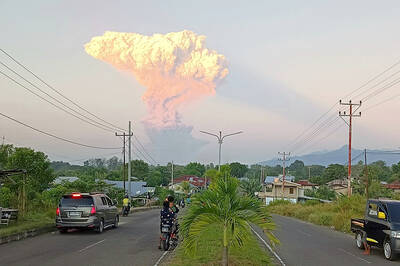
Indonesia’s Mount Lewotobi Laki-Laki yesterday erupted again with giant ash and smoke plumes after forcing evacuations of villages and flight cancelations, including to and from the resort island of Bali. Several eruptions sent ash up to 5km into the sky on Tuesday evening to yesterday afternoon. An eruption on Tuesday afternoon sent thick, gray clouds 10km into the sky that expanded into a mushroom-shaped ash cloud visible as much as 150km kilometers away. The eruption alert was raised on Tuesday to the highest level and the danger zone where people are recommended to leave was expanded to 8km from the crater. Officers also

ESPIONAGE: The British government’s decision on the proposed embassy hinges on the security of underground data cables, a former diplomat has said A US intervention over China’s proposed new embassy in London has thrown a potential resolution “up in the air,” campaigners have said, amid concerns over the site’s proximity to a sensitive hub of critical communication cables. The furor over a new “super-embassy” on the edge of London’s financial district was reignited last week when the White House said it was “deeply concerned” over potential Chinese access to “the sensitive communications of one of our closest allies.” The Dutch parliament has also raised concerns about Beijing’s ideal location of Royal Mint Court, on the edge of the City of London, which has so


 RSS
RSS