


The UN's top humanitarian official denounced Israel's use of cluster bombs in the last days of the Lebanon conflict as "immoral" and said that thousands of civilians were at risk from unexploded munitions.
UN humanitarian chief Jan Egeland said on Wednesday that UN teams had identified "359 separate cluster bomb strike locations that are contaminated with as many 100,000 unexploded bomblets" dropped by Israeli forces fighting against Hezbollah guerrillas.
Egeland, employing unusually strong language, expressed outrage at the findings that showed that most of the cluster bombs were dropped in the final three days of the war when negotiations on a truce were at a pivotal stage.
"What's shocking and I would say completely immoral is that 90 percent of the cluster bomb strikes occurred in the last 72 hours of the conflict when we knew there would be a resolution, when we knew there would be an end," he said.
"Every day, people are maimed, wounded and are killed by these ordnances," the UN relief coordinator said.
He said the bombs may have been manufactured "in a number of places," including the US.
"Those places who made those bombs should have a serious talk with Israel on the use of such bombs that are making our lives so miserable trying to help the Lebanese people," he said.
"I hope the US will talk to the Israelis on that, because it is an outrage that we have 100,000 bombs among where children, women, shopkeepers and farmers are now going to tread," Egeland said.
He said that he had not been able to get an explanation from the Israelis so far.
Egeland said he would launch an appeal for more money for mine clearance when he attended a conference in Stockholm yesterday on Lebanon's reconstruction.
Meanwhile, Amnesty International yesterday called on the EU to ensure that alleged human rights violations in Lebanon and Israel are properly investigated.
In a statement, the human rights group urged the EU foreign ministers meeting in Finland this weekend "to actively support the UN Secretary-General Kofi Annan in establishing a comprehensive investigation."
Last week Amnesty accused Israel of war crimes, saying it broke international law by deliberately destroying Lebanon's civilian infrastructure during its recent war with Hezbollah guerrillas.
Yesterday it said that attacks by Hezbollah on northern Israel were also violations of international humanitarian law.

Le Tuan Binh keeps his Moroccan soldier father’s tombstone at his village home north of Hanoi, a treasured reminder of a man whose community in Vietnam has been largely forgotten. Mzid Ben Ali, or “Mohammed” as Binh calls him, was one of tens of thousands of North Africans who served in the French army as it battled to maintain its colonial rule of Indochina. He fought for France against the Viet Minh independence movement in the 1950s, before leaving the military — as either a defector or a captive — and making a life for himself in Vietnam. “It’s very emotional for me,”

The Chinese Communist Party’s (CCP) Central Committee is to gather in July for a key meeting known as a plenum, the third since the body of elite decisionmakers was elected in 2022, focusing on reforms amid “challenges” at home and complexities broad. Plenums are important events on China’s political calendar that require the attendance of all of the Central Committee, comprising 205 members and 171 alternate members with Chinese President Xi Jinping (習近平) at the helm. The Central Committee typically holds seven plenums between party congresses, which are held once every five years. The current central committee members were elected at the
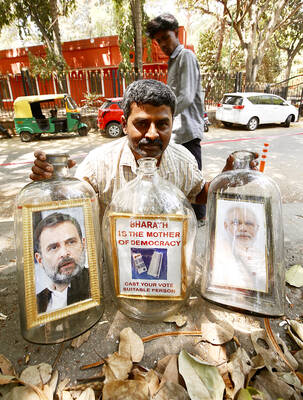
Indian Prime Minister Narendra Modi reaffirmed his pledge to replace India’s religion-based marriage and inheritance laws with a uniform civil code if he returns to office for a third term, a move that some minority groups have opposed. In an interview with the Times of India listing his agenda, Modi said his government would push for making the code a reality. “It is clear that separate laws for communities are detrimental to the health of society,” he said in the interview published yesterday. “We cannot be a nation where one community is progressing with the support of the Constitution while the other

CODIFYING DISCRIMINATION: Transgender people would be sentenced to three years in prison, while same-sex relations could land a person in jail for more than a decade Iraq’s parliament on Saturday passed a bill criminalizing same-sex relations, which would receive a sentence of up to 15 years in prison, in a move rights groups condemned as an “attack on human rights.” Transgender people would be sentenced to three years’ jail under the amendments to a 1988 anti-prostitution law, which were adopted during a session attended by 170 of 329 lawmakers. A previous draft had proposed capital punishment for same-sex relations, in what campaigners had called a “dangerous” escalation. The new amendments enable courts to sentence people engaging in same-sex relations to 10 to 15 years in prison, according to the


 RSS
RSS