


A mysterious cargo plane believed to be loaded with weapons landed in the capital, setting off another round of allegations that Somalia's neighbors are using this chaotic Horn of Africa nation to fight a proxy war.
The US and other Western powers have expressed concern about Eritrea and Ethiopia meddling on opposite sides of the conflict in Somalia, which has no single ruling authority and can be manipulated by anyone with money and guns.
Somalia's virtually powerless government said the plane that landed on Wednesday was packed with land mines, bombs and guns from Eritrea and bound for an Islamic militia that has seized the capital and most of the rest of southern Somalia. Just hours later, a UN envoy confirmed Ethiopian troops were in Somalia to help the government, which controls just one town.
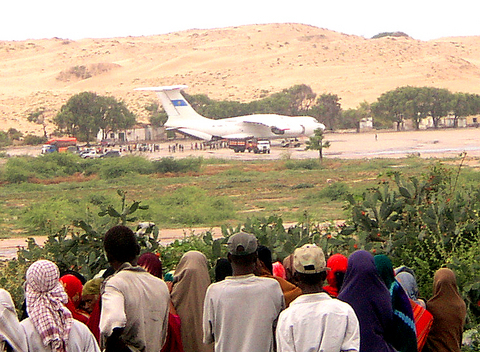
PHOTO: AP
"Ethiopia and Eritrea are competing throughout the region, opening up new fronts in their Cold War whenever the opportunity arises," said John Prendergast, a senior adviser with the International Crisis Group, which monitors conflict zones.
Ethiopia and Eritrea fought a horrendously destructive border war from 1998-2000 and have backed rebel groups to destabilize each other in recent years. Somalia's transitional government has close ties to Ethiopia and the UN says Eritrea has reportedly backed the Islamic courts to counteract Ethiopia's growing influence.
The US also has been involved in the conflict in Somalia and has accused the Islamic militia of ties to Osama bin Laden's terror group. In recent tapes attributed to bin Laden, he urged Somalis to support the militants and warned nations not to send troops here.
The US secretly backed an alliance of warlords earlier this year when they tried to defeat the Islamic militia and capture three suspected al-Qaeda members who were allegedly hiding out within the group.
The warlords were defeated, and the US now supports the government.
It was not clear what role extremists from the wider Islamic world might play, though there have been repeated reports of foreign fighters among the Islamic militiamen. Journalists have obtained a recruitment video that shows Arab soldiers alongside Somali Islamic militiamen and encourages more Arab Islamic extremists to join the Islamic group.
Ethiopia and Eritrea deny being involved in Somalia, despite widespread witness accounts and reports by the UN.
In a report earlier this year, a UN committee monitoring the arms embargo on Somalia named Ethiopia, Eritrea and Yemen as countries backing the different factions fighting inside the country. Another country went unnamed, but was widely believed to be the US.
"Eritrea is only in there because of Ethiopia," said Omar Jamal, executive director of the Somalia Justice Advocacy Center in St Paul, Minnesota.
He added: "The US is simply extending its war on terrorism."
Eritrea's information minister, Ali Abdu, told reporters on Wednesday that although his country was not sending arms to the Islamic militia, Ethiopia was "exploiting the current situation in order to solve their historical dispute with Somalia."
Ethiopia and Somalia fought a war in the 1970s, but Somalia's president is allied with the country and has asked for its support. Ethiopia's foreign minister was not immediately available for comment on Wednesday.
"There are external parties involved on all sides," said Jendayi Frazer, the US State Department's top Africa official. "This is a problem."
On Wednesday, the plane, an Ilyushin-76, landed in Mogadishu, but was quickly ordered to leave by Islamic militiamen. The plane's tail carried a flag from Kazakhstan, a former Soviet republic that often charters its planes.
The UN special envoy to Som-alia, Francois Lonseny Fall, said on Wednesday a small number of Ethiopian troops are in Somalia.

SPEAKING OUT: After Siranudh Scott’s allegations surfaced, celebrities and public figures took to social media to share their own experiences of sexual misconduct and abuse A high-profile alleged sexual abuse case within a wealthy Thai beer brewing family has prompted a wave of painful accounts from survivors of unconnected abuse in the conservative nation. Siranudh Scott, a member of the billionaire Thai family that founded the ubiquitous Singha beer brand, posted an emotional video this month accusing his elder brother Sunit of repeatedly abusing him when he was a teenager. Sunit, who is in his 30s, later denied the allegations in a video posted online, but Singha parent Boonrawd dismissed him from his executive role with the company on Tuesday last week. “I felt I needed to speak

A Hong Kong astronaut is to join a Chinese space mission for the first time as part of a three-person crew launching today, as Beijing edges closer to its goal of landing people on the moon. The Tiangong space station — crewed by teams of three astronauts that are typically rotated every six months — is the crown jewel of China’s space program, boosted by billions in state investment in a bid to catch up with the US and Russia. The Shenzhou-23 mission is to blast off at 11:08pm from the Jiuquan Satellite Launch Center in northwestern China, carrying three astronauts to
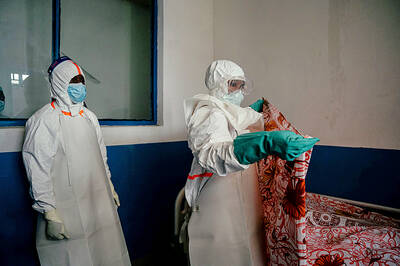
UPGRADED ALERT: The risk inside DR Congo is now considered ‘very high,’ while neighboring countries face a ‘high’ threat as the outbreak continues, the WHO said Ebola is spreading faster than responders can track it in eastern Congo, where health workers managed to follow up with barely one in five identified contacts in a single day. Authorities in the Democratic Republic of the Congo (DR Congo) reported 83 confirmed infections, 746 suspected cases and 1,603 identified contacts as of Thursday, but health workers were able to follow up on only 342 contacts that day — about 21 percent of the total under monitoring — data released by the DR Congo Ministry of Public Health on Friday showed. The figures suggest the response is falling behind the outbreak itself,
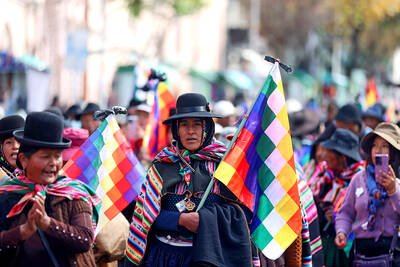
SEEKING ORDER: Rodrigo Paz said that ‘anyone who wants to destroy the nation will have to deal with this president and the full force of the constitution’ Bolivian President Rodrigo Paz on Wednesday said that the nation was at a “breaking point” after nearly a month of protests that have caused shortages of food, fuel and medicine. Paz, who took office six months ago amid the worst economic crisis there in four decades, is battling a groundswell of fury over his policies. The political capital, La Paz, has been besieged by low-income workers and members of the indigenous majority calling for his resignation. “The country needs order and is reaching breaking point,” the 58-year-old said at a public event in La Paz, renewing his appeal for dialogue. On Tuesday, the Bolivian


 RSS
RSS