


A grouping of granite blocks along a grassy Amazon hilltop may be the vestiges of a centuries-old astronomical observatory -- a find archeologists say indicates early rainforest inhabitants were more sophisticated than previously believed.
The 127 blocks, some as high as 3m tall, are spaced at regular intervals around the hill, like a crown 33m in diameter.
On the shortest day of the year -- Dec. 21 -- the shadow of one of the blocks disappears when the sun is directly above it.
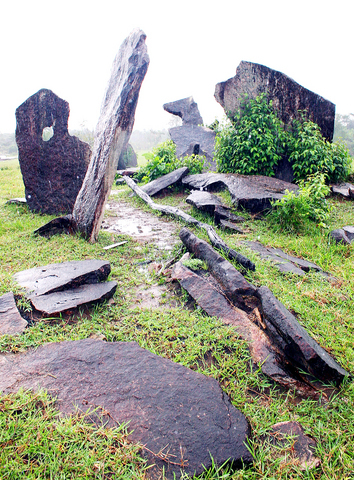
PHOTO: AP
"It is this block's alignment with the winter solstice that leads us to believe the site was once an astronomical observatory," said Mariana Petry Cabral, an archeologist at the Amapa State Scientific and Technical Research Institute.
"We may be also looking at the remnants of a sophisticated culture," Cabral said.
Anthropologists have long known that local indigenous populations were acute observers of the stars and sun. But the discovery of a structure that appears to incorporate this knowledge suggests pre-Columbian people in the Amazon may have been more sophisticated than previously suspected.
"Transforming this kind of knowledge into a monument; the transformation of something ephemeral into something concrete, could indicate the existence of a larger population and of a more complex social organization," Cabral said.
Cabral has been studying the site, near the village of Calcoene, just north of the equator in Amapa state in far northern Brazil, since last year. She says that while the blocks have not yet been submitted to carbon dating, pottery shards near the site indicate they are pre-Columbian and may be older -- as much as 2,000 years old.
Farmers and fishermen in the region around the Amazon site have long known about it, and the local press has dubbed it the "tropical Stonehenge." Archeologists got involved last year after geographers and geologists did a socio-economic survey of the area, by foot and helicopter, and noticed "the unique circular structure on top of the hill," Cabral said.
A ship that appears to be taking on the identity of a scrapped gas carrier exited the Strait of Hormuz on Friday, showing how strategies to get through the waterway are evolving as the Middle East war progresses. The vessel identifying as liquefied natural gas (LNG) carrier Jamal left the Strait on Friday morning, ship-tracking data show. However, the same tanker was also recorded as having beached at an Indian demolition yard in October last year, where it is being broken up, according to market participants and port agent’s reports. The ship claiming to be Jamal is likely a zombie vessel that

Japan is to downgrade its description of ties with China from “one of its most important” in an annual diplomatic report, according to a draft reviewed by Reuters, as relations with Beijing worsen. This year’s Diplomatic Bluebook, which Japanese Prime Minister Sanae Takaichi’s government is expected to approve next month, would instead describe China as an important neighbor and the relationship as “strategic” and “mutually beneficial.” The draft cites a series of confrontations with Beijing over the past year, including export controls on rare earths, radar lock-ons targeting Japanese military aircraft and increased pressure around Taiwan. The shift in tone underscores a deterioration

LAW CONSTRAINTS: The US has been pressing allies to send warships to open the Strait, but Tokyo’s military actions are limited under its postwar pacifist constitution Japan could consider deploying its military for minesweeping in the Strait of Hormuz if a ceasefire is reached in the war on Iran, Japanese Minister of Foreign Affairs Toshimitsu Motegi said yesterday. “If there were to be a complete ceasefire, hypothetically speaking, then things like minesweeping could come up,” Motegi said. “This is purely hypothetical, but if a ceasefire were established and naval mines were creating an obstacle, then I think that would be something to consider.” Japan’s military actions are limited under its postwar pacifist constitution, but 2015 security legislation allows Tokyo to use its Self-Defense Forces overseas if an attack,

German Chancellor Friedrich Merz’s conservative Christian Democratic Union (CDU) yesterday faced a regional election battle in Rhineland-Palatinate, now held by the center-left Social Democratic Party (SPD). Merz’s CDU has enjoyed a narrow poll lead over the SPD — their coalition partners at the national level — who have ruled the mid-sized state for 35 years. Polling third is the far-right Alternative for Germany (AfD), which spells a greater threat to the two centrist parties in several state elections in September in the country’s ex-communist east. The picturesque state of Rhineland-Palatinate, bordering France, Belgium and Luxembourg and with a population of about 4 million,


 RSS
RSS